M.Sc. (Aquatic Biology)
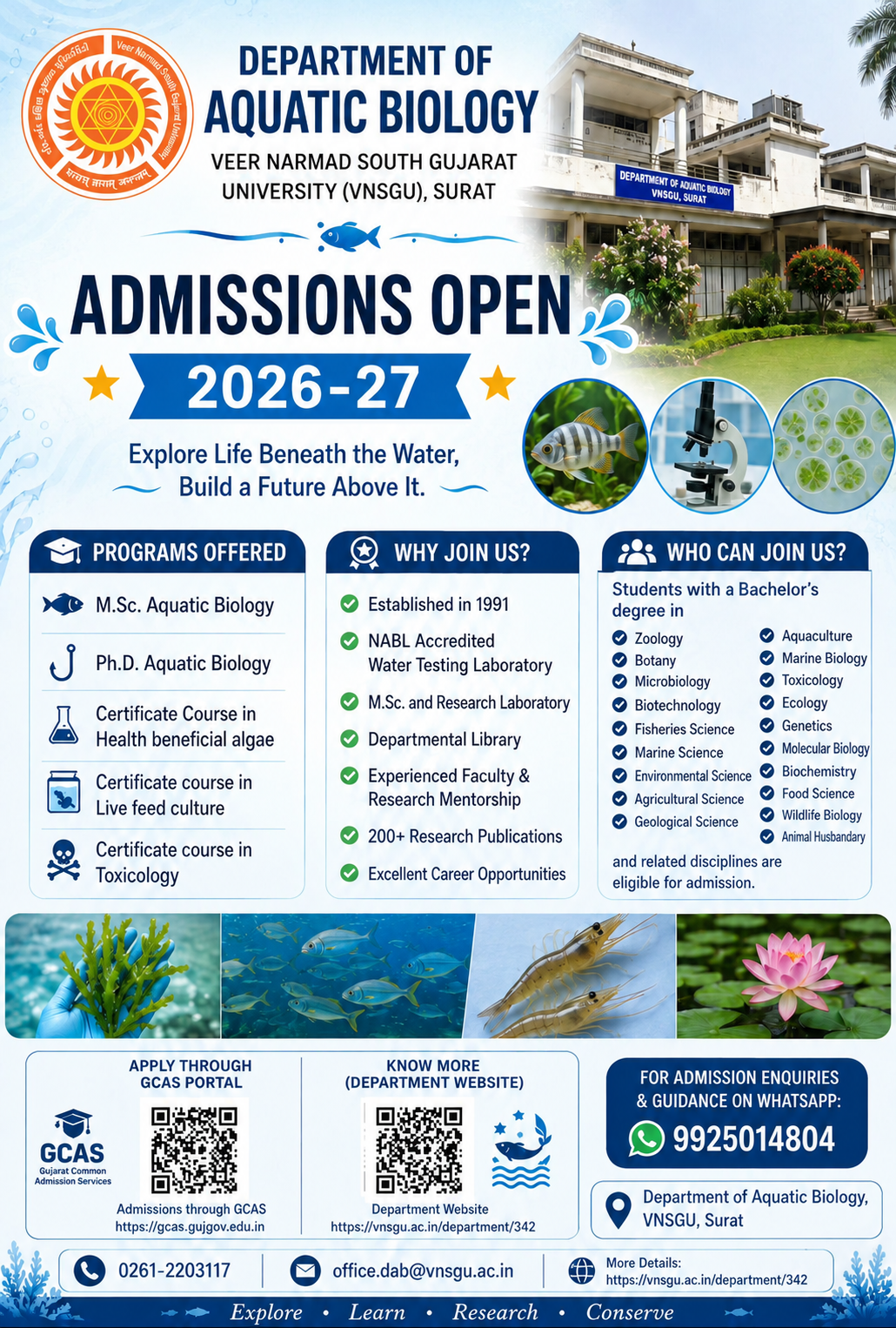
The main objective of the programme is to prepare the students for productive career in Aquatic resources management and sustainable utilization of aquatic resources by providing an outstanding environment of teaching and research in the specific aspects of the designed program. This structured course will facilitate a career in various institutions such as research and development centers of private limited, public companies, Aquaculture sectors, farms, fisheries department etc.
Syllabus Download
The main objective of the programme is to prepare the students for productive career in Aquatic resources management and sustainable utilization of aquatic resources by providing an outstanding environment of teaching and research in the specific aspects of the designed program. This structured course will facilitate a career in various institutions such as research and development centers of private limited, public companies, Aquaculture sectors, farms, fisheries department etc.
PO-01: Advanced Knowledge & Conceptual Understanding
To establish a strong foundation in aquaculture and fisheries sciences the program focus on developing essential skills across various disciplines. Emphasising proficiency in laboratory techniques, effective aqua farm management, disease control practices, feed technology, biochemistry, microbiology, fish genetics, biotechnology, and bioinformatics will improve students’ knowledge. Additionally, gaining knowledge in ornamental fishes, marine and freshwater fisheries, along with planktonology, will further enrich students' potential in this field.
PO-02: Research & Analytical Skills
The program aims to cultivate advanced problem-solving and research-oriented skills by hands-on experimental analysis and immersive field-based studies. Implementation of scientific methodologies helps to evaluate aquatic ecosystems, develop effective disease management strategies, and promote sustainable fisheries practices. Through this comprehensive approach, students can gain a deeper understanding of the interactions within marine environments and contribute to the conservation and responsible management of valuable aquatic resources.
PO-03: Technological Proficiency & Instrumentation
The program can help to develop proficiency in advanced laboratory techniques, computational modelling, and instrumentation used in aquaculture, fisheries, and aquatic pollution management. Students will be capable of employing modern tools for sustainable aquatic resource management.
PO-04: Environmental & Societal Impact
The program offers the capability to recognize the importance of aquaculture and fisheries in undertaking environmental challenges, conserving biodiversity, and helping sustainable resource use. Students can utilize scientific knowledge to advance eco-friendly aquaculture practices and implement pollution control measures.
PO-05: Innovation & Entrepreneurship
The students can apply innovative solutions to enhance aquaculture production, improve fisheries management, and advance aquatic biotechnology. Furthermore, in the programme, there is an emphasis on fostering entrepreneurial skills to support the establishment of startups focused on sustainable fisheries, aquaculture feed technology, and biotechnology. This approach will develop sustainability as well as encourage economic growth within the sector.
PO-06: Communication & Collaborative Research
The program can enhance students' communication skills through technical writing, research presentations, and interdisciplinary collaborations. Participation in group discussions, industry visits and comprehensive research initiatives can help to tackle key challenges in the aquaculture sector.
PO-07: Ethical & Value-Based Scientific Practices
The program helps to maintain ethical standards in research, ensure professional honesty, and prioritize sustainability in aquaculture and fisheries sciences. The program enhances the knowledge to handle ethical issues, taking into account societal, legal, and environmental consequences. Students can apply advanced scientific knowledge to foster environmental responsibility.
PO-08: Lifelong Learning & Career Readiness
The program can nurture a mentality for continuous learning, flexibility, and professional development. Students can be equipped for diverse and rewarding careers in research, academia, and governmental roles, as well as in the flourishing aquaculture industries. Furthermore, students can excel in competitive examinations related to aquatic biology, enhancing their skills and knowledge for a dynamic future in these fields.
Grant in Aid (GIA) : 25
Higher Payment (HP) : 13
96 credit program (4 semesters of 24 credits each)
Toal 24 courses covering various subject area
6 Practical Subjects
Project, Seminar, Desertation in final Semester
A candidate must have passed the Bachelor’s Degree examination in Science with English as compulsory subject. A candidate who has obtained his/her Bachelor’s degree with any one subject in Biological Sciences e.g. Botany, Zoology, Microbiology, Fishery Sciences, Industrial Fish & Fisheries, Marine Science, Environmental Science, Biotechnology and Medical Technology as principal or subsidiary shall be eligible to apply for admission in M.Sc. Aquatic Biology degree Course.
Fee Structure *
*Subject to Revision Periodically