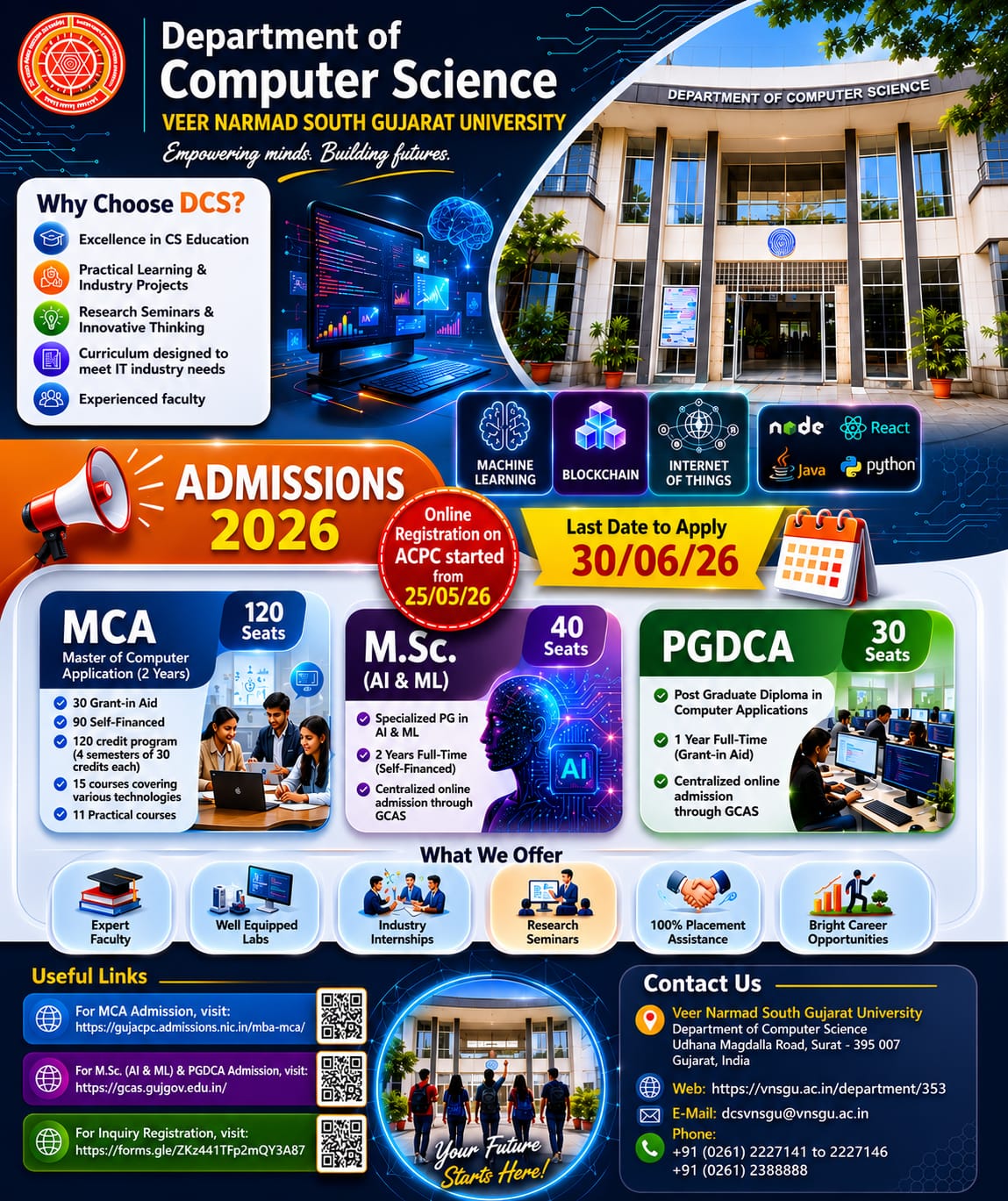
The era of computer science studies started in South Gujarat University (renamed as Veer Narmad South Gujarat University in 2004) in the year 1987-1988 with the introduction of the program Post-B.Sc. Diploma in Computer Application. Later, in the academic year 1990-91, the university introduced three year Master program, Master of Computer Application (MCA) with an intake capacity of thirty seats. With the growth of the department, research programs, Master of Philosophy (M.Phil.) and Doctor of Philosophy (Ph.D.) in Computer Science were started from the academic year 1996-97. To fulfil the local needs, the department offered the Post Graduate Diploma in Computer Application in part-time mode and a post-graduate degree program, viz, Master of Science (Bioinformatics), which was later discontinued. Gradually, the department of computer science emerged as one of the most progressive departments of the Veer Narmad South Gujarat University. The department is considered to be the most preferred institute for MCA admissions in the South Gujarat region.
Research activities are one of the prime activities for any department in the university. The department of computer science is also involved in theoretical and society-oriented research. For its research activities, the University Grants Commission (UGC) awarded the Department of Computer Science with the Special Assistance Program (SAP-DRS-I) in the year 2012 for the period of five years. After the success of this research project, UGC continued with the SAP (DRS-II) from the year 2018 for the period of the next five years. The faculties of the department are also involved in research projects, training programs, extension activities, etc.
The department of computer science has a very rich alumni base. The alumni of the department of computer science have an evident presence in most of the countries in all most all the continents. Many of them have senior positions in multinational companies, and few of the alumni have turned into successful entrepreneurs. The Computer Science studies that started in a very small room have now turned out to be a huge department with state-of-the-art computing and other infrastructural facilities spread in a building of more than 30,000 square feet.
Vision
To be a department of excellence in imparting higher education in Computer Science keeping in pace with the changing needs of the IT industry resulting in increase in employment
Mission
To be a hub for cutting edge technology in computer science by offering various post graduate and research programs
▶ Department of Computer Science
Department of Computer Science
Veer Narmad South Gujarat University
Master of Computer Application (MCA) program is specially designed for computer science, information technology, engineering, etc graduate students. Although non-IT graduates can also pursue the program. There is a bridge course compulsory for such graduates, which will bridge the gap between subjects studied at the graduate level and subjects they would be studying at Master of Computer Application. Such graduates have to clear the bridge course and get 16 credits during the completion of the MCA program. The curriculum is designed and updated regularly to match the IT industry’s needs. The program was of 3 years duration, but from the academic year 2020-21, it is of two years duration.
Syllabus Download
Objective of Program
The core objective of the MCA program is to prepare the students for a productive career in the software industry and academia by providing an outstanding environment of teaching and research in the core and emerging areas of the discipline.
Program Outcome
PO1 : Fundamental Knowledge Enrichment Program trains students with the core computer science and Information Technology (IT) knowledge domains. It also makes students capable of using core concepts in the conceptualization of domain specific application development.
PO2 : Critical Thinking Development The program develops the skills of critical thinking, problem solving, evaluative learning of various techniques, and understanding the essence of the problem.
PO3 : Advanced Emerging Technology Awareness The program trains students with the latest technologies that is being used in the industry. The continuous syllabi review adds value to the program for the outgoing students and make them ready to face challenging demands of the industry.
PO4 : Advanced Tools Usage The program teaches the students to apply the advanced tools to solve real world problems.
PO5 : Nurturing Project Planning and Management Capabilities The program trains students for designing and conceptualizing the software architecture, planning and managing the product development process of complex and live software projects. It also makes students understand the decision making for selection of an appropriate project management capabilities.
PO6 : Real World Problem / Project Development Real world project provides the candidates exposure to work in the challenging and demanding environment of the industry. The project development training makes students employable and industry ready.
PO7 : Team Work and Leadership Development Train students to work in a team and also to take leadership of the of the project management team.
Program Specific Outcome
PSO1 : Develop and strengthen the fundamental core concepts that are required to solve complex problems.
PSO2 : Develop the professional and entrepreneurship skills that needs independent logical and analytical thinking, teamwork and leadership.
PSO3 : Nurture the students to investigate for the design and development of a workable solution for a real world problem.
PSO4 : Develop students for self-learning and practicing challenging problem solution.
PSO5 : Train students to apply managerial skills to develop business applications.
PSO6 : Train students to use recent computer science and application domain specific knowledge.
PSO7 : Train students to take-up the real world challenges to develop workable solution to a domain specific problem.
PSO8 : Inculcate the passion for continuous learning and doing research for making a successful professional career.
Intake
Grant in Aid (GIA) : 30 Self-financed (SFI) : 90
Program Duration
2 years (4 Semesters)
Program Features
120 credit program (4 semesters of 30 credits each)
Toal 15 courses covering various technologies
11 Practical courses
Practical learning experience with a semester long industry internship (Project) in the last semester
Research based Seminar in the last semester
The curriculum is designed and updated regularly to match the IT industry’s needs
MCA Semester - III (Common Papers) ▾
Course Code
Course Title
Outcome
Credit
301
Elective 1: Internet of Things Elective 2: Machine Learning
Elective 1: Internet of Things
CO1: Understand the IoT ecosystem and architecture. Understand IoT standards and protocols. Understand the privacy, security and governance issues in IoT applications. Exposing students with IoT botnet and the risks involved with IoT based applications.
CO2: Understand the overview and working of the various sensors used in IoT applications. Introduce and Explain various network communication protocols, standards and IoT data Protocols. Understanding the Wireless Sensor Network and how IoT devices communicate with each other.
CO3: Understand Micro-Controller and its architecture. Understand the usage of Micro-Controller in IoT applications. Understand how Arduino and NodeMCU interact with sensors and communicate over the network.
CO4: Understand Micro-Computer and its architecture. Understand the difference between a Micro-Controller and Micro-Computer. Understand the usage of Micro-Computer in IoT applications. Understand how Raspberry Pi interact with sensors and communicate over the network.
CO5: Expose the students with Server-side development in IoT applications. Understand how to develop and deploy applications in Arduino and NodeMCU. Understand how Arduino and NodeMCU communicate among themselves, sensors and the server. Understand how to build a full IoT app by integrating them with mobile applications.
Elective 2: Machine Learning
CO1: Explain to the students the fundamental know how like the types of machine learning algorithms, applications and various required libraries, model selection etc. required to implement machine learning algorithms.
CO2: Train students with can utilize various data wrangling techniques, data cleaning, data transformation, data reduction, data discretization, feature selection, and data visualization
CO3: Train students who can implement supervised learning algorithms utilizing regression and classification algorithm on the real world dataset.
CO4: Train student to have understanding of Artificial Neural Network and its working. Also, to make them capable of implementing ANN for solving real world problems using it.
CO5: Explain to the students to use clustering and association rules as unsupervised le CO6: Train students to use machine learning techniques to solve real life complex problems.arning method to solve complex problems.
4
302
Design Patterns
CO1: Explain students about the various design patterns; their categories, and purpose.
CO2: Explain the creational design patterns.
CO3: Explain the structural design patterns.
CO4: Explain the behavioural design patterns.
CO5: Explain some more design patterns used in IT industry currently.
CO6: Make students understand the applicability of design patterns practiced by IT companies and how effectively combine these patterns for effective software development.
4
MCA Semester - I ▾
Course Code
Course Title
Outcome
Credit
101
Relational Database Management System
CO1: Students will be able to understand and evaluate the role of database management systems in IT applications within an organization.
CO2: Students will be able to normalise any real-life database and hence they will be able to design and implement properly structured databases of realworld applications.
CO3: Students will be able to write queries using Structured Query Language (SQL) and programs using PL/SQL.
CO4: Students will understand how Oracle Database works and the importance of various components of OracleDatabase.
CO5: Students will understand administration and security enforcement of Oracle Database. This will help them in pursuing higher studies and career in Database Administration
4
MCA Semester - II ▾
Course Code
Course Title
Outcome
Credit
201
Artificial Intelligence
CO1: Explain students the insight of the historical and fundamental aspects the artificial intelligence.
CO2: Train students to represent declarative knowledge in the form of symbolic knowledge through various Knowledge Representation (KR) techniques like First Order Predicate Logic (FOPL), Semantic Network, Conceptual Graphs, Scripts, and Frames.
CO3: Train students to apply various searching algorithms fall under informed and uninformed search methods to solve complex problem of AI domain.
CO4: Explain and train students to deal with the uncertainty that inherently lies within many AI problem.
CO5: Expose the students with the analysis and development process of the knowledge based system development.
CO6: Explain students to utilize the AI problem solving techniques in the advanced AI problem domain like Natural Language Processing (NLP) and Computer Vision (CV)
4
202
Front End Technologies
CO1: Explain students the insight of the fundamental aspects of the static web technology like HTMl , CSS and Javascript
CO2: Train students to represent declarative knowledge in the Boorstrap and it’s components , with help of this students can learn static web designing .
CO3: Train students to understand various Javascript based technologies like Jquery , JSON and AJAX.
CO4: Explain and train students to understand basic concepts of Angular JS.
CO5: Expose the students to the various UI technology and real world use of it..
CO6: After completion of this course, the student will be able to design and develop web pages and Interactive UI for Web Applications
4
203
Programming in .NET
CO1: Study .Net Architecture.
CO2: Design and develop console and window based .NET application.
CO-3-To learn basic syntax and implement small applications in C# programming language.
CO4: Create and manipulate GUI components in C#.
CO5: Create applications in C# using Object Oriented Properties.
CO6: Design and implement Database connectivity using ADO.Net.
CO7: Identify and resolver problems in C# applications
4
204
Python Programming Language
CO1: Students will be able to Write, Test and Debug Python Programs.
CO2: Students will be able to Implement Conditionals and Loops, use functions and represent Compound data using Lists, Tuples and Dictionaries in Python programs.
CO3: Students will be able to Read and write data from & to files in Python and develop Real World Application.
CO4: Students will be able to Design and implement programs to solve real-world problems using Python Programming Language.
CO5: Students will learn essential packages like NumPy and Matplotlib, which are necessary for Machine Learning, Data Analytics, and AI.
4
205
Elective 1: iOS Using Swift Elective 2: Android
Elective 1: iOS Using Swift
CO1: Understand the iOS ecosystem and Xcode IDE. Understand the life cycle of iOS application and how to implement it in MVC. Understand Foundation framework in iOS.
CO2: Understand the syntax, and semantics of the Swift programming language. Expose the students to CLI applications with Swift.
CO3: Understand the UIKit framework in iOS. Understand the usage and working of UI elements in iOS application. Understanding various types of design and their implementation.
CO4: Understand data persistence in mobile application. Understand working with files in iOS. Expose students with implementation and usage of database in an iOS application.
CO5: Understand the usage and data extraction of sensors in iPhone. Expose the students with Location and MapKit Framework in iOS to build map-based applications. Expose the students with ad-hoc and App Store application deployment
Elective 2: Android
CO1: Train students for installing and using the Android Developer's Toolkit such as SDK Manager, Android Virtual Device, Dalvik Debug Monitor Service (DDMS), Android Debug Bridge (ADB) and make them capable to develop, manage and maintain application(Apps) using Android and publish Apps on Google Play.
CO2: Understand the Android software stack & program building bloc ks like activities, services and notifications to use them effectively to de velop Android applications.
CO3: Explain working with AndroidManifest, xml resources like layout and values and incorporate xml resources with Java code. CO4. Explain the use of java library for views, controls, menus, dialogs, graphics, media, storage, SQLiteDatabase etc… to make interactive applications.
CO5: Train students to build Android app that access the database & other resources on web server using web services.
CO6: Train students for managing Telephony and Message services. Make them capable of using Location Manager and Google MAP related APIs for App and create the professional applications
4
206
Programming Skills - IV
After completion of this course, the student will be able to design and develop web pages and Interactive UI for Web Applications
3
207
Programming Skills - V
After studying the course, students will be able to understand how .NET Technology works and the importance of object-oriented programming. This course will also help students to appreciate the C#.NET programming
2
208
Programming Skills - VI
After completion of this course, the student will be capable to develop, manage and maintain mobile device-based application using Android/iOS
2
209
Programming Skills - VII
After completion of this course, the student will be capable to develop, manage and maintain mobile device-based application using Android/iOS.
3
MCA Semester - IV ▾
Course Code
Course Title
Outcome
Credit
401
Seminar
6
402
Project
24
MCA Semester - III (Web Technology Group) ▾
Course Code
Course Title
Outcome
Credit
303
Elective 1: Advanced Web Technologies Elective 2: Advanced Java Technologies
Elective 1: Advanced Web Technologies
CO1: Explain students the fundamental aspects of .NET framework and ASP.NET.
CO2: Train students to use various tools and controls available in ASP.NET in web application development, how to integrate them and to get them work as a part of one single unit.
CO3: Train students to work with database using ADO.NET through design alternatives and through coding as well, also learn the concept of Language Integrated Query.
CO4: Explain and train students to work with MVC architecture to adopt the requirements of modern days application development. Also learn component based development through web services and APIs.
CO5: Expose the students to the new era of .NET Core to understand the upgrades and developments in .NET architecture.
CO6: Explain students to utilize tools & techniques available in ASP.NET for web based application development and server side component development
Elective 2: Advanced Web Technologies
CO1: Explain students the insight of the various aspects the Java web technologies.
CO2: learn to access database through Java programs, using Java Data Base Connectivity (JDBC).
CO3: Create dynamic web pages, using Servlets and JSP, make a reusable software component, using Java Bean.
CO4: Understand the multi-tier architecture of web-based enterprise applications using Enterprise JavaBeans (EJB), develop Session and Entity Beans
CO5: Expose the students with the analysis and development process of the web application development using Java.
CO6: Map Java classes and object associations to relational database tables with JPA
4
304
Full Stack Technology
CO1: Understand the syntax, and semantics of the JavaScript programming language. Manipulate DOM elements with the help of JavaScript.
CO2: Understand the design of single-page applications and how React facilitates their development. Understand advantages and disadvantages of using React. Understand functional components, state components, parent & child components, lifecycle, hooks, routing, and state management in React.
CO3: Understanding the working of Node environment and Express Framework. Understand Server-side Web Application development and Server-side routing.
CO4: Understanding Mongo as a data store. Understanding common use-cases and architectures of Mongo. Performing database operations using Mongo's query and update languages.
CO5: Expose the students with the combined development process of the full stack application. Understand connecting React and Node. Understand Github and CI/CD. Understand the deployment of full stack application using Netlify / Heroku.
4
305
Open Source Web-based Programming
CO1: Explain students the fundamental as well as Advanced aspects of the Open Source Web based Technology.
CO2: Train students about react JS and difference between React JS and React Native.
CO3: Train students to understand MVC structure and it’s benefits.
CO4: Explain and train students to deal with possible problem while developing websites and it’s solution.
CO5: Expose the students with the analysis and development process of Websites.
CO6: After studying the course, students will be able to understand how Open source web technology works. They will also be able to create database driven Professional Websites.
4
306
Programming Skills - VIII
After successful completion, students will be able to work with different types of Micro-Controllers, Micro-Computers and sensors for their IoT based application development. OR After successful completion, students will be able to work with different types of ML algorithms and ML based application development.
2
307
Programming Skills - V
After studying the course, students will be able to practically work on advanced technology platforms of .NET/Java.
3
308
Programming Skills - X
After completion of this course, the students will be able to design and develop Full Stack web applications
2
309
Programming Skills - XI
After studying the course, students will be able to practically develop dynamic websites using PHP/MySql.
3
MCA Semester - III (Database Group) ▾
Course Code
Course Title
Outcome
Credit
303
Elective 1: ERP Using SAP Elective 2: NoSQL Databases
Elective 1: ERP using SAP
CO1: Explain students the insight of the fundamental aspects of the ERP and SAP.
CO2: Train students to represent declarative knowledge of Sap Application Server and 3-Tier Architecture.
CO3: Train students to understand concepts of Data Dictionary and data structure in ABAP.
CO4: Explain and train students to understand basic concepts of Modularization Technique, Module pool programing, BDC & LSMW and Selection-Screen programming.
CO5: The course emphasizes on teaching SAP implementation as the whole process of transforming ERP business procedures to organization wide requirements.
CO6: After studying this students will be able to understand how to work with ERP modules. After successful completion, students will be able to develop ERP application using SAP
Elective 2: NoSQL Databases
CO1: Explain students about history, concept , characteristics and types of NoSQL databases
CO2: Explain students about the differences between relational databases and NoSQL databases, Advantages and disadvantages of NoSQL databases and application of NoSQL databases
CO3: Explain students about fundamentals of MongoDB, MongoDB feature set and Architecture
CO4: Train student to create document, collection and databases in MongoDB, use of simple and complex queries to insert, update and view data.
CO5: Explain and train student to use MongoDB restful API and applying security
CO6: Explain students about Cassandra Architecture, Data modelling in Cassandra and integration of Cassandra with Hadoop
CO7: Train student to create and use keyspaces and databases in Cassandra, Also explain and train student about Cassandra administration
4
304
Advanced Database Administration
CO1: To provide strong foundation in Advanced Database Administration concepts from an industry perspective.
CO2: To have thorough understanding of Oracle Database Management System internal architecture.
CO3: To understand the security aspects and user management.
CO4: To apply and learn various Oracle utilities
CO5: To learn how to practically tune the database to optimize the overall performance.
CO6: To learn and implement Backup and Recovery
4
305
Elective 1: Data Warehousing and Data Mining Elective 2: Big Data
Elective 1: Data Warehousing and Data Mining
CO1: Explores Differences between Online Transaction Processing and Online Analytical processing System & describe Multidimensional schemas suitable for data warehousing
CO2: Explains Data warehousing architectures and tools for organizing able to voluminous data of online processing systematically in Data warehouse/Data Mart and use those data for making strategic decisions
CO3: Explains various data pre-processing methods via data reduction, data cleaning, data integration, data transformation etc...
CO4: Trains students to extract knowledge using data mining techniques & to discover interesting patterns from large amounts of data for predictions and classification
CO5: Trains students to develop a data mining application for data analysis using various algorithms & tools.
Elective 2: Big Data
CO1: Student should be able to understand concept and the building blocks of Big Data
CO2: Student should be able to articulate the programming aspects of cloud computing (map Reduce etc.)
CO3: Access and Process Data on Distributed File System, and to understand big data with the help of different big data applications
CO4: Student must be able to represent the analytical aspects of Big Data
CO5: Students will have understanding of distributed computing and will have hands-on experience on Hadoop
CO6: Student shall know the recent trends related to Hadoop File System, MapReduce etc.
4
306
Programming Skills - VIII
After studying the course, students will be able to practically work on advanced technology platforms of Unix Internals with Shell Scripting /IOT.
2
307
Programming Skills - V
After studying the course, students will be able to practically work on SAP/NoSQL Databases
3
308
Programming Skills - X
After studying the course, students will be able to handle database administration, tuning and maintenance in various fields
2
309
Programming Skills - XI
After studying the course, students will be able to understand Data warehousing and data mining/Big Data practically
3
MCA Semester - III (Network Group) ▾
Course Code
Course Title
Outcome
Credit
303
Network Essential & its Security
4
304
Network Administration
4
305
Wireless Network & Mobile Computing
4
306
Programming Skills - VIII
2
307
Programming Skills - V
3
308
Programming Skills - X
2
309
Programming Skills - XI
3
MCA Semester - III (General Group) ▾
Course Code
Course Title
Outcome
Credit
303
Network Essential & its Security
4
304
Advanced Database Administration
4
305
Open Source Web-based Programming
4
306
Programming Skills - VIII
2
307
Programming Skills - V
3
308
Programming Skills - X
2
309
Programming Skills - XI
3
Eligibility Criteria
The aspiring candidate shall have appeared in CMAT examination 2021 conducted by NTA (prescribed by AICTE) and shall have passed qualifying examination with minimum 50% (45% for SC/ST/SEBC/EWS).
A candidate shall have passed the qualifying examination BCA/Bachelor Degree in Computer Science Engineering or Equivalent Degree OR Passed B.Sc./B.Com./B.A. with Mathematics or Business Mathematics or Statistics at (10+2) level or at Graduation level (With Additional bridge courses as per norms of Concerned University) from recognized institutes / universities duly stated in admission rules. For further details, please refer notifications related to admission rules issued by Government of Gujarat from time to time. All such notifications are available on the official website of Admission Committee for Professional Courses (ACPC), Gujarat.
Admission Details
The admission to MCA programme is handled by The Admission Committee for Professional Courses (ACPC) Gujarat. For filling up the ACPC form, candidates need to qualify in the CMAT exam conducted by NTA every year (https://cmat.nta.nic.in). (The forms for CMAT are to be filled online – and they are circulated in the month of February, each year). The details about the admission procedure and other related information is available at the links to the ACPC, Gujarat viz. https://gujacpc.nic.in/ and https://jacpcldce.ac.in/mba-mca-courses. These links are common for admission to MCA and MBA programmes.
Reservation Policy
Reservation will be based on the Reservation Policy by Government of Gujarat. The details about the reservation policy is available at the links to the ACPC, Gujarat viz.
Fee Structure *
Grant in Aid (GIA)
Self Finance (SFI)
1st Semester
Other Semesters
1st Semester
Other Semester
Boys
Rs. 6,915/-
Rs. 6,365/-
Rs. 25,100/-
Rs. 25,000/-
Girls
Rs. 4,415/-
Rs. 3,865/-
Rs. 25,100/-
Rs. 25,000/-
*Subject to Revision Periodically
P.G.D.C.A.
PGDCA programme is aimed towards building prospective career in the field of computer application. The curriculum has been prepared and frequently updated keeping in mind the needs of local IT industry. Successful candidates of this course find themselves very well placed in the growing IT industry in and around Surat. With the initiative of the present Gujarat Government of promoting IT industry in tier-2 cities will create huge opportunities for the prospective PGDCA students. The Department offers PGDCA programme in regular (2 semesters) mode.
Syllabus Download
Objective of Program
PGDCA programme is aimed towards building prospective career in the field of computer application. The programme is designed with the objective to provide knowledge and skills in the various aspects of computer applications and core programming. Students will also be trained in the latest trends of information technology.
Program Outcome
PO1: Fundamental Knowledge Enrichment Program trains students with the core computer science and Information Technology (IT) knowledge domains. It also makes students capable of using core concepts in the conceptualization of domain specific application development.
PO2: Critical Thinking Development The program develops the skills of critical thinking, problem solving, evaluative learning of various techniques, and understanding the essence of the problem.
PO3: Advanced Emerging Technology Awareness The program trains students with the latest technologies that is being used in the industry. The continuous syllabi review adds value to the program for the outgoing students and make them ready to face challenging demands of the industry.
PO4: Advanced Tools Usage The program teaches the students to apply the advanced tools to solve real world problems.
PO5: Nurturing Project Planning and Management Capabilities The program trains students for designing and conceptualizing the software architecture, planning and managing the product development process of complex and live software projects. It also makes students understand the decision making for selection of an appropriate project management capabilities.
PO6: Real World Problem / Project Development Real world project provides the candidates exposure to work in the challenging and demanding environment of the industry. The project development training makes students employable and industry ready.
PO7: Team Work and Leadership Development Trains students to work in a team and also to take leadership of the of the project management team.
Program Specific Outcome
PSO1 : Develop and strengthen the fundamental core concepts that are required to solve practical problems.
PSO2 : Develop the professional skills that needs independent logical and analytical thinking, teamwork and leadership.
PSO3 : Nurture the students to investigate for the design and development of a workable solution for real-world desktop based applications.
PSO4 : Train students for self-learning and performing challenging problem solution.
PSO5 : Train students to use recent desktop application and web designing tools.
PSO6 : Inculcate the passion for continuous learning for making a successful professional career
Intake
Grant in Aid (GIA) : 30
Program Duration
1 year (2 Semesters)
Program Features
60 credit program (2 semesters of 30 credits each)
Total 9 courses covering various technologies
5 Practical courses
Practical learning experience with an inhouse project
The curriculum is designed and updated regularly to match the IT industry’s needs
PGDCA Semester - I ▾
Course Code
Course Title
Outcome
Credit
101
Fundamentals of Computers and Introduction to Information Technology
CO1: Explain students about how computer works and the importance of various components of computers
CO2: Understanding the secondary storage devices like HDD, CD, DVD, Bluray and other portable devices
CO3: To provide students a foundation of the importance and use of operating systems.
CO4: Explain and train students to use GUI OS, Windows component, files and folder and control panel
CO5: Explain and train students to utilize Internet, Email and search engine
4
102
Database Management Systems
CO1: Introduce and explain Basics of Database , Database Management System, Various pros and cons of manual system and database system, Relational database and its applications.
CO2: Train students to apply various constraints on database and to store and retrieve data easily.
CO3: Explain and train students to deal with inconsistency of the database, removing various database anomalies using normalization approach.
CO4: Train students to work with DBMS like MS-ACCESS, MySQL, Oracle and DB2 via SQL Interface
4
103
Fundamentals of C programming
CO1: Students will be trained to write algorithm and draw flowcharts for solving complex computer programs.
CO2: Students will be able to understand the fundamentals of programming language like Variables, Scope of variables and also the storage classes (How and where the value of the variable will be saved?)
CO3: Students will be able to understand the basics of programming language such as operators, datatypes, control structures etc.
CO4: Students will be able to write user defined functions to write complex code in more simpler way and also understands the reusability of code.
4
104
GUI Programming – 1
CO1: Introduce and explain various basic components of Microsoft.NET frame work and VB.NET Language.
CO2: Explain students about various programming fundamentals and VB.Net components which help them to work with basic .NET Programs.
CO3: Train students to work with windows forms and various .NET tools that helps to create windows based application in VB.Net
CO4: Explain and train students to work with various Container controls, Various Dialog Boxes and Types of Menu controls of VB.NET.
CO5: Train students to work with integration of Database and .NET application using ADO.Net that fulfill the basic requirements to create a project.
4
105
Office Automation Tools
CO1: Explain fundamental aspects of the MS Office suite and it’s advantages to the students
CO2: Train students about word processing such as formatting, tables, Macro, Mail Merge etc. using MS Word.
CO3: Train students about concepts like data formatting, conditional formatting, chats etc. using MS Excel.
CO4: Explain and train students about Professional Presentation with various tools like Animation, adding graphics and sound using MS PowerPoint.
CO5: Expose the students to the various data formatting, processing and presentation technology and real world use of it.
CO6: After studying the course, students will be able to work with office suite and also understand about the important features of word processing software, spreadsheet software and presentation software
4
106
Practical – I
CO1: After studying this course, Students will be able to effectively work with DBMS like like MS- ACCESS, MySQL, Oracle and DB2 via SQL Interface.
CO2: After studying this course, Students will be able to write program for solutions to various problems using ‘C’ language
4
107
Practical – II
CO: After studying the course, Students will be able to develop GUI application using basic controls of Visual Studio.
3
108
Practical – III
CO: After studying the course, students will be able to work with office suite and also understand about the important features of word processing software, spreadsheet software and presentation software.
3
PGDCA Semester - II ▾
Course Code
Course Title
Outcome
Credit
201
GUI Programming – II
CO1: Introduce and explain basics of Microsoft.NET and VB.NET Language, Types of menus , various windows tools and Exception handling methodology in detail.
CO2: Explain students about Advanced GUI controls and train student to work with Multiple Document Interface , Web browser control and basics about configuration file.
CO3: Train students to work with Multiple Document Interface that helps in project design and development.
CO4: Explain and train students to deal with Connected and Disconnected Architecture of ADO .NET and data binding with grid view control.
CO5: Train students to work with integration of Database system and .NET application that helps them to develop VB.NET project by using various database systems.
4
202
Web Designing tools4
CO1: Explain fundamental aspects of JavaScript and CSS.
CO2: Train students about concepts of Graphics Basic like various image type, Tolerance, Opacity , Types of Color etc.
CO3: Train students about Photoshop and it’s various tools.
CO4: Explain and train students about How to make professional HTML,CSS based Static HTML websites and how to make different professional images for website using Photoshop.
CO5: Expose the students to the various Advance Photoshop techniques like Transformation, layers Channels and Filters.
CO6: After studying this course, students will be able to understand and create HTML web pages with multimedia.
4
203
Network Essentials and E-Commerce
CO1: Understand students the fundamental aspects of the computer network, Internet and E-Commerce.
CO2: Train students to understand various aspects to deal with the Internet connection like communication devices, PSTN, DSL, Network addressing.
CO3: Familiarize students with the process of E-commerce and security concerns while using E-commerce in business management.
CO4: Explain student recognize the business impact and potential of ecommerce and the economic consequence of e-Commerce
CO5: Explain students the trends in e-Commerce and the use of the Internet.
4
204
Basics of Accounts and Accounting Packages
CO1: Gives knowledge of the basic terminology of financial and management accounting system
CO2: Introduces the process of double entry system and its various components like Journal, Cashbook, Subsidiary Books and Ledger etc...
CO3: Students will be able to understand the entire process of financial accounting starting from journal entry up-to preparing & interpreting final accounts.
CO4: Explores the various component of accounting package and usage of accounting package for commercial use.
CO5: Trains student to perform book keeping, to prepare final account and financial statements using accounting package.
4
205
Practical – IV
CO: After studying this course, students shall be able to develop database related programs in Vb.Net.
3
206
Practical – V
CO: After studying this course, students will be able to understand and create HTML web pages with multimedia. This course will also help students to understand how to validate user Input and how to apply common design on every web page
3
207
Project
CO: Student will be able to develop software applications.
8
Eligibility Criteria
A graduate degree in any faculty from a recognised University.
Admission Details
1. Candidate seeking admission should purchase the prospectus from the office of the Department of Computer Science, Veer Narmad South Gujarat University, Surat and then apply ONLINE ONLY. The instruction regarding filling up the application form and procedure thereafter is given later in this prospectus and available online.
2. If the number of applicants is more than the number of seats then the candidates applying for PGDCA (Full Time) have to appear in the Common Written Test to be held at Veer Narmad South Gujarat University, Surat on date decided by the Department of Computer Science, VNSGU.
3. In case of the written test the candidates applying for PGDCA (Full Time) will be short listed in all statutory reserved categories based on their performance in the written test.
4. The “Final Merit List” of the short-listed candidates shall be prepared as given in item 3 above. Admissions shall be done based on the final merit list. The final merit list shall be declared on a pre-announced date and the candidates from various categories shall be called to the University in the order of merit (as appearing in the final merit list) according to the timetable announced at the time of declaration of the final merit list.
5. TIE BREAKER: In case there are more than one candidates having same merit then the order of preference to break the tie shall be A) Aggregate marks in the final year of the qualifying examination B) Age of the candidate (senior candidate will be given higher preference).
6. If the number of applicants is less than or equal to the number of seats then the candidates are called at the Department of Computer Science with necessary documents for the admission process.
Reservation Policy
The following reservation policy is applied for the admission to PGDCA (Regular & Part-Time) courses. Quota/Reservation, in-force from time to time as per University norms will be applicable.
Category
Percentage
SC
7% *
ST
15% *
SEBC
27% *
EBC
10% *
Fee Structure *
Grant in Aid (GIA)
Fees per Year *
Boys
Rs. 13,280/-
Girls
Rs. 8,280/-
*Subject to Revision Periodically
M.Sc(AI & ML)
The M.Sc. AI (Artificial Intelligence) and ML (Machine Learning) is an introduction to modern and advanced AI and ML concepts and practices on real-world problems. The program will expose the foundations of modern AI along with enough attention to the recent explosion of machine learning techniques such as deep learning, artificial neural network, etc. Students will have a good understanding of the fundamental issues and challenges of machine learning. Students will be able to design and implement various machine learning algorithms in a range of real-world applications. This program will make the students understand regarding the strength and weaknesses of many popular machine learning approaches. This program will also imparts the knowledge of basic ethical and professional ethics related to the development and application of AI and ML. The program content has the ability to adapt, contribute and innovate new technologies and systems in the key domain of AI and ML. The core knowledge of this program will explore research areas and produce an outstanding contribution in various areas of Artificial Intelligence and Machine Learning. The students who will graduated from this program will become expert solution providers and entrepreneurs in the field of Computer Science with AI/ML specialization.
Syllabus Download
Objective of Program
The core objective of the MSC in AI & MLprogramme is to prepare the students for productive career in AI and ML, Research and academia by providing an outstanding environment to teaching and research in the core and emerging are as of the discipline.
Program Outcome
PO1 : Fundamental Knowledge Enrichment Program trains students with the core Artificial Intelligence and Machine Learning domain. It also makes students capable of using core concepts in the conceptualization of domain specific application development. PO2 : Critical Thinking Development The program develops the skills of critical thinking, problem solving, evaluative learning of various techniques, and understanding the essence of the problem. PO3 : Advanced Emerging Technology Awareness The program trains students with the latest technologies that is being used in the industry. The continuous syllabi review adds value to the program for the outgoing students and make them ready to face challenging demands of the industry. PO4 : Advanced Tools Usage The program teaches the students to apply the advanced tools to solve real world problems. PO5 : Nurturing Research Oriented Approach The program trains students to develop research oriented approach which will help them to make user centric applications. PO6 : Real World Problem / Project Development Real world project provides the candidates exposure to work in the challenging and demanding environment of the industry. The project development training makes students employable and industry ready. PO7 : Team Work and Leadership Development Trains students to work in a team and also to take leadership of the of the project management team.
Program Specific Outcome
PO1 : Fundamental Knowledge Enrichment Program trains students with the core Artificial Intelligence and Machine Learning domain. It also makes students capable of using core concepts in the conceptualization of domain specific application development. PO2 : Critical Thinking Development The program develops the skills of critical thinking, problem solving, evaluative learning of various techniques, and understanding the essence of the problem. PO3 : Advanced Emerging Technology Awareness The program trains students with the latest technologies that is being used in the industry. The continuous syllabi review adds value to the program for the outgoing students and make them ready to face challenging demands of the industry. PO4 : Advanced Tools Usage The program teaches the students to apply the advanced tools to solve real world problems. PO5 : Nurturing Research Oriented Approach The program trains students to develop research oriented approach which will help them to make user centric applications. PO6 : Real World Problem / Project Development Real world project provides the candidates exposure to work in the challenging and demanding environment of the industry. The project development training makes students employable and industry ready. PO7 : Team Work and Leadership Development Trains students to work in a team and also to take leadership of the of the project management team.
Intake
: 40
Program Duration
2 year (4 Semesters)
Program Features
122 credit program (4 semesters)
Total 17 courses covering various technologies
10 Practical courses
Practical learning experience with
The core objective of the MSC in AI & MLprogramme is to prepare the students for productive career in AI and ML, Research and academia by providing an outstanding environment to teaching and research in the core and emerging are as of the discipline.
Eligibility Criteria
Passed BCA/Bachelor Degree in Computer Science Engineering or equivalent Degree. OR Passed Graduation or Post Graduation with Mathematics or Statistics as a principal Subject OR Passed Graduation or Post Graduation in Engineering
Admission Details
On the basis of the Merit of the graduation Marks
Fee Structure *
Fees : Rs. 60,000/- per Year (Rs. 30,000/- per Semester) + Examination and University Fees
*Subject to Revision Periodically
Ph.D.
Ph.D. programme is aimed towards promoting high quality research computer science and applications. It will help researchers develop critical thinking skills that will help in their research. The researchers will be capable of undertaking various research projects that will benefit the society. The department offers an interdisciplinary exposure to research that will help in building a career in academia, or R&D sectors of industry. The Department offers PhD programme in regular and part time modes.
Syllabus Download
Objective of Program
Ph.D. programme is aimed towards promoting research activities. It will help researchers develop critical thinking skills that will help in their research. The researchers will be capable of undertaking various research projects that will benefit the society.
Program Outcome
PO1: Fundamental Knowledge Enrichment Program trains students with the core computer science and Information Technology (IT) knowledge domains. It also makes research scholars capable of using core concepts in the conceptualization of domain specific research.
PO2: Critical Thinking Development Critically apply theories, methodologies, and knowledge to address fundamental questions in their primary area of study.
PO3: Knowledge and Intellectual Abilities The knowledge, intellectual abilities, and techniques to carry out excellent research.
PO4: Advanced Tools Usage The program teaches the researchers to apply the advanced tools to solve research problems.
PO5: Research governance and organisation The knowledge of the standards, requirements and professional conduct that are needed for the effective management of research.
PO6: Undertake Research Projects Develop skills to lead research projects within specified limits and participate constructively in more complex interdisciplinary research projects.
PO7: General Competence Train researchers to conduct their research in accordance with recognized ethical standards for research.
Program Specific Outcome
PSO1 : Develop and strengthen the fundamental core concepts that are required to solve research problems.
PSO2 : Develop skills that needs independent logical and analytical thinking to solve research problems.
PSO3 : Nurture the researchers to investigate for the design and development of a workable solution for a research problem.
PSO4 : Train researchers for self-learning and performing challenging problem solution in their research area.
PSO5 : Train researchers to use recent computer science and application domain specific knowledge in their research problem.
PSO6 : Train researchers to take-up the real-world challenges to develop workable solution to a domain specific research problem.
PSO7 : Inculcate the passion for continuous learning and doing research for making a successful professional career.
Program Duration
Ph.D. programme shall be for a minimum duration of three years, including course work and a maximum of six years.
Extension beyond the above limits may be granted by Hon. Vice Chancellor on recommendation of the Research Supervisor and Research Advisory Committee for the maximum of another two (2) years.
The women candidates and Persons with Disability (more than 40% disability) shall be allowed a relaxation of two years for Ph.D. in the maximum duration. In addition, the women candidates shall be provided Maternity Leave/Child Care Leave once in the entire duration of Ph.D. for up to 240 days.
Ph.D. Coursework ▾
Course Code
Course Title
Outcome
Credit
I
Research Methodology
CO1: Discuss different methodologies and techniques used in research work.
CO2: Explain basic computer skills necessary for the conduct of research.
CO3: Assess the basic function and working of programming and analytical software used in research.
CO4: Propose the required numerical skills necessary to carry out research.
CO5: Organize and conduct research in an organized and ethical manner.
100
Elective-I
Advanced Web Technology
CO1: Explain researchers the Advanced aspects of the Web based Technology.
CO2: Train various web technologies like Java, Microsoft .NET and Open-Source PHP in the aspects of Performance, Security, System Resource Requirement etc.
CO3: Train various advanced web technologies like Swing, Silverlight, AJAX, JQuery, MVC etc.
CO4: Explain and train researchers to deal with possible problems & their solutions while developing websites.
CO5: Expose the researchers with the analysis and development process of Websites and recent trends in Markup Languages.
100
Elective-II
Operating Systems
CO1: Explain and train the researchers with different implementations of the policies for scheduling, process synchronization, deadlocks, memory management, system calls, and file systems.
CO2: Expose the researchers with the core concepts of multi-processing/multithreading, that will help them to manage and synchronize the concurrent tasks/transactions while developing professional program of their research problem using any platform.
CO3: Impart knowledge of various algorithms for memory management that will make the researchers efficiently utilize memory while developing a software.
CO4: Expose the researchers with the core concepts of distributed systems and distributed resource management.
CO5: The researchers will be able to compare various Operating Systems in the aspects of Memory Management, File System and Security.
100
Elective-III
Database Concepts and Knowledge Management
CO1: The researchers will get an insight on how the data is stored in various types of Files.
CO2: The researchers will get an insight of internal structure of various types of indices, their merits, and demerits. They will understand how these indices will be affected and updated whenever the data is updated.
CO3: The researchers will be able to optimize query which will, in turn, help in improving the performance of the overall system.
CO4: The researchers will study recent trends in database. They will also get an idea about the Spatial & Temporal Data.
CO5: This course will help the researchers to understand the internal working of data storage and indices. This will help them in choosing an appropriate database for their research.
100
Elective-IV
Object-Oriented Programming Methodology
CO1: The researcher will get an insight into the principles of Object-Oriented Problem solving and programming.
CO2: The researcher will be able to compare the object-oriented features of at least three programming languages.
CO3: The researcher will be able to compare and implement advanced object-oriented features like generic programming across at least three programming languages.
CO4: The researcher will be able to understand and study the object-oriented features incorporated in various Database Management Systems.
CO5: The researcher will be able to do gap analysis and proceed further in Research area of Object-Oriented Methodology and Data Management.
100
Elective-V
Digital Image Processing
CO1: Explain the fundamentals of digital image and its processing.
CO2: Perform image enhancement techniques in spatial and frequency domain.
CO3: Explain the mathematical modelling of image restoration and compression.
CO4: Apply the concept of image segmentation.
CO5: Describe object detection and recognition techniques.
100
-
Dissertation
400
Eligibility Criteria
Candidates for admission to the Ph.D. programme shall have a Master's degree or a professional degree declared equivalent to the Master’s degree by the corresponding statutory regulatory body in concerned subject, with at least 55% marks in aggregate or its equivalent grade 'B' in the UGC 7-point scale (or an equivalent grade in a point scale wherever grading system is followed) or an equivalent degree from a foreign educational Institution accredited by an Assessment and Accreditation Agency which is approved, recognized or authorized by an authority, established or incorporated under a law in its home country or any other statutory authority in that country for the purpose of assessing, accrediting or assuring quality and standards of educational institutions.
A relaxation of 5% of marks, from 55% to 50%, or an equivalent relaxation of grade, may be allowed for those belonging to SC/ST/OBC (non-creamy layer)/Differently-abled and other categories of candidates as per the decision of the Commission from time to time, or for those who have obtained their Master's degree prior to 19th September, 1991. The eligibility marks of 55% (or an equivalent grade in a point scale wherever grading system is followed) and the relaxation of 5% to the categories mentioned above are permissible based only on the qualifying marks without including the grace marks.
Candidates possessing a Degree considered equivalent to M.Phil. Degree of an Indian Institution, from a Foreign Educational Institution accredited by an Assessment and Accreditation Agency which is approved, recognized or authorized by an authority, established or incorporated under a law in its home country or any other statutory authority in that country for the purpose of assessing, accrediting or assuring quality and standards of educational institutions, shall be eligible for admission to Ph.D. programme.
Candidates who qualify for teachers’ fellowship of UGC, or who have passed UGC / CSIR (JRF) examination, NET/SLET/GATE, NET conducted by any National Body or who have the M.Phil. Degree from a recognized university shall be exempted from the entrance test, but they shall have to present research proposal before the Research Advisory Committee.
Notwithstanding anything contained above, a student who has passed the Master's Degree Examination in any subject may be permitted on the recommendation of the Board of University Teaching to register for an allied subject under the same and/ or other Faculty for the Ph.D. degree.
A candidate desirous of pursuing interdisciplinary and multidisciplinary research shall submit application with justification well in advance. Formal application will be subject to the approval and conditions specified by the RAC of concerned subject.
Admission Details
University shall conduct an entrance test (offline or online). The Syllabus of the entrance test shall consist of 50% of Research Methodology and 50% shall be subject specific.
The admission shall be based on the criteria notified by the University, keeping in view the guidelines/norms in this regard issued by the UGC and other statutory bodies concerned, and taking into account the reservation policy of the Central/State Government from time to time.
All the qualified candidates shall present research proposal before Research Advisory Committee.
All the candidates who have been recommended by RAC for admission to Ph.D. program shall have to attend Pre-Registration course work and shall have to appear for the examination of Pre-Registration course work. The candidate shall have to pass the Pre-Registration course work examination in maximally two attempts (including the regular one). The Syllabus of Pre-Registration course work shall be in accordance to the notification of UGC.
Presentation of the research proposal shall be assessed by the Research Advisory Committee. Considering the aforesaid method of merit calculation the Research Advisory Committee shall submit a report consisting of the presentations by the candidates and the list of the candidates recommended for admissions, along with the list of the respective Research Supervisors. On the basis of the report of the Research Advisory Committee, the final list of admitted candidates shall be declared. On successfully completion of preregistration course work the candidate shall be finally registered.
If any seat/s remains vacant after the last date of registration, waiting list will be operated for a period of thirty days from formally announced last date of registration. However, if the seats allotted for SC / ST / OBC (Non Creamy layer) / Differently-abled categories remain unfilled, a Special Admission Drive, for that particular category, shall be conducted within one month from the date of closure of admissions. Even after special drive the seats allotted for SC / ST / OBC (Non Creamy layer) / Differently-abled categories remain unfilled, such seats shall not be converted to any other category and shall be kept vacant.
For additional details refer Ph.D. Ordinance available on the university website.
Reservation Policy
Reservation will be based on the Reservation Policy by Government of Gujarat.
Fee Structure *
Rs. 8,000/- per term.
*Subject to Revision Periodically
Vibrant and Conducive Atmosphere for Research
The department of Computer Science is conducive place for research in various areas of Computer Science and Technology. The major areas of research in the department are Optical Character Recognition, Natural Language Processing, Data Mining, Text Mining, Web Mining, Software Engineering, Artificial Intelligence, Soft Computing, Databases etc. The faculty members and their research scholars have published many research papers in National & International Journals and Conferences. As many as nine books have been authored by the faculty members of the department. . Researchers in the department are mostly working in the areas like Image processing, Databases, Web Mining and Information Retrieval, IDS, Natural Language Processing, Wireless sensor network.
Considering the research that is carried out in the department of Computer Science, the UGC awarded the department with the status of Special Assistance Program (SAP DRS-I) in the thrust area of Natural Language Processing and Data Mining for the duration 2012 – 2017. Subsequently, SAP –DRS-II was also awarded to the department for the period of 2018 – 2022 for the thrust area of Computer Vision and Digital Image Processing. The faculties of the department are also working on the research projects funded by the various finding agencies.
The department is also conducting conferences and workshop in the thrust areas of the SAP and also in the other emerging areas of Computer Science. These events provides researchers a platform to showcase their research work before the leading academicians and industry technocrats.
Extraction and Recognition of Handwritten Gujarati Characters and Numerals from Images Using Deep Learning, Shukla Deepika, Desai Apurva, Proceedings of the International e-Conference on Intelligent Systems and Signal Processing. Advances in Intelligent Systems and Computing,Vol 1370, 657-669, 2021, Springer, Singapore
An Improvement of Link Analysis Algorithm to Mine Pertinent Links: Weighted HITS Algorithm based on additive fusion of graphs by Query Similarity,Patel Hemangini,Desai Apurva, International Journal of Computer Applications, 176,24,21-27,2020
Segmentation of Frequently Used Handwritten Gujarati Conjunctive Alphabet, Parikh Megha, Desai Apurva, 5th International Conference On Computing, Communication, Control And Automation (ICCUBEA),2020
Impact of Shadow Detection and Removal on Object Recognition Using Machine Learning from Images, Shukla Deepika, Desai Apurva, International Journal of Imaging and Robotics,19,2,29-39,2019
Link Analysis to discover relevant documents using Information Retrieval, Patel Hemangini, Desai Apurva,International Journal of Computer Applications,178, 10, 23-27, 2019
Evaluation of various features of Gujarati continuous numerals speech signal used for segmentation, Patel Bharat, Desai Apurva, International Journal of Research and Analytical Reviews,6, 2, 58-67,2019
Performance analysis of various wavelet filters for Gujarati text localization in images International,Patel Jagin, Desai Apurva, Journal of Research and Analytical Reviews, 6, 2, 96-100, 2019
Online handwritten Gujarati word recognition, Naik Vishal, Desai Apurva, International Journal of Computer Vision and Image Processing (IJCVIP), 9, 1, 35-50, 2019
Online Handwritten Gujarati Numeral Recognition Using Support Vector Machine, Naik Vishal, Desai Apurva, International Journal of Computer Sciences and Engineering, Open Access, 6, 9, 416-421, 2018
Multi-layer Classification Approach for Online Handwritten Gujarati Character Recognition, Naik Vishal, Desai Apurva, Computational Intelligence: Theories, Applications and Future Directions-Volume II, 595-606, 2018, Springer, Singapore
Rule based Gujarati morphological analyzer, Kapadia Utkarsh, Desai Apurva, International Journal of Computer Science Issues, (IJCSI), 14, 2, 30, 2017
WHITS Algorithm for Detecting Web Communities: Using Link Structure Analysis by double weighting of links, Patel Hemangini, Desai Apurva, International Journal of Computer Applications Technology and Research, 6, 7, 316-325, 2017
Pattern mining using Linked list (PML) mine the frequent patterns from transaction dataset using Linked list data structure, Sandip Surati, Apurva Desai, 8th International Conference on Computing, Communication and Networking Technologies (ICCCNT), 01-Jun, 2017
Online handwritten Gujarati character recognition using SVM, MLP, and K-NN, "Naik, Vishal, Desai Apurva, 8th International Conference on Computing, Communication and Networking Technologies (ICCCNT), 01-Jun, 2017
Human Computer Interaction through hand gestures for home automation using Microsoft Kinect, Desai Smit, Desai Apurva, Proceedings of International Conference on Communication and Networks, 19-29, 2017, Springer, Singapore
Recognition of fruits using hybrid features and machine learning, Shukla Deepika, Desai Apurva, International Conference on Computing, Analytics and Security Trends (CAST), 572-577, 2016
Latest Survey on Frequesnt Pattern Mining : Mine the Frequent Patterns from Transaction Database, Surati Sandip,Desai Apurva, VNSGU Journal of Science and Technology, 4, 1, 01-Jul, 2015
Morphological Rule Set and Lexicon of Gujarati Grammar: A Linguistics Approach, Kapadia Utkarsh, Desai Apurva, VNSGU Journal of Science and Technology, 4,1,127-133, 2015
Review On Generic Object Recognition Techniques Challanges and Opportunities, Shukla Deepika, Desai Apurva, International Journal of Advanced Research in Engineering and Technology, 6, 12, 104-133,2015
Support vector machine for identification of handwritten Gujarati alphabets using hybrid feature space, Desai Apurva, CSI transactions on ICT, 2, 4, 235-241, 2015, Springer
Integrating Computer Vision and Natural Language Processing : Issues and Challenges, Dipeeka Shukla, Apurva Desai, VNSGU Journal of Science and Technology, 4,1, 190-196, 2015
Morphological Rule Set and Lexicon of Gujarati Grammar : A linguistics Approach, Kapadia Utkarsh, Desai Apurva, VNSGU Journal of Science and Technology, 4,1,127-133, 2015
Segmentation Guajarati Words from Continuous spoken Gujarati Speech Signals, Patel Bharat, Desai Apurva, VNSGU Journal of Science and Technology, 4,1, 106-122, 2015
An Anchor Based Information Retrieval for Link Analysis : A Survey, Patel Hemangini, Desai Apurva, , VNSGU Journal of Science and Technology, 4,1, 22-35, 2015
Steganography of Images Using Hilbert Curve, Desai Hardik, Desai Apurva, VNSGU Journal of Science and Technology, 4,1, 8 -21, 2015
Latest Survey on Frequent Pattern Mining : Mine the Frequent Patterns from Transaction Database, Surati Sandip, Desai Apurva, VNSGU Journal of Science and Technology, 4,1, 1-7, 2015
Comparative Study of Role Based Access Control in Cloud Databases and NOSQL Databases,Gayatri Kapadia, R D Morena,,0976-5697,International,IJARCS,Volume Issue 5,,June 2017
A Survey of Association Rule Mining Algorithms,Jalpa Pandya, R D Morena,0976-5697,International,IJARCS,Volume 8 Issue 5,June 2017
Issues with Concurrency Control Techniques,Sonal Kanungo, R D Morena,2454-1222,International,IJEECSE,Special Issue AET-2017,June 2017
A Novel Hybrid Method for Generating Association Rules for Stock Market Data,Jalpa Pandya, R D Morena,,2278-2540,International,IJLTEMAS,Volume 6 Issue 7s,,Jul 2017
A Survey of Database Cache Management,Priti Tailor, R D Morena,,0976-5697,International,IJARCS,Volume 8, Issue 3,1.4.17
A Study on Constrained Frequent Pattern Mining of Streaming Data,Priti Tailor, R D Morena,,2320-5822,International,JGRCS,Vol : 8 No. 9,Sep 2017
Survey on Various Integrity Constraints on Various Object Oriented Database,Vaishali Dindoliwala, R D Morena,,2229-371X,International,IJRCS,Volume 8 No.11,,Nov 2017
Comparative Study of Integrity Constraints, Storage and Profile Management of Relational and Non-Relational Database Using MongoDB and Oracle,Vaishali Dindoliwala, R D Morena,International journal of Computer Sciences and Engineering,831-837,Vol. 6, Issue 7,01/07/2018
Evaluation of Multiversion Concurrency Control Algorithms,Sonal Kanungo, R D Morena,International journal of Research in Electronics and Computer Engineering,807-813,VOL. 6 ISSUE 3 ,01/09/2018
Comparative Study of Caching Mechanism of Relational and NoSQL Database Using Oracle and MongoDB,Prity Tailor, R D Morena,National Conference on Emerging Technologies in IT 2019,107-116, ,01/01/2019
Survey on NoSQL Document Store Databases-MongoDB,CouchDB and RavenDB,Vaishali Dindoliwala, R D Morena,National Conference on Emerging Technologies in IT 2019,122-131, ,01/01/2019
Use of Appropriate Loss Function in Rainfall Prediction using Deep Learning,Vimal D Patel, R D Morena,IJEAT,2021
Trend Analysis and Prediction of Rainfall Using Genetic Algorithm,Vimal D Patel, R D Morena,International Conference on Science, Technology and Innovation,2021
Privacy preserving data mining: techniques, classification and implications-a survey, Alpa Shah, Ravi Gulati, Int. J. Comput.Appl,137(12),40-46, Nov 2016
Script identification using Gabor feature and SVM classifier, Procedia Computer Science, S Chaudhari and RM Gulati,79,85-92,2016
Data mining techniques for diagnostic support of glaucoma using stratus OCT and perimetric data, International Journal of Computer Applications, K Chauhan, P Chauhan, A Sudhakar, K Lad, R Gulati,151,0975-8887, Oct 2016
Measuring Spatial Correlation of Soil pH and Fe using Theoretical Variograms, Jayshree Tailor, Kalpesh Lad and R M Gulati, International Journal of Computer Science and Network (IJCN), 533-538,8,5, Oct 2017,4,7
Detection of Glaucoma from Retinal Fundus , Images by analysing ISNT Measurement and features of Optic Cup and Blood Vessels,Kartik Thakkar, Kinjan Chauhan, Anand Sudhalkar and R M Gulati,487-493,7,4,Jul 2017
iHiMod Perturb: Histogram Modification Based Reversible Data Perturbation Algorithm For Adaptable Privacy Preservation and Integrity,Dr Alpa K Shah and Dr Ravi M Gulati, INTERNATIONAL JOURNAL OF SCIENTIFIC & TECHNOLOGY RESEARCH, November 2019
Discovering Performance Indicator for web Performance Analysis with idyllic measurements,Patel Charmy S and Gulati Ravi M,VNSGU Journal of Science and Technology,Vol 5,No 1,86-93,July 2016
A Comparative Analysis of Feature Extraction Techniques and Classifiers Inaccuracies for Bilingual Printed Documents (Gujarati-English),Shailesh A. Chaudhari and Ravi M. Gulati,International Journal of Applied Information Systems (IJAIS),Vol ICCCV2016, No. 1,16-20, July 2016
Web Usage Mining using Fuzzy Approach-A Survey,Hardik Gangadwala & Ravi Gulati,International Journal of Computer Science & Engineering (IJCSE),Vol 7, Issue 4 ,1082-1087,Apr-19/li>
Exploring Sub Dominant Community on Web Graph: Using Link Structure and Usage Analysis, Nimisha Modi, BIJIT - BVICAM’s International Journal of Information Technology , Vol. 7, 886-890, 2015
Relative Study Of Various Web Structure Mining Algorithms ,PANCHOLI Vishal R., CHAUDHARI Vimal,VNSGU Journal of Science and Technology,77-82,4,1,1,July 2015
COMPARATIVE STUDY OF DIFFERENT CLASSIFIRES: AN APPLE FRUIT AS CASE STUDY,Chirag C. Patel1 , Dr. Vimal K. Chaudhari2,International Journal of Creative Research Thoughts,2nd April 2018
Fruit Identification using Multi-Class SVM,Chirag C. Patel1 , Dr. Vimal K. Chaudhari2,INTERNATIONAL JOURNAL OF RESEARCH IN ELECTRONICS AND COMPUTER ENGINEERING (IJRECE),,7,2,(APRIL-JUNE 2019)
Comparative Analysis of Fruit Categorization Using Different Classifiers,Chirag C. Patel1 , Dr. Vimal K. Chaudhari2, ,Advanced Engineering Optimization Through Intelligent Techniques,153-164,,, 10 July 2019
Rule based Gujarati morphological analyzer, Kapadia U, Desai A, International Journal of Computer Science Issues, (IJCSI), 14, 2, 30, 2017
Morphological Rule Set and Lexicon of Gujarati Grammar: A Linguistics Approach, Kapadia U, Desai A, VNSGU Journal of Science and Technology, 4,1,127-133, 2016
Clustering NSE scripts using K-means algorithm with KD-tree,Rana P. C. and Morena Rustom D.,VNSGU Journal of Science and Technology,134-140,4,1,July 2015
TRIPLEPR- MAC: A Triple Queue Priority Based Medium Access Control Protocol for Wireless Sensor Network,Mrs. Rinku Patel and Dr. Nirav Bhatt,International Journal of Sensors, Wireless Communications and Control,1-16,11,1,March 2021
Energy Efficient Quality Assurance MAC Protocols in WSN.,Mrs. Rinku Patel and Dr. Nirav Bhatt,International Journal of Engineering and Advanced Technology.,2090 -2097
Design and Implementation of QoS Aware Priority based MAC for Delay Sensitive Areas of WSN,Mrs. Rinku Patel and Dr. Nirav Bhatt,International Journal of Advanced Networking and Applications,3411-3420,9,3,Nov-2017
Wireless Sensor Network MAC Survey,Mrs. Rinku Patel and Dr. Nirav Bhatt,International Journal of Advanced Research in Computer Science and Software Engineering,872-878,6,5,May 2016
Prototype of MAC Protocols using reliable and throughput aware Protocols in Wireless,Ms. Rinku Patel and Dr. Kamaljit Lakhtaria,National Conference on Recent trends in Information Technology, Organized by School Of information Technology,Feb 2015,AURO University, Surat
Research Review on Text-to-Speech Systems and Speech Synthesizing Techniques,Ms. Gargi B. Shah & Dr.Priti S. Sajja,International Journal of Research in Engineering, IT and Social Sciences (IJREISS) Journal No. : 42301,41-47,8,1,22/01/2018
Implementation of Words and Characters segmentation of Gujarati Script using MATLAB,Ms. Gargi B. Shah & Dr.Priti S. Sajja,Innovative Data Communication Technologies and Application,247-256,46,1,31/01/2020
Major Research Project Principal Investigator: Dr. A. A. Desai Title : Gujarati Handwritten Optical Character Recognition Funding Agency : UGC Funds Senctioned : Rs. 7,40,000 Duration : 2011 to 2017 Status : Completed
Special Assistance Program (SAP DRS-I) Principal Investigator: Dr. A. A. Desai Co-Investigator: Dr.R.D.Morena Trust Area : Digital Image Processing & Data Mining Role : Principal Investigator Funding Agency : UGC Funds Senctioned : Rs. 46,40,000 Duration : 2011 to 2017 Status : Completed
Special Assistance Program (SAP DRS-II) Principal Investigator: Dr. A. A. Desai Co-Investigator: Dr.R.D.Morena Trust Area : Digital Image Processing & Natural Language Processing Role : Principal Investigator Funding Agency : UGC Funds Senctioned : Rs. 46,40,000 Duration : 2018 to 2022 Status : Ongoing
Minor Research Project Principal Investigator: Dr. N. A. Modi Title : Digital Document Categorization and Ranking Using Citation Information Funding Agency : UGC Funds Senctioned : Rs. 40,000 Duration : 2015 to 2017 Status : Completed
“Gujarati Grammar Analysis”, STTP on Natural Language Processing: Recent Advancements and Challenges, School of Engineering, P P Savani University, 1st March, 2021
"Recent Developments in Computer Science Research", International Conference on Emerging Issues In Development For Future Generation, J.Z. Shah Arts and H.P. Desai College of Commerce and The International Institute for Development Studies, Amaroli, Surat, 11 February, 2020
“Natural Language Processing”, Faculty Development Program, Symbiosis Institute of Computer Studies and Research, Pune, 26 October, 2020
“Criteria 5 - Student Support and Prograssion”, Workshop on How to Prepare Self Study Report (SSR) by Knowledge Consortium of Gujarat, Ahmedabad, 22 May, 2019
“ICT Based Teaching-Learning Process”, Faculty development program “CPE Faculty Development Program”, J.P. Shorff Arts College, Valsad, 15 March, 2019
“Paradigm Shift in Computer Science Research”, Conference on Recent Trends in Pure and Applied Science (RTPAS-2019), Bhgwan Mahavir College of Science and Technology, Surat, 24 February, 2019
“Machine Learning Techniques and Applications”, International Conference, Auro University, Surat, 18 January, 2019
“Machine Learning Techniques and Applications“, National Conference on Advanced Trends and Challenges in computer science, Shirpur, Maharastra, 19 November, 2018
"Digital Image Processing and Its Applications in City Surveillance", National Conference NCSCA–16, CHARUSAT, Chnaga, 5 February, 2016
“Binary Morphology in Computer Vision”, Annual Convention of Gujarat Ganit Madal, Valsad, 25 December, 2015
“Use of ICT in safety of a City”, Refresher Course, HRDC, Gujarat University, Ahmedabad, 26 September, 2015
“Use of ICT in safety of a City”, Refresher Course, HRDC, S.P. University, Vallabh Vidhyanagar, 14 September, 2015
“Experimental Research and Natural Language Processing”, Sarvajanik College of Engineering and Technology, Surat, 21 August, 2015
“Optical Character Recognition : Issues and Solutions”, 1st National Conference on Recent Trends in Information Technology”, Auro University, Surat, 21 February, 2015
Dr. R. M. Gulati
Title of e-content: Introduction to DBMS using MS Access, Resource person in the UGC Sponsored 1st Online Refresher Course in ICT from 07.09.2020 to 20.09.2020
Title of e-content: MS Access 2007, Resource person in the UGC Sponsored 1st Online Refresher Course in ICT from 07.09.2020 to 20.09.2020
Expert Talk on "Dealing with Imprecise Queries using Fuzzy Set Theory" in Lecture Series during the pandemic COVID-19 on 14.04.2020 organized by Bhagwan Mahavir College of Computer Application.
Dr. V. K. Chaudhari
"Machine Learning Using Orange Software",Workshop, DBIM, VNSGU,Surat,22-23-Sep-17
Segmentation And Recognition Of Printed Gujarati Text From Images
2021
2
Surati Sandip
Dr. A. A. Desai
Frequent Pattern Mining Usinglinked List : Generate Frequent Patterns Using Linked List Structure
2020
3
Patel Bharat
Dr. A. A. Desai
Recognition Of Continuous Spoken Gujarati Numerals And To Translate Them Into Textual Form
2020
4
Naik Vishal
Dr. A. A. Desai
Online Handwritten Word Recognition System For Gujarati
2020
5
Priti Tailor
Dr. R. D. Morena
An efficient Buffer Cache Management Strategy for document Oriented Nasal Databases
2020
6
Dindoliwala Vaishali
Dr. R. D. Morena
An Efficient Strategy for Ensuring Integrity of Data In Document Oriented NoSQL
2020
7
Deepika Shukla
Dr. A. A. Desai
Study And Enhancing The Performance Of Object – Fruit Recognition From Images
2019
8
Tejash Shah
Dr. S. V. Patel
Design of a Security and Privacy Aware Service Oriented Requirement Engineering framework
2019
9
Shailesh Chaudhari
Dr. R. M. Gulati
Character Level Script Identification and Character Recognition from Bilingual Printed Gujarati-English Text
2019
10
Alpa Shah
Dr. R. M. Gulati
A Reversible Data Perturbation Model for Adaptable Privacy Preserving Data Mining
2019
11
Patel Hemangini
Dr. A. A. Desai
Mining Pertinent Links From Web For Information Retrieval Using Link Analysis
2018
12
Parul Patel
Dr. S. V. Patel
Temporal Information Retrieval System
2018
13
Dhaval Joshi
Dr. S. V. Patel
Design and Development of Schema Matching and Migration as a Service for Heterogenic ous Relational Databases of Legacy Application and Cloud Based Publication
2018
14
Payal Joshi
Dr. S. V. Patel
Intelligent information Retrieval in BI-Lingual Digital Library
2018
15
Sonal Sharma
Dr. R. D. Morena
High Performance Concurrency Control Technique for Object Oriented Database Management System
2018
16
Kapadia Utkarsh
Dr. A. A. Desai
Natural Language Grammar Inference For Gujarati Script : Neural Network Approach
2017
17
Vina Jokhakar
Dr. S. V. Patel
Analysis of Mild Steel Products Defects using Business intelligence tools and Techniques
2017
18
Charmi Patel
Dr. R. M. Gulati
WebN - Performance Monitoring & Analysis through Augmented Matrices for Webpage Optimization
2017
19
Charmi Patel
Dr. R. M. Gulati
WebN - Performance Monitoring & Analysis through Augmented Matrices for Webpage Optimization
2017
Pursuing
Sr.No.
Research Scholar
Name of Guide
1
Dharmen Shah
Dr. A. A. Desai
2
Sangita Makhija
Dr. A. A. Desai
3
Nikisha Mithaiwala
Dr. A. A. Desai
4
Megha Parikh
Dr. A. A. Desai
5
MBhautika Patel
Dr. A. A. Desai
Contact Us
Phone
+91 (0261) 2257911
Address
Veer Narmad South Gujarat University Department of Computer Science Udhana Magdalla Road, Surat - 395 007 Gujarat- India
Master of Computer Application (MCA) program is specially designed for computer science, information technology, engineering, etc graduate students. Although non-IT graduates can also pursue the program. There is a bridge course compulsory for such graduates, which will bridge the gap between subjects studied at the graduate level and subjects they would be studying at Master of Computer Application. Such graduates have to clear the bridge course and get 16 credits during the completion of the MCA program. The curriculum is designed and updated regularly to match the IT industry’s needs. The program was of 3 years duration, but from the academic year 2020-21, it is of two years duration.
Syllabus Download
Objective of Program
The core objective of the MCA program is to prepare the students for a productive career in the software industry and academia by providing an outstanding environment of teaching and research in the core and emerging areas of the discipline.
Program Outcome
PO1 : Fundamental Knowledge Enrichment Program trains students with the core computer science and Information Technology (IT) knowledge domains. It also makes students capable of using core concepts in the conceptualization of domain specific application development.
PO2 : Critical Thinking Development The program develops the skills of critical thinking, problem solving, evaluative learning of various techniques, and understanding the essence of the problem.
PO3 : Advanced Emerging Technology Awareness The program trains students with the latest technologies that is being used in the industry. The continuous syllabi review adds value to the program for the outgoing students and make them ready to face challenging demands of the industry.
PO4 : Advanced Tools Usage The program teaches the students to apply the advanced tools to solve real world problems.
PO5 : Nurturing Project Planning and Management Capabilities The program trains students for designing and conceptualizing the software architecture, planning and managing the product development process of complex and live software projects. It also makes students understand the decision making for selection of an appropriate project management capabilities.
PO6 : Real World Problem / Project Development Real world project provides the candidates exposure to work in the challenging and demanding environment of the industry. The project development training makes students employable and industry ready.
PO7 : Team Work and Leadership Development Train students to work in a team and also to take leadership of the of the project management team.
Program Specific Outcome
PSO1 : Develop and strengthen the fundamental core concepts that are required to solve complex problems.
PSO2 : Develop the professional and entrepreneurship skills that needs independent logical and analytical thinking, teamwork and leadership.
PSO3 : Nurture the students to investigate for the design and development of a workable solution for a real world problem.
PSO4 : Develop students for self-learning and practicing challenging problem solution.
PSO5 : Train students to apply managerial skills to develop business applications.
PSO6 : Train students to use recent computer science and application domain specific knowledge.
PSO7 : Train students to take-up the real world challenges to develop workable solution to a domain specific problem.
PSO8 : Inculcate the passion for continuous learning and doing research for making a successful professional career.
Intake
Grant in Aid (GIA) : 30 Self-financed (SFI) : 90
Program Duration
2 years (4 Semesters)
Program Features
120 credit program (4 semesters of 30 credits each)
Toal 15 courses covering various technologies
11 Practical courses
Practical learning experience with a semester long industry internship (Project) in the last semester
Research based Seminar in the last semester
The curriculum is designed and updated regularly to match the IT industry’s needs
MCA Semester - III (Common Papers) ▾
Course Code
Course Title
Outcome
Credit
301
Elective 1: Internet of Things Elective 2: Machine Learning
Elective 1: Internet of Things
CO1: Understand the IoT ecosystem and architecture. Understand IoT standards and protocols. Understand the privacy, security and governance issues in IoT applications. Exposing students with IoT botnet and the risks involved with IoT based applications.
CO2: Understand the overview and working of the various sensors used in IoT applications. Introduce and Explain various network communication protocols, standards and IoT data Protocols. Understanding the Wireless Sensor Network and how IoT devices communicate with each other.
CO3: Understand Micro-Controller and its architecture. Understand the usage of Micro-Controller in IoT applications. Understand how Arduino and NodeMCU interact with sensors and communicate over the network.
CO4: Understand Micro-Computer and its architecture. Understand the difference between a Micro-Controller and Micro-Computer. Understand the usage of Micro-Computer in IoT applications. Understand how Raspberry Pi interact with sensors and communicate over the network.
CO5: Expose the students with Server-side development in IoT applications. Understand how to develop and deploy applications in Arduino and NodeMCU. Understand how Arduino and NodeMCU communicate among themselves, sensors and the server. Understand how to build a full IoT app by integrating them with mobile applications.
Elective 2: Machine Learning
CO1: Explain to the students the fundamental know how like the types of machine learning algorithms, applications and various required libraries, model selection etc. required to implement machine learning algorithms.
CO2: Train students with can utilize various data wrangling techniques, data cleaning, data transformation, data reduction, data discretization, feature selection, and data visualization
CO3: Train students who can implement supervised learning algorithms utilizing regression and classification algorithm on the real world dataset.
CO4: Train student to have understanding of Artificial Neural Network and its working. Also, to make them capable of implementing ANN for solving real world problems using it.
CO5: Explain to the students to use clustering and association rules as unsupervised le CO6: Train students to use machine learning techniques to solve real life complex problems.arning method to solve complex problems.
4
302
Design Patterns
CO1: Explain students about the various design patterns; their categories, and purpose.
CO2: Explain the creational design patterns.
CO3: Explain the structural design patterns.
CO4: Explain the behavioural design patterns.
CO5: Explain some more design patterns used in IT industry currently.
CO6: Make students understand the applicability of design patterns practiced by IT companies and how effectively combine these patterns for effective software development.
4
MCA Semester - I ▾
Course Code
Course Title
Outcome
Credit
101
Relational Database Management System
CO1: Students will be able to understand and evaluate the role of database management systems in IT applications within an organization.
CO2: Students will be able to normalise any real-life database and hence they will be able to design and implement properly structured databases of realworld applications.
CO3: Students will be able to write queries using Structured Query Language (SQL) and programs using PL/SQL.
CO4: Students will understand how Oracle Database works and the importance of various components of OracleDatabase.
CO5: Students will understand administration and security enforcement of Oracle Database. This will help them in pursuing higher studies and career in Database Administration
4
MCA Semester - II ▾
Course Code
Course Title
Outcome
Credit
201
Artificial Intelligence
CO1: Explain students the insight of the historical and fundamental aspects the artificial intelligence.
CO2: Train students to represent declarative knowledge in the form of symbolic knowledge through various Knowledge Representation (KR) techniques like First Order Predicate Logic (FOPL), Semantic Network, Conceptual Graphs, Scripts, and Frames.
CO3: Train students to apply various searching algorithms fall under informed and uninformed search methods to solve complex problem of AI domain.
CO4: Explain and train students to deal with the uncertainty that inherently lies within many AI problem.
CO5: Expose the students with the analysis and development process of the knowledge based system development.
CO6: Explain students to utilize the AI problem solving techniques in the advanced AI problem domain like Natural Language Processing (NLP) and Computer Vision (CV)
4
202
Front End Technologies
CO1: Explain students the insight of the fundamental aspects of the static web technology like HTMl , CSS and Javascript
CO2: Train students to represent declarative knowledge in the Boorstrap and it’s components , with help of this students can learn static web designing .
CO3: Train students to understand various Javascript based technologies like Jquery , JSON and AJAX.
CO4: Explain and train students to understand basic concepts of Angular JS.
CO5: Expose the students to the various UI technology and real world use of it..
CO6: After completion of this course, the student will be able to design and develop web pages and Interactive UI for Web Applications
4
203
Programming in .NET
CO1: Study .Net Architecture.
CO2: Design and develop console and window based .NET application.
CO-3-To learn basic syntax and implement small applications in C# programming language.
CO4: Create and manipulate GUI components in C#.
CO5: Create applications in C# using Object Oriented Properties.
CO6: Design and implement Database connectivity using ADO.Net.
CO7: Identify and resolver problems in C# applications
4
204
Python Programming Language
CO1: Students will be able to Write, Test and Debug Python Programs.
CO2: Students will be able to Implement Conditionals and Loops, use functions and represent Compound data using Lists, Tuples and Dictionaries in Python programs.
CO3: Students will be able to Read and write data from & to files in Python and develop Real World Application.
CO4: Students will be able to Design and implement programs to solve real-world problems using Python Programming Language.
CO5: Students will learn essential packages like NumPy and Matplotlib, which are necessary for Machine Learning, Data Analytics, and AI.
4
205
Elective 1: iOS Using Swift Elective 2: Android
Elective 1: iOS Using Swift
CO1: Understand the iOS ecosystem and Xcode IDE. Understand the life cycle of iOS application and how to implement it in MVC. Understand Foundation framework in iOS.
CO2: Understand the syntax, and semantics of the Swift programming language. Expose the students to CLI applications with Swift.
CO3: Understand the UIKit framework in iOS. Understand the usage and working of UI elements in iOS application. Understanding various types of design and their implementation.
CO4: Understand data persistence in mobile application. Understand working with files in iOS. Expose students with implementation and usage of database in an iOS application.
CO5: Understand the usage and data extraction of sensors in iPhone. Expose the students with Location and MapKit Framework in iOS to build map-based applications. Expose the students with ad-hoc and App Store application deployment
Elective 2: Android
CO1: Train students for installing and using the Android Developer's Toolkit such as SDK Manager, Android Virtual Device, Dalvik Debug Monitor Service (DDMS), Android Debug Bridge (ADB) and make them capable to develop, manage and maintain application(Apps) using Android and publish Apps on Google Play.
CO2: Understand the Android software stack & program building bloc ks like activities, services and notifications to use them effectively to de velop Android applications.
CO3: Explain working with AndroidManifest, xml resources like layout and values and incorporate xml resources with Java code. CO4. Explain the use of java library for views, controls, menus, dialogs, graphics, media, storage, SQLiteDatabase etc… to make interactive applications.
CO5: Train students to build Android app that access the database & other resources on web server using web services.
CO6: Train students for managing Telephony and Message services. Make them capable of using Location Manager and Google MAP related APIs for App and create the professional applications
4
206
Programming Skills - IV
After completion of this course, the student will be able to design and develop web pages and Interactive UI for Web Applications
3
207
Programming Skills - V
After studying the course, students will be able to understand how .NET Technology works and the importance of object-oriented programming. This course will also help students to appreciate the C#.NET programming
2
208
Programming Skills - VI
After completion of this course, the student will be capable to develop, manage and maintain mobile device-based application using Android/iOS
2
209
Programming Skills - VII
After completion of this course, the student will be capable to develop, manage and maintain mobile device-based application using Android/iOS.
3
MCA Semester - IV ▾
Course Code
Course Title
Outcome
Credit
401
Seminar
6
402
Project
24
MCA Semester - III (Web Technology Group) ▾
Course Code
Course Title
Outcome
Credit
303
Elective 1: Advanced Web Technologies Elective 2: Advanced Java Technologies
Elective 1: Advanced Web Technologies
CO1: Explain students the fundamental aspects of .NET framework and ASP.NET.
CO2: Train students to use various tools and controls available in ASP.NET in web application development, how to integrate them and to get them work as a part of one single unit.
CO3: Train students to work with database using ADO.NET through design alternatives and through coding as well, also learn the concept of Language Integrated Query.
CO4: Explain and train students to work with MVC architecture to adopt the requirements of modern days application development. Also learn component based development through web services and APIs.
CO5: Expose the students to the new era of .NET Core to understand the upgrades and developments in .NET architecture.
CO6: Explain students to utilize tools & techniques available in ASP.NET for web based application development and server side component development
Elective 2: Advanced Web Technologies
CO1: Explain students the insight of the various aspects the Java web technologies.
CO2: learn to access database through Java programs, using Java Data Base Connectivity (JDBC).
CO3: Create dynamic web pages, using Servlets and JSP, make a reusable software component, using Java Bean.
CO4: Understand the multi-tier architecture of web-based enterprise applications using Enterprise JavaBeans (EJB), develop Session and Entity Beans
CO5: Expose the students with the analysis and development process of the web application development using Java.
CO6: Map Java classes and object associations to relational database tables with JPA
4
304
Full Stack Technology
CO1: Understand the syntax, and semantics of the JavaScript programming language. Manipulate DOM elements with the help of JavaScript.
CO2: Understand the design of single-page applications and how React facilitates their development. Understand advantages and disadvantages of using React. Understand functional components, state components, parent & child components, lifecycle, hooks, routing, and state management in React.
CO3: Understanding the working of Node environment and Express Framework. Understand Server-side Web Application development and Server-side routing.
CO4: Understanding Mongo as a data store. Understanding common use-cases and architectures of Mongo. Performing database operations using Mongo's query and update languages.
CO5: Expose the students with the combined development process of the full stack application. Understand connecting React and Node. Understand Github and CI/CD. Understand the deployment of full stack application using Netlify / Heroku.
4
305
Open Source Web-based Programming
CO1: Explain students the fundamental as well as Advanced aspects of the Open Source Web based Technology.
CO2: Train students about react JS and difference between React JS and React Native.
CO3: Train students to understand MVC structure and it’s benefits.
CO4: Explain and train students to deal with possible problem while developing websites and it’s solution.
CO5: Expose the students with the analysis and development process of Websites.
CO6: After studying the course, students will be able to understand how Open source web technology works. They will also be able to create database driven Professional Websites.
4
306
Programming Skills - VIII
After successful completion, students will be able to work with different types of Micro-Controllers, Micro-Computers and sensors for their IoT based application development. OR After successful completion, students will be able to work with different types of ML algorithms and ML based application development.
2
307
Programming Skills - V
After studying the course, students will be able to practically work on advanced technology platforms of .NET/Java.
3
308
Programming Skills - X
After completion of this course, the students will be able to design and develop Full Stack web applications
2
309
Programming Skills - XI
After studying the course, students will be able to practically develop dynamic websites using PHP/MySql.
3
MCA Semester - III (Database Group) ▾
Course Code
Course Title
Outcome
Credit
303
Elective 1: ERP Using SAP Elective 2: NoSQL Databases
Elective 1: ERP using SAP
CO1: Explain students the insight of the fundamental aspects of the ERP and SAP.
CO2: Train students to represent declarative knowledge of Sap Application Server and 3-Tier Architecture.
CO3: Train students to understand concepts of Data Dictionary and data structure in ABAP.
CO4: Explain and train students to understand basic concepts of Modularization Technique, Module pool programing, BDC & LSMW and Selection-Screen programming.
CO5: The course emphasizes on teaching SAP implementation as the whole process of transforming ERP business procedures to organization wide requirements.
CO6: After studying this students will be able to understand how to work with ERP modules. After successful completion, students will be able to develop ERP application using SAP
Elective 2: NoSQL Databases
CO1: Explain students about history, concept , characteristics and types of NoSQL databases
CO2: Explain students about the differences between relational databases and NoSQL databases, Advantages and disadvantages of NoSQL databases and application of NoSQL databases
CO3: Explain students about fundamentals of MongoDB, MongoDB feature set and Architecture
CO4: Train student to create document, collection and databases in MongoDB, use of simple and complex queries to insert, update and view data.
CO5: Explain and train student to use MongoDB restful API and applying security
CO6: Explain students about Cassandra Architecture, Data modelling in Cassandra and integration of Cassandra with Hadoop
CO7: Train student to create and use keyspaces and databases in Cassandra, Also explain and train student about Cassandra administration
4
304
Advanced Database Administration
CO1: To provide strong foundation in Advanced Database Administration concepts from an industry perspective.
CO2: To have thorough understanding of Oracle Database Management System internal architecture.
CO3: To understand the security aspects and user management.
CO4: To apply and learn various Oracle utilities
CO5: To learn how to practically tune the database to optimize the overall performance.
CO6: To learn and implement Backup and Recovery
4
305
Elective 1: Data Warehousing and Data Mining Elective 2: Big Data
Elective 1: Data Warehousing and Data Mining
CO1: Explores Differences between Online Transaction Processing and Online Analytical processing System & describe Multidimensional schemas suitable for data warehousing
CO2: Explains Data warehousing architectures and tools for organizing able to voluminous data of online processing systematically in Data warehouse/Data Mart and use those data for making strategic decisions
CO3: Explains various data pre-processing methods via data reduction, data cleaning, data integration, data transformation etc...
CO4: Trains students to extract knowledge using data mining techniques & to discover interesting patterns from large amounts of data for predictions and classification
CO5: Trains students to develop a data mining application for data analysis using various algorithms & tools.
Elective 2: Big Data
CO1: Student should be able to understand concept and the building blocks of Big Data
CO2: Student should be able to articulate the programming aspects of cloud computing (map Reduce etc.)
CO3: Access and Process Data on Distributed File System, and to understand big data with the help of different big data applications
CO4: Student must be able to represent the analytical aspects of Big Data
CO5: Students will have understanding of distributed computing and will have hands-on experience on Hadoop
CO6: Student shall know the recent trends related to Hadoop File System, MapReduce etc.
4
306
Programming Skills - VIII
After studying the course, students will be able to practically work on advanced technology platforms of Unix Internals with Shell Scripting /IOT.
2
307
Programming Skills - V
After studying the course, students will be able to practically work on SAP/NoSQL Databases
3
308
Programming Skills - X
After studying the course, students will be able to handle database administration, tuning and maintenance in various fields
2
309
Programming Skills - XI
After studying the course, students will be able to understand Data warehousing and data mining/Big Data practically
3
MCA Semester - III (Network Group) ▾
Course Code
Course Title
Outcome
Credit
303
Network Essential & its Security
4
304
Network Administration
4
305
Wireless Network & Mobile Computing
4
306
Programming Skills - VIII
2
307
Programming Skills - V
3
308
Programming Skills - X
2
309
Programming Skills - XI
3
MCA Semester - III (General Group) ▾
Course Code
Course Title
Outcome
Credit
303
Network Essential & its Security
4
304
Advanced Database Administration
4
305
Open Source Web-based Programming
4
306
Programming Skills - VIII
2
307
Programming Skills - V
3
308
Programming Skills - X
2
309
Programming Skills - XI
3
Eligibility Criteria
The aspiring candidate shall have appeared in CMAT examination 2021 conducted by NTA (prescribed by AICTE) and shall have passed qualifying examination with minimum 50% (45% for SC/ST/SEBC/EWS).
A candidate shall have passed the qualifying examination BCA/Bachelor Degree in Computer Science Engineering or Equivalent Degree OR Passed B.Sc./B.Com./B.A. with Mathematics or Business Mathematics or Statistics at (10+2) level or at Graduation level (With Additional bridge courses as per norms of Concerned University) from recognized institutes / universities duly stated in admission rules. For further details, please refer notifications related to admission rules issued by Government of Gujarat from time to time. All such notifications are available on the official website of Admission Committee for Professional Courses (ACPC), Gujarat.
Admission Details
The admission to MCA programme is handled by The Admission Committee for Professional Courses (ACPC) Gujarat. For filling up the ACPC form, candidates need to qualify in the CMAT exam conducted by NTA every year (https://cmat.nta.nic.in). (The forms for CMAT are to be filled online – and they are circulated in the month of February, each year). The details about the admission procedure and other related information is available at the links to the ACPC, Gujarat viz. https://gujacpc.nic.in/ and https://jacpcldce.ac.in/mba-mca-courses. These links are common for admission to MCA and MBA programmes.
Reservation Policy
Reservation will be based on the Reservation Policy by Government of Gujarat. The details about the reservation policy is available at the links to the ACPC, Gujarat viz.
Fee Structure *
Grant in Aid (GIA)
Self Finance (SFI)
1st Semester
Other Semesters
1st Semester
Other Semester
Boys
Rs. 6,915/-
Rs. 6,365/-
Rs. 25,100/-
Rs. 25,000/-
Girls
Rs. 4,415/-
Rs. 3,865/-
Rs. 25,100/-
Rs. 25,000/-
*Subject to Revision Periodically
P.G.D.C.A.
PGDCA programme is aimed towards building prospective career in the field of computer application. The curriculum has been prepared and frequently updated keeping in mind the needs of local IT industry. Successful candidates of this course find themselves very well placed in the growing IT industry in and around Surat. With the initiative of the present Gujarat Government of promoting IT industry in tier-2 cities will create huge opportunities for the prospective PGDCA students. The Department offers PGDCA programme in regular (2 semesters) mode.
Syllabus Download
Objective of Program
PGDCA programme is aimed towards building prospective career in the field of computer application. The programme is designed with the objective to provide knowledge and skills in the various aspects of computer applications and core programming. Students will also be trained in the latest trends of information technology.
Program Outcome
PO1: Fundamental Knowledge Enrichment Program trains students with the core computer science and Information Technology (IT) knowledge domains. It also makes students capable of using core concepts in the conceptualization of domain specific application development.
PO2: Critical Thinking Development The program develops the skills of critical thinking, problem solving, evaluative learning of various techniques, and understanding the essence of the problem.
PO3: Advanced Emerging Technology Awareness The program trains students with the latest technologies that is being used in the industry. The continuous syllabi review adds value to the program for the outgoing students and make them ready to face challenging demands of the industry.
PO4: Advanced Tools Usage The program teaches the students to apply the advanced tools to solve real world problems.
PO5: Nurturing Project Planning and Management Capabilities The program trains students for designing and conceptualizing the software architecture, planning and managing the product development process of complex and live software projects. It also makes students understand the decision making for selection of an appropriate project management capabilities.
PO6: Real World Problem / Project Development Real world project provides the candidates exposure to work in the challenging and demanding environment of the industry. The project development training makes students employable and industry ready.
PO7: Team Work and Leadership Development Trains students to work in a team and also to take leadership of the of the project management team.
Program Specific Outcome
PSO1 : Develop and strengthen the fundamental core concepts that are required to solve practical problems.
PSO2 : Develop the professional skills that needs independent logical and analytical thinking, teamwork and leadership.
PSO3 : Nurture the students to investigate for the design and development of a workable solution for real-world desktop based applications.
PSO4 : Train students for self-learning and performing challenging problem solution.
PSO5 : Train students to use recent desktop application and web designing tools.
PSO6 : Inculcate the passion for continuous learning for making a successful professional career
Intake
Grant in Aid (GIA) : 30
Program Duration
1 year (2 Semesters)
Program Features
60 credit program (2 semesters of 30 credits each)
Total 9 courses covering various technologies
5 Practical courses
Practical learning experience with an inhouse project
The curriculum is designed and updated regularly to match the IT industry’s needs
PGDCA Semester - I ▾
Course Code
Course Title
Outcome
Credit
101
Fundamentals of Computers and Introduction to Information Technology
CO1: Explain students about how computer works and the importance of various components of computers
CO2: Understanding the secondary storage devices like HDD, CD, DVD, Bluray and other portable devices
CO3: To provide students a foundation of the importance and use of operating systems.
CO4: Explain and train students to use GUI OS, Windows component, files and folder and control panel
CO5: Explain and train students to utilize Internet, Email and search engine
4
102
Database Management Systems
CO1: Introduce and explain Basics of Database , Database Management System, Various pros and cons of manual system and database system, Relational database and its applications.
CO2: Train students to apply various constraints on database and to store and retrieve data easily.
CO3: Explain and train students to deal with inconsistency of the database, removing various database anomalies using normalization approach.
CO4: Train students to work with DBMS like MS-ACCESS, MySQL, Oracle and DB2 via SQL Interface
4
103
Fundamentals of C programming
CO1: Students will be trained to write algorithm and draw flowcharts for solving complex computer programs.
CO2: Students will be able to understand the fundamentals of programming language like Variables, Scope of variables and also the storage classes (How and where the value of the variable will be saved?)
CO3: Students will be able to understand the basics of programming language such as operators, datatypes, control structures etc.
CO4: Students will be able to write user defined functions to write complex code in more simpler way and also understands the reusability of code.
4
104
GUI Programming – 1
CO1: Introduce and explain various basic components of Microsoft.NET frame work and VB.NET Language.
CO2: Explain students about various programming fundamentals and VB.Net components which help them to work with basic .NET Programs.
CO3: Train students to work with windows forms and various .NET tools that helps to create windows based application in VB.Net
CO4: Explain and train students to work with various Container controls, Various Dialog Boxes and Types of Menu controls of VB.NET.
CO5: Train students to work with integration of Database and .NET application using ADO.Net that fulfill the basic requirements to create a project.
4
105
Office Automation Tools
CO1: Explain fundamental aspects of the MS Office suite and it’s advantages to the students
CO2: Train students about word processing such as formatting, tables, Macro, Mail Merge etc. using MS Word.
CO3: Train students about concepts like data formatting, conditional formatting, chats etc. using MS Excel.
CO4: Explain and train students about Professional Presentation with various tools like Animation, adding graphics and sound using MS PowerPoint.
CO5: Expose the students to the various data formatting, processing and presentation technology and real world use of it.
CO6: After studying the course, students will be able to work with office suite and also understand about the important features of word processing software, spreadsheet software and presentation software
4
106
Practical – I
CO1: After studying this course, Students will be able to effectively work with DBMS like like MS- ACCESS, MySQL, Oracle and DB2 via SQL Interface.
CO2: After studying this course, Students will be able to write program for solutions to various problems using ‘C’ language
4
107
Practical – II
CO: After studying the course, Students will be able to develop GUI application using basic controls of Visual Studio.
3
108
Practical – III
CO: After studying the course, students will be able to work with office suite and also understand about the important features of word processing software, spreadsheet software and presentation software.
3
PGDCA Semester - II ▾
Course Code
Course Title
Outcome
Credit
201
GUI Programming – II
CO1: Introduce and explain basics of Microsoft.NET and VB.NET Language, Types of menus , various windows tools and Exception handling methodology in detail.
CO2: Explain students about Advanced GUI controls and train student to work with Multiple Document Interface , Web browser control and basics about configuration file.
CO3: Train students to work with Multiple Document Interface that helps in project design and development.
CO4: Explain and train students to deal with Connected and Disconnected Architecture of ADO .NET and data binding with grid view control.
CO5: Train students to work with integration of Database system and .NET application that helps them to develop VB.NET project by using various database systems.
4
202
Web Designing tools4
CO1: Explain fundamental aspects of JavaScript and CSS.
CO2: Train students about concepts of Graphics Basic like various image type, Tolerance, Opacity , Types of Color etc.
CO3: Train students about Photoshop and it’s various tools.
CO4: Explain and train students about How to make professional HTML,CSS based Static HTML websites and how to make different professional images for website using Photoshop.
CO5: Expose the students to the various Advance Photoshop techniques like Transformation, layers Channels and Filters.
CO6: After studying this course, students will be able to understand and create HTML web pages with multimedia.
4
203
Network Essentials and E-Commerce
CO1: Understand students the fundamental aspects of the computer network, Internet and E-Commerce.
CO2: Train students to understand various aspects to deal with the Internet connection like communication devices, PSTN, DSL, Network addressing.
CO3: Familiarize students with the process of E-commerce and security concerns while using E-commerce in business management.
CO4: Explain student recognize the business impact and potential of ecommerce and the economic consequence of e-Commerce
CO5: Explain students the trends in e-Commerce and the use of the Internet.
4
204
Basics of Accounts and Accounting Packages
CO1: Gives knowledge of the basic terminology of financial and management accounting system
CO2: Introduces the process of double entry system and its various components like Journal, Cashbook, Subsidiary Books and Ledger etc...
CO3: Students will be able to understand the entire process of financial accounting starting from journal entry up-to preparing & interpreting final accounts.
CO4: Explores the various component of accounting package and usage of accounting package for commercial use.
CO5: Trains student to perform book keeping, to prepare final account and financial statements using accounting package.
4
205
Practical – IV
CO: After studying this course, students shall be able to develop database related programs in Vb.Net.
3
206
Practical – V
CO: After studying this course, students will be able to understand and create HTML web pages with multimedia. This course will also help students to understand how to validate user Input and how to apply common design on every web page
3
207
Project
CO: Student will be able to develop software applications.
8
Eligibility Criteria
A graduate degree in any faculty from a recognised University.
Admission Details
1. Candidate seeking admission should purchase the prospectus from the office of the Department of Computer Science, Veer Narmad South Gujarat University, Surat and then apply ONLINE ONLY. The instruction regarding filling up the application form and procedure thereafter is given later in this prospectus and available online.
2. If the number of applicants is more than the number of seats then the candidates applying for PGDCA (Full Time) have to appear in the Common Written Test to be held at Veer Narmad South Gujarat University, Surat on date decided by the Department of Computer Science, VNSGU.
3. In case of the written test the candidates applying for PGDCA (Full Time) will be short listed in all statutory reserved categories based on their performance in the written test.
4. The “Final Merit List” of the short-listed candidates shall be prepared as given in item 3 above. Admissions shall be done based on the final merit list. The final merit list shall be declared on a pre-announced date and the candidates from various categories shall be called to the University in the order of merit (as appearing in the final merit list) according to the timetable announced at the time of declaration of the final merit list.
5. TIE BREAKER: In case there are more than one candidates having same merit then the order of preference to break the tie shall be A) Aggregate marks in the final year of the qualifying examination B) Age of the candidate (senior candidate will be given higher preference).
6. If the number of applicants is less than or equal to the number of seats then the candidates are called at the Department of Computer Science with necessary documents for the admission process.
Reservation Policy
The following reservation policy is applied for the admission to PGDCA (Regular & Part-Time) courses. Quota/Reservation, in-force from time to time as per University norms will be applicable.
Category
Percentage
SC
7% *
ST
15% *
SEBC
27% *
EBC
10% *
Fee Structure *
Grant in Aid (GIA)
Fees per Year *
Boys
Rs. 13,280/-
Girls
Rs. 8,280/-
*Subject to Revision Periodically
M.Sc(AI & ML)
The M.Sc. AI (Artificial Intelligence) and ML (Machine Learning) is an introduction to modern and advanced AI and ML concepts and practices on real-world problems. The program will expose the foundations of modern AI along with enough attention to the recent explosion of machine learning techniques such as deep learning, artificial neural network, etc. Students will have a good understanding of the fundamental issues and challenges of machine learning. Students will be able to design and implement various machine learning algorithms in a range of real-world applications. This program will make the students understand regarding the strength and weaknesses of many popular machine learning approaches. This program will also imparts the knowledge of basic ethical and professional ethics related to the development and application of AI and ML. The program content has the ability to adapt, contribute and innovate new technologies and systems in the key domain of AI and ML. The core knowledge of this program will explore research areas and produce an outstanding contribution in various areas of Artificial Intelligence and Machine Learning. The students who will graduated from this program will become expert solution providers and entrepreneurs in the field of Computer Science with AI/ML specialization.
Syllabus Download
Objective of Program
The core objective of the MSC in AI & MLprogramme is to prepare the students for productive career in AI and ML, Research and academia by providing an outstanding environment to teaching and research in the core and emerging are as of the discipline.
Program Outcome
PO1 : Fundamental Knowledge Enrichment Program trains students with the core Artificial Intelligence and Machine Learning domain. It also makes students capable of using core concepts in the conceptualization of domain specific application development. PO2 : Critical Thinking Development The program develops the skills of critical thinking, problem solving, evaluative learning of various techniques, and understanding the essence of the problem. PO3 : Advanced Emerging Technology Awareness The program trains students with the latest technologies that is being used in the industry. The continuous syllabi review adds value to the program for the outgoing students and make them ready to face challenging demands of the industry. PO4 : Advanced Tools Usage The program teaches the students to apply the advanced tools to solve real world problems. PO5 : Nurturing Research Oriented Approach The program trains students to develop research oriented approach which will help them to make user centric applications. PO6 : Real World Problem / Project Development Real world project provides the candidates exposure to work in the challenging and demanding environment of the industry. The project development training makes students employable and industry ready. PO7 : Team Work and Leadership Development Trains students to work in a team and also to take leadership of the of the project management team.
Program Specific Outcome
PO1 : Fundamental Knowledge Enrichment Program trains students with the core Artificial Intelligence and Machine Learning domain. It also makes students capable of using core concepts in the conceptualization of domain specific application development. PO2 : Critical Thinking Development The program develops the skills of critical thinking, problem solving, evaluative learning of various techniques, and understanding the essence of the problem. PO3 : Advanced Emerging Technology Awareness The program trains students with the latest technologies that is being used in the industry. The continuous syllabi review adds value to the program for the outgoing students and make them ready to face challenging demands of the industry. PO4 : Advanced Tools Usage The program teaches the students to apply the advanced tools to solve real world problems. PO5 : Nurturing Research Oriented Approach The program trains students to develop research oriented approach which will help them to make user centric applications. PO6 : Real World Problem / Project Development Real world project provides the candidates exposure to work in the challenging and demanding environment of the industry. The project development training makes students employable and industry ready. PO7 : Team Work and Leadership Development Trains students to work in a team and also to take leadership of the of the project management team.
Intake
: 40
Program Duration
2 year (4 Semesters)
Program Features
122 credit program (4 semesters)
Total 17 courses covering various technologies
10 Practical courses
Practical learning experience with
The core objective of the MSC in AI & MLprogramme is to prepare the students for productive career in AI and ML, Research and academia by providing an outstanding environment to teaching and research in the core and emerging are as of the discipline.
Eligibility Criteria
Passed BCA/Bachelor Degree in Computer Science Engineering or equivalent Degree. OR Passed Graduation or Post Graduation with Mathematics or Statistics as a principal Subject OR Passed Graduation or Post Graduation in Engineering
Admission Details
On the basis of the Merit of the graduation Marks
Fee Structure *
Fees : Rs. 60,000/- per Year (Rs. 30,000/- per Semester) + Examination and University Fees
*Subject to Revision Periodically
Ph.D.
Ph.D. programme is aimed towards promoting high quality research computer science and applications. It will help researchers develop critical thinking skills that will help in their research. The researchers will be capable of undertaking various research projects that will benefit the society. The department offers an interdisciplinary exposure to research that will help in building a career in academia, or R&D sectors of industry. The Department offers PhD programme in regular and part time modes.
Syllabus Download
Objective of Program
Ph.D. programme is aimed towards promoting research activities. It will help researchers develop critical thinking skills that will help in their research. The researchers will be capable of undertaking various research projects that will benefit the society.
Program Outcome
PO1: Fundamental Knowledge Enrichment Program trains students with the core computer science and Information Technology (IT) knowledge domains. It also makes research scholars capable of using core concepts in the conceptualization of domain specific research.
PO2: Critical Thinking Development Critically apply theories, methodologies, and knowledge to address fundamental questions in their primary area of study.
PO3: Knowledge and Intellectual Abilities The knowledge, intellectual abilities, and techniques to carry out excellent research.
PO4: Advanced Tools Usage The program teaches the researchers to apply the advanced tools to solve research problems.
PO5: Research governance and organisation The knowledge of the standards, requirements and professional conduct that are needed for the effective management of research.
PO6: Undertake Research Projects Develop skills to lead research projects within specified limits and participate constructively in more complex interdisciplinary research projects.
PO7: General Competence Train researchers to conduct their research in accordance with recognized ethical standards for research.
Program Specific Outcome
PSO1 : Develop and strengthen the fundamental core concepts that are required to solve research problems.
PSO2 : Develop skills that needs independent logical and analytical thinking to solve research problems.
PSO3 : Nurture the researchers to investigate for the design and development of a workable solution for a research problem.
PSO4 : Train researchers for self-learning and performing challenging problem solution in their research area.
PSO5 : Train researchers to use recent computer science and application domain specific knowledge in their research problem.
PSO6 : Train researchers to take-up the real-world challenges to develop workable solution to a domain specific research problem.
PSO7 : Inculcate the passion for continuous learning and doing research for making a successful professional career.
Program Duration
Ph.D. programme shall be for a minimum duration of three years, including course work and a maximum of six years.
Extension beyond the above limits may be granted by Hon. Vice Chancellor on recommendation of the Research Supervisor and Research Advisory Committee for the maximum of another two (2) years.
The women candidates and Persons with Disability (more than 40% disability) shall be allowed a relaxation of two years for Ph.D. in the maximum duration. In addition, the women candidates shall be provided Maternity Leave/Child Care Leave once in the entire duration of Ph.D. for up to 240 days.
Ph.D. Coursework ▾
Course Code
Course Title
Outcome
Credit
I
Research Methodology
CO1: Discuss different methodologies and techniques used in research work.
CO2: Explain basic computer skills necessary for the conduct of research.
CO3: Assess the basic function and working of programming and analytical software used in research.
CO4: Propose the required numerical skills necessary to carry out research.
CO5: Organize and conduct research in an organized and ethical manner.
100
Elective-I
Advanced Web Technology
CO1: Explain researchers the Advanced aspects of the Web based Technology.
CO2: Train various web technologies like Java, Microsoft .NET and Open-Source PHP in the aspects of Performance, Security, System Resource Requirement etc.
CO3: Train various advanced web technologies like Swing, Silverlight, AJAX, JQuery, MVC etc.
CO4: Explain and train researchers to deal with possible problems & their solutions while developing websites.
CO5: Expose the researchers with the analysis and development process of Websites and recent trends in Markup Languages.
100
Elective-II
Operating Systems
CO1: Explain and train the researchers with different implementations of the policies for scheduling, process synchronization, deadlocks, memory management, system calls, and file systems.
CO2: Expose the researchers with the core concepts of multi-processing/multithreading, that will help them to manage and synchronize the concurrent tasks/transactions while developing professional program of their research problem using any platform.
CO3: Impart knowledge of various algorithms for memory management that will make the researchers efficiently utilize memory while developing a software.
CO4: Expose the researchers with the core concepts of distributed systems and distributed resource management.
CO5: The researchers will be able to compare various Operating Systems in the aspects of Memory Management, File System and Security.
100
Elective-III
Database Concepts and Knowledge Management
CO1: The researchers will get an insight on how the data is stored in various types of Files.
CO2: The researchers will get an insight of internal structure of various types of indices, their merits, and demerits. They will understand how these indices will be affected and updated whenever the data is updated.
CO3: The researchers will be able to optimize query which will, in turn, help in improving the performance of the overall system.
CO4: The researchers will study recent trends in database. They will also get an idea about the Spatial & Temporal Data.
CO5: This course will help the researchers to understand the internal working of data storage and indices. This will help them in choosing an appropriate database for their research.
100
Elective-IV
Object-Oriented Programming Methodology
CO1: The researcher will get an insight into the principles of Object-Oriented Problem solving and programming.
CO2: The researcher will be able to compare the object-oriented features of at least three programming languages.
CO3: The researcher will be able to compare and implement advanced object-oriented features like generic programming across at least three programming languages.
CO4: The researcher will be able to understand and study the object-oriented features incorporated in various Database Management Systems.
CO5: The researcher will be able to do gap analysis and proceed further in Research area of Object-Oriented Methodology and Data Management.
100
Elective-V
Digital Image Processing
CO1: Explain the fundamentals of digital image and its processing.
CO2: Perform image enhancement techniques in spatial and frequency domain.
CO3: Explain the mathematical modelling of image restoration and compression.
CO4: Apply the concept of image segmentation.
CO5: Describe object detection and recognition techniques.
100
-
Dissertation
400
Eligibility Criteria
Candidates for admission to the Ph.D. programme shall have a Master's degree or a professional degree declared equivalent to the Master’s degree by the corresponding statutory regulatory body in concerned subject, with at least 55% marks in aggregate or its equivalent grade 'B' in the UGC 7-point scale (or an equivalent grade in a point scale wherever grading system is followed) or an equivalent degree from a foreign educational Institution accredited by an Assessment and Accreditation Agency which is approved, recognized or authorized by an authority, established or incorporated under a law in its home country or any other statutory authority in that country for the purpose of assessing, accrediting or assuring quality and standards of educational institutions.
A relaxation of 5% of marks, from 55% to 50%, or an equivalent relaxation of grade, may be allowed for those belonging to SC/ST/OBC (non-creamy layer)/Differently-abled and other categories of candidates as per the decision of the Commission from time to time, or for those who have obtained their Master's degree prior to 19th September, 1991. The eligibility marks of 55% (or an equivalent grade in a point scale wherever grading system is followed) and the relaxation of 5% to the categories mentioned above are permissible based only on the qualifying marks without including the grace marks.
Candidates possessing a Degree considered equivalent to M.Phil. Degree of an Indian Institution, from a Foreign Educational Institution accredited by an Assessment and Accreditation Agency which is approved, recognized or authorized by an authority, established or incorporated under a law in its home country or any other statutory authority in that country for the purpose of assessing, accrediting or assuring quality and standards of educational institutions, shall be eligible for admission to Ph.D. programme.
Candidates who qualify for teachers’ fellowship of UGC, or who have passed UGC / CSIR (JRF) examination, NET/SLET/GATE, NET conducted by any National Body or who have the M.Phil. Degree from a recognized university shall be exempted from the entrance test, but they shall have to present research proposal before the Research Advisory Committee.
Notwithstanding anything contained above, a student who has passed the Master's Degree Examination in any subject may be permitted on the recommendation of the Board of University Teaching to register for an allied subject under the same and/ or other Faculty for the Ph.D. degree.
A candidate desirous of pursuing interdisciplinary and multidisciplinary research shall submit application with justification well in advance. Formal application will be subject to the approval and conditions specified by the RAC of concerned subject.
Admission Details
University shall conduct an entrance test (offline or online). The Syllabus of the entrance test shall consist of 50% of Research Methodology and 50% shall be subject specific.
The admission shall be based on the criteria notified by the University, keeping in view the guidelines/norms in this regard issued by the UGC and other statutory bodies concerned, and taking into account the reservation policy of the Central/State Government from time to time.
All the qualified candidates shall present research proposal before Research Advisory Committee.
All the candidates who have been recommended by RAC for admission to Ph.D. program shall have to attend Pre-Registration course work and shall have to appear for the examination of Pre-Registration course work. The candidate shall have to pass the Pre-Registration course work examination in maximally two attempts (including the regular one). The Syllabus of Pre-Registration course work shall be in accordance to the notification of UGC.
Presentation of the research proposal shall be assessed by the Research Advisory Committee. Considering the aforesaid method of merit calculation the Research Advisory Committee shall submit a report consisting of the presentations by the candidates and the list of the candidates recommended for admissions, along with the list of the respective Research Supervisors. On the basis of the report of the Research Advisory Committee, the final list of admitted candidates shall be declared. On successfully completion of preregistration course work the candidate shall be finally registered.
If any seat/s remains vacant after the last date of registration, waiting list will be operated for a period of thirty days from formally announced last date of registration. However, if the seats allotted for SC / ST / OBC (Non Creamy layer) / Differently-abled categories remain unfilled, a Special Admission Drive, for that particular category, shall be conducted within one month from the date of closure of admissions. Even after special drive the seats allotted for SC / ST / OBC (Non Creamy layer) / Differently-abled categories remain unfilled, such seats shall not be converted to any other category and shall be kept vacant.
For additional details refer Ph.D. Ordinance available on the university website.
Reservation Policy
Reservation will be based on the Reservation Policy by Government of Gujarat.
Fee Structure *
Rs. 8,000/- per term.
*Subject to Revision Periodically
M.C.A.
Master of Computer Application (MCA) program is specially designed for computer science, information technology, engineering, etc graduate students. Although non-IT graduates can also pursue the program. There is a bridge course compulsory for such graduates, which will bridge the gap between subjects studied at the graduate level and subjects they would be studying at Master of Computer Application. Such graduates have to clear the bridge course and get 16 credits during the completion of the MCA program. The curriculum is designed and updated regularly to match the IT industry’s needs. The program was of 3 years duration, but from the academic year 2020-21, it is of two years duration.
Syllabus Download
Objective of Program
The core objective of the MCA program is to prepare the students for a productive career in the software industry and academia by providing an outstanding environment of teaching and research in the core and emerging areas of the discipline.
Program Outcome
PO1 : Fundamental Knowledge Enrichment Program trains students with the core computer science and Information Technology (IT) knowledge domains. It also makes students capable of using core concepts in the conceptualization of domain specific application development.
PO2 : Critical Thinking Development The program develops the skills of critical thinking, problem solving, evaluative learning of various techniques, and understanding the essence of the problem.
PO3 : Advanced Emerging Technology Awareness The program trains students with the latest technologies that is being used in the industry. The continuous syllabi review adds value to the program for the outgoing students and make them ready to face challenging demands of the industry.
PO4 : Advanced Tools Usage The program teaches the students to apply the advanced tools to solve real world problems.
PO5 : Nurturing Project Planning and Management Capabilities The program trains students for designing and conceptualizing the software architecture, planning and managing the product development process of complex and live software projects. It also makes students understand the decision making for selection of an appropriate project management capabilities.
PO6 : Real World Problem / Project Development Real world project provides the candidates exposure to work in the challenging and demanding environment of the industry. The project development training makes students employable and industry ready.
PO7 : Team Work and Leadership Development Train students to work in a team and also to take leadership of the of the project management team.
Program Specific Outcome
PSO1 : Develop and strengthen the fundamental core concepts that are required to solve complex problems.
PSO2 : Develop the professional and entrepreneurship skills that needs independent logical and analytical thinking, teamwork and leadership.
PSO3 : Nurture the students to investigate for the design and development of a workable solution for a real world problem.
PSO4 : Develop students for self-learning and practicing challenging problem solution.
PSO5 : Train students to apply managerial skills to develop business applications.
PSO6 : Train students to use recent computer science and application domain specific knowledge.
PSO7 : Train students to take-up the real world challenges to develop workable solution to a domain specific problem.
PSO8 : Inculcate the passion for continuous learning and doing research for making a successful professional career.
Intake
Grant in Aid (GIA) : 30 Self-financed (SFI) : 90
Program Duration
2 years (4 Semesters)
Program Features
120 credit program (4 semesters of 30 credits each)
Toal 15 courses covering various technologies
11 Practical courses
Practical learning experience with a semester long industry internship (Project) in the last semester
Research based Seminar in the last semester
The curriculum is designed and updated regularly to match the IT industry’s needs
MCA Semester - III (Common Papers) ▾
Course Code
Course Title
Outcome
Credit
301
Elective 1: Internet of Things Elective 2: Machine Learning
Elective 1: Internet of Things
CO1: Understand the IoT ecosystem and architecture. Understand IoT standards and protocols. Understand the privacy, security and governance issues in IoT applications. Exposing students with IoT botnet and the risks involved with IoT based applications.
CO2: Understand the overview and working of the various sensors used in IoT applications. Introduce and Explain various network communication protocols, standards and IoT data Protocols. Understanding the Wireless Sensor Network and how IoT devices communicate with each other.
CO3: Understand Micro-Controller and its architecture. Understand the usage of Micro-Controller in IoT applications. Understand how Arduino and NodeMCU interact with sensors and communicate over the network.
CO4: Understand Micro-Computer and its architecture. Understand the difference between a Micro-Controller and Micro-Computer. Understand the usage of Micro-Computer in IoT applications. Understand how Raspberry Pi interact with sensors and communicate over the network.
CO5: Expose the students with Server-side development in IoT applications. Understand how to develop and deploy applications in Arduino and NodeMCU. Understand how Arduino and NodeMCU communicate among themselves, sensors and the server. Understand how to build a full IoT app by integrating them with mobile applications.
Elective 2: Machine Learning
CO1: Explain to the students the fundamental know how like the types of machine learning algorithms, applications and various required libraries, model selection etc. required to implement machine learning algorithms.
CO2: Train students with can utilize various data wrangling techniques, data cleaning, data transformation, data reduction, data discretization, feature selection, and data visualization
CO3: Train students who can implement supervised learning algorithms utilizing regression and classification algorithm on the real world dataset.
CO4: Train student to have understanding of Artificial Neural Network and its working. Also, to make them capable of implementing ANN for solving real world problems using it.
CO5: Explain to the students to use clustering and association rules as unsupervised le CO6: Train students to use machine learning techniques to solve real life complex problems.arning method to solve complex problems.
4
302
Design Patterns
CO1: Explain students about the various design patterns; their categories, and purpose.
CO2: Explain the creational design patterns.
CO3: Explain the structural design patterns.
CO4: Explain the behavioural design patterns.
CO5: Explain some more design patterns used in IT industry currently.
CO6: Make students understand the applicability of design patterns practiced by IT companies and how effectively combine these patterns for effective software development.
4
MCA Semester - I ▾
Course Code
Course Title
Outcome
Credit
101
Relational Database Management System
CO1: Students will be able to understand and evaluate the role of database management systems in IT applications within an organization.
CO2: Students will be able to normalise any real-life database and hence they will be able to design and implement properly structured databases of realworld applications.
CO3: Students will be able to write queries using Structured Query Language (SQL) and programs using PL/SQL.
CO4: Students will understand how Oracle Database works and the importance of various components of OracleDatabase.
CO5: Students will understand administration and security enforcement of Oracle Database. This will help them in pursuing higher studies and career in Database Administration
4
MCA Semester - II ▾
Course Code
Course Title
Outcome
Credit
201
Artificial Intelligence
CO1: Explain students the insight of the historical and fundamental aspects the artificial intelligence.
CO2: Train students to represent declarative knowledge in the form of symbolic knowledge through various Knowledge Representation (KR) techniques like First Order Predicate Logic (FOPL), Semantic Network, Conceptual Graphs, Scripts, and Frames.
CO3: Train students to apply various searching algorithms fall under informed and uninformed search methods to solve complex problem of AI domain.
CO4: Explain and train students to deal with the uncertainty that inherently lies within many AI problem.
CO5: Expose the students with the analysis and development process of the knowledge based system development.
CO6: Explain students to utilize the AI problem solving techniques in the advanced AI problem domain like Natural Language Processing (NLP) and Computer Vision (CV)
4
202
Front End Technologies
CO1: Explain students the insight of the fundamental aspects of the static web technology like HTMl , CSS and Javascript
CO2: Train students to represent declarative knowledge in the Boorstrap and it’s components , with help of this students can learn static web designing .
CO3: Train students to understand various Javascript based technologies like Jquery , JSON and AJAX.
CO4: Explain and train students to understand basic concepts of Angular JS.
CO5: Expose the students to the various UI technology and real world use of it..
CO6: After completion of this course, the student will be able to design and develop web pages and Interactive UI for Web Applications
4
203
Programming in .NET
CO1: Study .Net Architecture.
CO2: Design and develop console and window based .NET application.
CO-3-To learn basic syntax and implement small applications in C# programming language.
CO4: Create and manipulate GUI components in C#.
CO5: Create applications in C# using Object Oriented Properties.
CO6: Design and implement Database connectivity using ADO.Net.
CO7: Identify and resolver problems in C# applications
4
204
Python Programming Language
CO1: Students will be able to Write, Test and Debug Python Programs.
CO2: Students will be able to Implement Conditionals and Loops, use functions and represent Compound data using Lists, Tuples and Dictionaries in Python programs.
CO3: Students will be able to Read and write data from & to files in Python and develop Real World Application.
CO4: Students will be able to Design and implement programs to solve real-world problems using Python Programming Language.
CO5: Students will learn essential packages like NumPy and Matplotlib, which are necessary for Machine Learning, Data Analytics, and AI.
4
205
Elective 1: iOS Using Swift Elective 2: Android
Elective 1: iOS Using Swift
CO1: Understand the iOS ecosystem and Xcode IDE. Understand the life cycle of iOS application and how to implement it in MVC. Understand Foundation framework in iOS.
CO2: Understand the syntax, and semantics of the Swift programming language. Expose the students to CLI applications with Swift.
CO3: Understand the UIKit framework in iOS. Understand the usage and working of UI elements in iOS application. Understanding various types of design and their implementation.
CO4: Understand data persistence in mobile application. Understand working with files in iOS. Expose students with implementation and usage of database in an iOS application.
CO5: Understand the usage and data extraction of sensors in iPhone. Expose the students with Location and MapKit Framework in iOS to build map-based applications. Expose the students with ad-hoc and App Store application deployment
Elective 2: Android
CO1: Train students for installing and using the Android Developer's Toolkit such as SDK Manager, Android Virtual Device, Dalvik Debug Monitor Service (DDMS), Android Debug Bridge (ADB) and make them capable to develop, manage and maintain application(Apps) using Android and publish Apps on Google Play.
CO2: Understand the Android software stack & program building bloc ks like activities, services and notifications to use them effectively to de velop Android applications.
CO3: Explain working with AndroidManifest, xml resources like layout and values and incorporate xml resources with Java code. CO4. Explain the use of java library for views, controls, menus, dialogs, graphics, media, storage, SQLiteDatabase etc… to make interactive applications.
CO5: Train students to build Android app that access the database & other resources on web server using web services.
CO6: Train students for managing Telephony and Message services. Make them capable of using Location Manager and Google MAP related APIs for App and create the professional applications
4
206
Programming Skills - IV
After completion of this course, the student will be able to design and develop web pages and Interactive UI for Web Applications
3
207
Programming Skills - V
After studying the course, students will be able to understand how .NET Technology works and the importance of object-oriented programming. This course will also help students to appreciate the C#.NET programming
2
208
Programming Skills - VI
After completion of this course, the student will be capable to develop, manage and maintain mobile device-based application using Android/iOS
2
209
Programming Skills - VII
After completion of this course, the student will be capable to develop, manage and maintain mobile device-based application using Android/iOS.
3
MCA Semester - IV ▾
Course Code
Course Title
Outcome
Credit
401
Seminar
6
402
Project
24
MCA Semester - III (Web Technology Group) ▾
Course Code
Course Title
Outcome
Credit
303
Elective 1: Advanced Web Technologies Elective 2: Advanced Java Technologies
Elective 1: Advanced Web Technologies
CO1: Explain students the fundamental aspects of .NET framework and ASP.NET.
CO2: Train students to use various tools and controls available in ASP.NET in web application development, how to integrate them and to get them work as a part of one single unit.
CO3: Train students to work with database using ADO.NET through design alternatives and through coding as well, also learn the concept of Language Integrated Query.
CO4: Explain and train students to work with MVC architecture to adopt the requirements of modern days application development. Also learn component based development through web services and APIs.
CO5: Expose the students to the new era of .NET Core to understand the upgrades and developments in .NET architecture.
CO6: Explain students to utilize tools & techniques available in ASP.NET for web based application development and server side component development
Elective 2: Advanced Web Technologies
CO1: Explain students the insight of the various aspects the Java web technologies.
CO2: learn to access database through Java programs, using Java Data Base Connectivity (JDBC).
CO3: Create dynamic web pages, using Servlets and JSP, make a reusable software component, using Java Bean.
CO4: Understand the multi-tier architecture of web-based enterprise applications using Enterprise JavaBeans (EJB), develop Session and Entity Beans
CO5: Expose the students with the analysis and development process of the web application development using Java.
CO6: Map Java classes and object associations to relational database tables with JPA
4
304
Full Stack Technology
CO1: Understand the syntax, and semantics of the JavaScript programming language. Manipulate DOM elements with the help of JavaScript.
CO2: Understand the design of single-page applications and how React facilitates their development. Understand advantages and disadvantages of using React. Understand functional components, state components, parent & child components, lifecycle, hooks, routing, and state management in React.
CO3: Understanding the working of Node environment and Express Framework. Understand Server-side Web Application development and Server-side routing.
CO4: Understanding Mongo as a data store. Understanding common use-cases and architectures of Mongo. Performing database operations using Mongo's query and update languages.
CO5: Expose the students with the combined development process of the full stack application. Understand connecting React and Node. Understand Github and CI/CD. Understand the deployment of full stack application using Netlify / Heroku.
4
305
Open Source Web-based Programming
CO1: Explain students the fundamental as well as Advanced aspects of the Open Source Web based Technology.
CO2: Train students about react JS and difference between React JS and React Native.
CO3: Train students to understand MVC structure and it’s benefits.
CO4: Explain and train students to deal with possible problem while developing websites and it’s solution.
CO5: Expose the students with the analysis and development process of Websites.
CO6: After studying the course, students will be able to understand how Open source web technology works. They will also be able to create database driven Professional Websites.
4
306
Programming Skills - VIII
After successful completion, students will be able to work with different types of Micro-Controllers, Micro-Computers and sensors for their IoT based application development. OR After successful completion, students will be able to work with different types of ML algorithms and ML based application development.
2
307
Programming Skills - V
After studying the course, students will be able to practically work on advanced technology platforms of .NET/Java.
3
308
Programming Skills - X
After completion of this course, the students will be able to design and develop Full Stack web applications
2
309
Programming Skills - XI
After studying the course, students will be able to practically develop dynamic websites using PHP/MySql.
3
MCA Semester - III (Database Group) ▾
Course Code
Course Title
Outcome
Credit
303
Elective 1: ERP Using SAP Elective 2: NoSQL Databases
Elective 1: ERP using SAP
CO1: Explain students the insight of the fundamental aspects of the ERP and SAP.
CO2: Train students to represent declarative knowledge of Sap Application Server and 3-Tier Architecture.
CO3: Train students to understand concepts of Data Dictionary and data structure in ABAP.
CO4: Explain and train students to understand basic concepts of Modularization Technique, Module pool programing, BDC & LSMW and Selection-Screen programming.
CO5: The course emphasizes on teaching SAP implementation as the whole process of transforming ERP business procedures to organization wide requirements.
CO6: After studying this students will be able to understand how to work with ERP modules. After successful completion, students will be able to develop ERP application using SAP
Elective 2: NoSQL Databases
CO1: Explain students about history, concept , characteristics and types of NoSQL databases
CO2: Explain students about the differences between relational databases and NoSQL databases, Advantages and disadvantages of NoSQL databases and application of NoSQL databases
CO3: Explain students about fundamentals of MongoDB, MongoDB feature set and Architecture
CO4: Train student to create document, collection and databases in MongoDB, use of simple and complex queries to insert, update and view data.
CO5: Explain and train student to use MongoDB restful API and applying security
CO6: Explain students about Cassandra Architecture, Data modelling in Cassandra and integration of Cassandra with Hadoop
CO7: Train student to create and use keyspaces and databases in Cassandra, Also explain and train student about Cassandra administration
4
304
Advanced Database Administration
CO1: To provide strong foundation in Advanced Database Administration concepts from an industry perspective.
CO2: To have thorough understanding of Oracle Database Management System internal architecture.
CO3: To understand the security aspects and user management.
CO4: To apply and learn various Oracle utilities
CO5: To learn how to practically tune the database to optimize the overall performance.
CO6: To learn and implement Backup and Recovery
4
305
Elective 1: Data Warehousing and Data Mining Elective 2: Big Data
Elective 1: Data Warehousing and Data Mining
CO1: Explores Differences between Online Transaction Processing and Online Analytical processing System & describe Multidimensional schemas suitable for data warehousing
CO2: Explains Data warehousing architectures and tools for organizing able to voluminous data of online processing systematically in Data warehouse/Data Mart and use those data for making strategic decisions
CO3: Explains various data pre-processing methods via data reduction, data cleaning, data integration, data transformation etc...
CO4: Trains students to extract knowledge using data mining techniques & to discover interesting patterns from large amounts of data for predictions and classification
CO5: Trains students to develop a data mining application for data analysis using various algorithms & tools.
Elective 2: Big Data
CO1: Student should be able to understand concept and the building blocks of Big Data
CO2: Student should be able to articulate the programming aspects of cloud computing (map Reduce etc.)
CO3: Access and Process Data on Distributed File System, and to understand big data with the help of different big data applications
CO4: Student must be able to represent the analytical aspects of Big Data
CO5: Students will have understanding of distributed computing and will have hands-on experience on Hadoop
CO6: Student shall know the recent trends related to Hadoop File System, MapReduce etc.
4
306
Programming Skills - VIII
After studying the course, students will be able to practically work on advanced technology platforms of Unix Internals with Shell Scripting /IOT.
2
307
Programming Skills - V
After studying the course, students will be able to practically work on SAP/NoSQL Databases
3
308
Programming Skills - X
After studying the course, students will be able to handle database administration, tuning and maintenance in various fields
2
309
Programming Skills - XI
After studying the course, students will be able to understand Data warehousing and data mining/Big Data practically
3
MCA Semester - III (Network Group) ▾
Course Code
Course Title
Outcome
Credit
303
Network Essential & its Security
4
304
Network Administration
4
305
Wireless Network & Mobile Computing
4
306
Programming Skills - VIII
2
307
Programming Skills - V
3
308
Programming Skills - X
2
309
Programming Skills - XI
3
MCA Semester - III (General Group) ▾
Course Code
Course Title
Outcome
Credit
303
Network Essential & its Security
4
304
Advanced Database Administration
4
305
Open Source Web-based Programming
4
306
Programming Skills - VIII
2
307
Programming Skills - V
3
308
Programming Skills - X
2
309
Programming Skills - XI
3
Eligibility Criteria
The aspiring candidate shall have appeared in CMAT examination 2021 conducted by NTA (prescribed by AICTE) and shall have passed qualifying examination with minimum 50% (45% for SC/ST/SEBC/EWS).
A candidate shall have passed the qualifying examination BCA/Bachelor Degree in Computer Science Engineering or Equivalent Degree OR Passed B.Sc./B.Com./B.A. with Mathematics or Business Mathematics or Statistics at (10+2) level or at Graduation level (With Additional bridge courses as per norms of Concerned University) from recognized institutes / universities duly stated in admission rules. For further details, please refer notifications related to admission rules issued by Government of Gujarat from time to time. All such notifications are available on the official website of Admission Committee for Professional Courses (ACPC), Gujarat.
Admission Details
The admission to MCA programme is handled by The Admission Committee for Professional Courses (ACPC) Gujarat. For filling up the ACPC form, candidates need to qualify in the CMAT exam conducted by NTA every year (https://cmat.nta.nic.in). (The forms for CMAT are to be filled online – and they are circulated in the month of February, each year). The details about the admission procedure and other related information is available at the links to the ACPC, Gujarat viz. https://gujacpc.nic.in/ and https://jacpcldce.ac.in/mba-mca-courses. These links are common for admission to MCA and MBA programmes.
Reservation Policy
Reservation will be based on the Reservation Policy by Government of Gujarat. The details about the reservation policy is available at the links to the ACPC, Gujarat viz.
Fee Structure *
Grant in Aid (GIA)
Self Finance (SFI)
1st Semester
Other Semesters
1st Semester
Other Semester
Boys
Rs. 6,915/-
Rs. 6,365/-
Rs. 25,100/-
Rs. 25,000/-
Girls
Rs. 4,415/-
Rs. 3,865/-
Rs. 25,100/-
Rs. 25,000/-
*Subject to Revision Periodically
P.G.D.C.A.
PGDCA programme is aimed towards building prospective career in the field of computer application. The curriculum has been prepared and frequently updated keeping in mind the needs of local IT industry. Successful candidates of this course find themselves very well placed in the growing IT industry in and around Surat. With the initiative of the present Gujarat Government of promoting IT industry in tier-2 cities will create huge opportunities for the prospective PGDCA students. The Department offers PGDCA programme in regular (2 semesters) mode.
Syllabus Download
Objective of Program
PGDCA programme is aimed towards building prospective career in the field of computer application. The programme is designed with the objective to provide knowledge and skills in the various aspects of computer applications and core programming. Students will also be trained in the latest trends of information technology.
Program Outcome
PO1: Fundamental Knowledge Enrichment Program trains students with the core computer science and Information Technology (IT) knowledge domains. It also makes students capable of using core concepts in the conceptualization of domain specific application development.
PO2: Critical Thinking Development The program develops the skills of critical thinking, problem solving, evaluative learning of various techniques, and understanding the essence of the problem.
PO3: Advanced Emerging Technology Awareness The program trains students with the latest technologies that is being used in the industry. The continuous syllabi review adds value to the program for the outgoing students and make them ready to face challenging demands of the industry.
PO4: Advanced Tools Usage The program teaches the students to apply the advanced tools to solve real world problems.
PO5: Nurturing Project Planning and Management Capabilities The program trains students for designing and conceptualizing the software architecture, planning and managing the product development process of complex and live software projects. It also makes students understand the decision making for selection of an appropriate project management capabilities.
PO6: Real World Problem / Project Development Real world project provides the candidates exposure to work in the challenging and demanding environment of the industry. The project development training makes students employable and industry ready.
PO7: Team Work and Leadership Development Trains students to work in a team and also to take leadership of the of the project management team.
Program Specific Outcome
PSO1 : Develop and strengthen the fundamental core concepts that are required to solve practical problems.
PSO2 : Develop the professional skills that needs independent logical and analytical thinking, teamwork and leadership.
PSO3 : Nurture the students to investigate for the design and development of a workable solution for real-world desktop based applications.
PSO4 : Train students for self-learning and performing challenging problem solution.
PSO5 : Train students to use recent desktop application and web designing tools.
PSO6 : Inculcate the passion for continuous learning for making a successful professional career
Intake
Grant in Aid (GIA) : 30
Program Duration
1 year (2 Semesters)
Program Features
60 credit program (2 semesters of 30 credits each)
Total 9 courses covering various technologies
5 Practical courses
Practical learning experience with an inhouse project
The curriculum is designed and updated regularly to match the IT industry’s needs
PGDCA Semester - I ▾
Course Code
Course Title
Outcome
Credit
101
Fundamentals of Computers and Introduction to Information Technology
CO1: Explain students about how computer works and the importance of various components of computers
CO2: Understanding the secondary storage devices like HDD, CD, DVD, Bluray and other portable devices
CO3: To provide students a foundation of the importance and use of operating systems.
CO4: Explain and train students to use GUI OS, Windows component, files and folder and control panel
CO5: Explain and train students to utilize Internet, Email and search engine
4
102
Database Management Systems
CO1: Introduce and explain Basics of Database , Database Management System, Various pros and cons of manual system and database system, Relational database and its applications.
CO2: Train students to apply various constraints on database and to store and retrieve data easily.
CO3: Explain and train students to deal with inconsistency of the database, removing various database anomalies using normalization approach.
CO4: Train students to work with DBMS like MS-ACCESS, MySQL, Oracle and DB2 via SQL Interface
4
103
Fundamentals of C programming
CO1: Students will be trained to write algorithm and draw flowcharts for solving complex computer programs.
CO2: Students will be able to understand the fundamentals of programming language like Variables, Scope of variables and also the storage classes (How and where the value of the variable will be saved?)
CO3: Students will be able to understand the basics of programming language such as operators, datatypes, control structures etc.
CO4: Students will be able to write user defined functions to write complex code in more simpler way and also understands the reusability of code.
4
104
GUI Programming – 1
CO1: Introduce and explain various basic components of Microsoft.NET frame work and VB.NET Language.
CO2: Explain students about various programming fundamentals and VB.Net components which help them to work with basic .NET Programs.
CO3: Train students to work with windows forms and various .NET tools that helps to create windows based application in VB.Net
CO4: Explain and train students to work with various Container controls, Various Dialog Boxes and Types of Menu controls of VB.NET.
CO5: Train students to work with integration of Database and .NET application using ADO.Net that fulfill the basic requirements to create a project.
4
105
Office Automation Tools
CO1: Explain fundamental aspects of the MS Office suite and it’s advantages to the students
CO2: Train students about word processing such as formatting, tables, Macro, Mail Merge etc. using MS Word.
CO3: Train students about concepts like data formatting, conditional formatting, chats etc. using MS Excel.
CO4: Explain and train students about Professional Presentation with various tools like Animation, adding graphics and sound using MS PowerPoint.
CO5: Expose the students to the various data formatting, processing and presentation technology and real world use of it.
CO6: After studying the course, students will be able to work with office suite and also understand about the important features of word processing software, spreadsheet software and presentation software
4
106
Practical – I
CO1: After studying this course, Students will be able to effectively work with DBMS like like MS- ACCESS, MySQL, Oracle and DB2 via SQL Interface.
CO2: After studying this course, Students will be able to write program for solutions to various problems using ‘C’ language
4
107
Practical – II
CO: After studying the course, Students will be able to develop GUI application using basic controls of Visual Studio.
3
108
Practical – III
CO: After studying the course, students will be able to work with office suite and also understand about the important features of word processing software, spreadsheet software and presentation software.
3
PGDCA Semester - II ▾
Course Code
Course Title
Outcome
Credit
201
GUI Programming – II
CO1: Introduce and explain basics of Microsoft.NET and VB.NET Language, Types of menus , various windows tools and Exception handling methodology in detail.
CO2: Explain students about Advanced GUI controls and train student to work with Multiple Document Interface , Web browser control and basics about configuration file.
CO3: Train students to work with Multiple Document Interface that helps in project design and development.
CO4: Explain and train students to deal with Connected and Disconnected Architecture of ADO .NET and data binding with grid view control.
CO5: Train students to work with integration of Database system and .NET application that helps them to develop VB.NET project by using various database systems.
4
202
Web Designing tools4
CO1: Explain fundamental aspects of JavaScript and CSS.
CO2: Train students about concepts of Graphics Basic like various image type, Tolerance, Opacity , Types of Color etc.
CO3: Train students about Photoshop and it’s various tools.
CO4: Explain and train students about How to make professional HTML,CSS based Static HTML websites and how to make different professional images for website using Photoshop.
CO5: Expose the students to the various Advance Photoshop techniques like Transformation, layers Channels and Filters.
CO6: After studying this course, students will be able to understand and create HTML web pages with multimedia.
4
203
Network Essentials and E-Commerce
CO1: Understand students the fundamental aspects of the computer network, Internet and E-Commerce.
CO2: Train students to understand various aspects to deal with the Internet connection like communication devices, PSTN, DSL, Network addressing.
CO3: Familiarize students with the process of E-commerce and security concerns while using E-commerce in business management.
CO4: Explain student recognize the business impact and potential of ecommerce and the economic consequence of e-Commerce
CO5: Explain students the trends in e-Commerce and the use of the Internet.
4
204
Basics of Accounts and Accounting Packages
CO1: Gives knowledge of the basic terminology of financial and management accounting system
CO2: Introduces the process of double entry system and its various components like Journal, Cashbook, Subsidiary Books and Ledger etc...
CO3: Students will be able to understand the entire process of financial accounting starting from journal entry up-to preparing & interpreting final accounts.
CO4: Explores the various component of accounting package and usage of accounting package for commercial use.
CO5: Trains student to perform book keeping, to prepare final account and financial statements using accounting package.
4
205
Practical – IV
CO: After studying this course, students shall be able to develop database related programs in Vb.Net.
3
206
Practical – V
CO: After studying this course, students will be able to understand and create HTML web pages with multimedia. This course will also help students to understand how to validate user Input and how to apply common design on every web page
3
207
Project
CO: Student will be able to develop software applications.
8
Eligibility Criteria
A graduate degree in any faculty from a recognised University.
Admission Details
1. Candidate seeking admission should purchase the prospectus from the office of the Department of Computer Science, Veer Narmad South Gujarat University, Surat and then apply ONLINE ONLY. The instruction regarding filling up the application form and procedure thereafter is given later in this prospectus and available online.
2. If the number of applicants is more than the number of seats then the candidates applying for PGDCA (Full Time) have to appear in the Common Written Test to be held at Veer Narmad South Gujarat University, Surat on date decided by the Department of Computer Science, VNSGU.
3. In case of the written test the candidates applying for PGDCA (Full Time) will be short listed in all statutory reserved categories based on their performance in the written test.
4. The “Final Merit List” of the short-listed candidates shall be prepared as given in item 3 above. Admissions shall be done based on the final merit list. The final merit list shall be declared on a pre-announced date and the candidates from various categories shall be called to the University in the order of merit (as appearing in the final merit list) according to the timetable announced at the time of declaration of the final merit list.
5. TIE BREAKER: In case there are more than one candidates having same merit then the order of preference to break the tie shall be A) Aggregate marks in the final year of the qualifying examination B) Age of the candidate (senior candidate will be given higher preference).
6. If the number of applicants is less than or equal to the number of seats then the candidates are called at the Department of Computer Science with necessary documents for the admission process.
Reservation Policy
The following reservation policy is applied for the admission to PGDCA (Regular & Part-Time) courses. Quota/Reservation, in-force from time to time as per University norms will be applicable.
Category
Percentage
SC
7% *
ST
15% *
SEBC
27% *
EBC
10% *
Fee Structure *
Grant in Aid (GIA)
Fees per Year *
Boys
Rs. 13,280/-
Girls
Rs. 8,280/-
*Subject to Revision Periodically
M.Sc(AI & ML)
The M.Sc. AI (Artificial Intelligence) and ML (Machine Learning) is an introduction to modern and advanced AI and ML concepts and practices on real-world problems. The program will expose the foundations of modern AI along with enough attention to the recent explosion of machine learning techniques such as deep learning, artificial neural network, etc. Students will have a good understanding of the fundamental issues and challenges of machine learning. Students will be able to design and implement various machine learning algorithms in a range of real-world applications. This program will make the students understand regarding the strength and weaknesses of many popular machine learning approaches. This program will also imparts the knowledge of basic ethical and professional ethics related to the development and application of AI and ML. The program content has the ability to adapt, contribute and innovate new technologies and systems in the key domain of AI and ML. The core knowledge of this program will explore research areas and produce an outstanding contribution in various areas of Artificial Intelligence and Machine Learning. The students who will graduated from this program will become expert solution providers and entrepreneurs in the field of Computer Science with AI/ML specialization.
Syllabus Download
Objective of Program
The core objective of the MSC in AI & MLprogramme is to prepare the students for productive career in AI and ML, Research and academia by providing an outstanding environment to teaching and research in the core and emerging are as of the discipline.
Program Outcome
PO1 : Fundamental Knowledge Enrichment Program trains students with the core Artificial Intelligence and Machine Learning domain. It also makes students capable of using core concepts in the conceptualization of domain specific application development. PO2 : Critical Thinking Development The program develops the skills of critical thinking, problem solving, evaluative learning of various techniques, and understanding the essence of the problem. PO3 : Advanced Emerging Technology Awareness The program trains students with the latest technologies that is being used in the industry. The continuous syllabi review adds value to the program for the outgoing students and make them ready to face challenging demands of the industry. PO4 : Advanced Tools Usage The program teaches the students to apply the advanced tools to solve real world problems. PO5 : Nurturing Research Oriented Approach The program trains students to develop research oriented approach which will help them to make user centric applications. PO6 : Real World Problem / Project Development Real world project provides the candidates exposure to work in the challenging and demanding environment of the industry. The project development training makes students employable and industry ready. PO7 : Team Work and Leadership Development Trains students to work in a team and also to take leadership of the of the project management team.
Program Specific Outcome
PO1 : Fundamental Knowledge Enrichment Program trains students with the core Artificial Intelligence and Machine Learning domain. It also makes students capable of using core concepts in the conceptualization of domain specific application development. PO2 : Critical Thinking Development The program develops the skills of critical thinking, problem solving, evaluative learning of various techniques, and understanding the essence of the problem. PO3 : Advanced Emerging Technology Awareness The program trains students with the latest technologies that is being used in the industry. The continuous syllabi review adds value to the program for the outgoing students and make them ready to face challenging demands of the industry. PO4 : Advanced Tools Usage The program teaches the students to apply the advanced tools to solve real world problems. PO5 : Nurturing Research Oriented Approach The program trains students to develop research oriented approach which will help them to make user centric applications. PO6 : Real World Problem / Project Development Real world project provides the candidates exposure to work in the challenging and demanding environment of the industry. The project development training makes students employable and industry ready. PO7 : Team Work and Leadership Development Trains students to work in a team and also to take leadership of the of the project management team.
Intake
: 40
Program Duration
2 year (4 Semesters)
Program Features
122 credit program (4 semesters)
Total 17 courses covering various technologies
10 Practical courses
Practical learning experience with
The core objective of the MSC in AI & MLprogramme is to prepare the students for productive career in AI and ML, Research and academia by providing an outstanding environment to teaching and research in the core and emerging are as of the discipline.
Eligibility Criteria
Passed BCA/Bachelor Degree in Computer Science Engineering or equivalent Degree. OR Passed Graduation or Post Graduation with Mathematics or Statistics as a principal Subject OR Passed Graduation or Post Graduation in Engineering
Admission Details
On the basis of the Merit of the graduation Marks
Fee Structure *
Fees : Rs. 60,000/- per Year (Rs. 30,000/- per Semester) + Examination and University Fees
*Subject to Revision Periodically
Ph.D.
Ph.D. programme is aimed towards promoting high quality research computer science and applications. It will help researchers develop critical thinking skills that will help in their research. The researchers will be capable of undertaking various research projects that will benefit the society. The department offers an interdisciplinary exposure to research that will help in building a career in academia, or R&D sectors of industry. The Department offers PhD programme in regular and part time modes.
Syllabus Download
Objective of Program
Ph.D. programme is aimed towards promoting research activities. It will help researchers develop critical thinking skills that will help in their research. The researchers will be capable of undertaking various research projects that will benefit the society.
Program Outcome
PO1: Fundamental Knowledge Enrichment Program trains students with the core computer science and Information Technology (IT) knowledge domains. It also makes research scholars capable of using core concepts in the conceptualization of domain specific research.
PO2: Critical Thinking Development Critically apply theories, methodologies, and knowledge to address fundamental questions in their primary area of study.
PO3: Knowledge and Intellectual Abilities The knowledge, intellectual abilities, and techniques to carry out excellent research.
PO4: Advanced Tools Usage The program teaches the researchers to apply the advanced tools to solve research problems.
PO5: Research governance and organisation The knowledge of the standards, requirements and professional conduct that are needed for the effective management of research.
PO6: Undertake Research Projects Develop skills to lead research projects within specified limits and participate constructively in more complex interdisciplinary research projects.
PO7: General Competence Train researchers to conduct their research in accordance with recognized ethical standards for research.
Program Specific Outcome
PSO1 : Develop and strengthen the fundamental core concepts that are required to solve research problems.
PSO2 : Develop skills that needs independent logical and analytical thinking to solve research problems.
PSO3 : Nurture the researchers to investigate for the design and development of a workable solution for a research problem.
PSO4 : Train researchers for self-learning and performing challenging problem solution in their research area.
PSO5 : Train researchers to use recent computer science and application domain specific knowledge in their research problem.
PSO6 : Train researchers to take-up the real-world challenges to develop workable solution to a domain specific research problem.
PSO7 : Inculcate the passion for continuous learning and doing research for making a successful professional career.
Program Duration
Ph.D. programme shall be for a minimum duration of three years, including course work and a maximum of six years.
Extension beyond the above limits may be granted by Hon. Vice Chancellor on recommendation of the Research Supervisor and Research Advisory Committee for the maximum of another two (2) years.
The women candidates and Persons with Disability (more than 40% disability) shall be allowed a relaxation of two years for Ph.D. in the maximum duration. In addition, the women candidates shall be provided Maternity Leave/Child Care Leave once in the entire duration of Ph.D. for up to 240 days.
Ph.D. Coursework ▾
Course Code
Course Title
Outcome
Credit
I
Research Methodology
CO1: Discuss different methodologies and techniques used in research work.
CO2: Explain basic computer skills necessary for the conduct of research.
CO3: Assess the basic function and working of programming and analytical software used in research.
CO4: Propose the required numerical skills necessary to carry out research.
CO5: Organize and conduct research in an organized and ethical manner.
100
Elective-I
Advanced Web Technology
CO1: Explain researchers the Advanced aspects of the Web based Technology.
CO2: Train various web technologies like Java, Microsoft .NET and Open-Source PHP in the aspects of Performance, Security, System Resource Requirement etc.
CO3: Train various advanced web technologies like Swing, Silverlight, AJAX, JQuery, MVC etc.
CO4: Explain and train researchers to deal with possible problems & their solutions while developing websites.
CO5: Expose the researchers with the analysis and development process of Websites and recent trends in Markup Languages.
100
Elective-II
Operating Systems
CO1: Explain and train the researchers with different implementations of the policies for scheduling, process synchronization, deadlocks, memory management, system calls, and file systems.
CO2: Expose the researchers with the core concepts of multi-processing/multithreading, that will help them to manage and synchronize the concurrent tasks/transactions while developing professional program of their research problem using any platform.
CO3: Impart knowledge of various algorithms for memory management that will make the researchers efficiently utilize memory while developing a software.
CO4: Expose the researchers with the core concepts of distributed systems and distributed resource management.
CO5: The researchers will be able to compare various Operating Systems in the aspects of Memory Management, File System and Security.
100
Elective-III
Database Concepts and Knowledge Management
CO1: The researchers will get an insight on how the data is stored in various types of Files.
CO2: The researchers will get an insight of internal structure of various types of indices, their merits, and demerits. They will understand how these indices will be affected and updated whenever the data is updated.
CO3: The researchers will be able to optimize query which will, in turn, help in improving the performance of the overall system.
CO4: The researchers will study recent trends in database. They will also get an idea about the Spatial & Temporal Data.
CO5: This course will help the researchers to understand the internal working of data storage and indices. This will help them in choosing an appropriate database for their research.
100
Elective-IV
Object-Oriented Programming Methodology
CO1: The researcher will get an insight into the principles of Object-Oriented Problem solving and programming.
CO2: The researcher will be able to compare the object-oriented features of at least three programming languages.
CO3: The researcher will be able to compare and implement advanced object-oriented features like generic programming across at least three programming languages.
CO4: The researcher will be able to understand and study the object-oriented features incorporated in various Database Management Systems.
CO5: The researcher will be able to do gap analysis and proceed further in Research area of Object-Oriented Methodology and Data Management.
100
Elective-V
Digital Image Processing
CO1: Explain the fundamentals of digital image and its processing.
CO2: Perform image enhancement techniques in spatial and frequency domain.
CO3: Explain the mathematical modelling of image restoration and compression.
CO4: Apply the concept of image segmentation.
CO5: Describe object detection and recognition techniques.
100
-
Dissertation
400
Eligibility Criteria
Candidates for admission to the Ph.D. programme shall have a Master's degree or a professional degree declared equivalent to the Master’s degree by the corresponding statutory regulatory body in concerned subject, with at least 55% marks in aggregate or its equivalent grade 'B' in the UGC 7-point scale (or an equivalent grade in a point scale wherever grading system is followed) or an equivalent degree from a foreign educational Institution accredited by an Assessment and Accreditation Agency which is approved, recognized or authorized by an authority, established or incorporated under a law in its home country or any other statutory authority in that country for the purpose of assessing, accrediting or assuring quality and standards of educational institutions.
A relaxation of 5% of marks, from 55% to 50%, or an equivalent relaxation of grade, may be allowed for those belonging to SC/ST/OBC (non-creamy layer)/Differently-abled and other categories of candidates as per the decision of the Commission from time to time, or for those who have obtained their Master's degree prior to 19th September, 1991. The eligibility marks of 55% (or an equivalent grade in a point scale wherever grading system is followed) and the relaxation of 5% to the categories mentioned above are permissible based only on the qualifying marks without including the grace marks.
Candidates possessing a Degree considered equivalent to M.Phil. Degree of an Indian Institution, from a Foreign Educational Institution accredited by an Assessment and Accreditation Agency which is approved, recognized or authorized by an authority, established or incorporated under a law in its home country or any other statutory authority in that country for the purpose of assessing, accrediting or assuring quality and standards of educational institutions, shall be eligible for admission to Ph.D. programme.
Candidates who qualify for teachers’ fellowship of UGC, or who have passed UGC / CSIR (JRF) examination, NET/SLET/GATE, NET conducted by any National Body or who have the M.Phil. Degree from a recognized university shall be exempted from the entrance test, but they shall have to present research proposal before the Research Advisory Committee.
Notwithstanding anything contained above, a student who has passed the Master's Degree Examination in any subject may be permitted on the recommendation of the Board of University Teaching to register for an allied subject under the same and/ or other Faculty for the Ph.D. degree.
A candidate desirous of pursuing interdisciplinary and multidisciplinary research shall submit application with justification well in advance. Formal application will be subject to the approval and conditions specified by the RAC of concerned subject.
Admission Details
University shall conduct an entrance test (offline or online). The Syllabus of the entrance test shall consist of 50% of Research Methodology and 50% shall be subject specific.
The admission shall be based on the criteria notified by the University, keeping in view the guidelines/norms in this regard issued by the UGC and other statutory bodies concerned, and taking into account the reservation policy of the Central/State Government from time to time.
All the qualified candidates shall present research proposal before Research Advisory Committee.
All the candidates who have been recommended by RAC for admission to Ph.D. program shall have to attend Pre-Registration course work and shall have to appear for the examination of Pre-Registration course work. The candidate shall have to pass the Pre-Registration course work examination in maximally two attempts (including the regular one). The Syllabus of Pre-Registration course work shall be in accordance to the notification of UGC.
Presentation of the research proposal shall be assessed by the Research Advisory Committee. Considering the aforesaid method of merit calculation the Research Advisory Committee shall submit a report consisting of the presentations by the candidates and the list of the candidates recommended for admissions, along with the list of the respective Research Supervisors. On the basis of the report of the Research Advisory Committee, the final list of admitted candidates shall be declared. On successfully completion of preregistration course work the candidate shall be finally registered.
If any seat/s remains vacant after the last date of registration, waiting list will be operated for a period of thirty days from formally announced last date of registration. However, if the seats allotted for SC / ST / OBC (Non Creamy layer) / Differently-abled categories remain unfilled, a Special Admission Drive, for that particular category, shall be conducted within one month from the date of closure of admissions. Even after special drive the seats allotted for SC / ST / OBC (Non Creamy layer) / Differently-abled categories remain unfilled, such seats shall not be converted to any other category and shall be kept vacant.
For additional details refer Ph.D. Ordinance available on the university website.
Reservation Policy
Reservation will be based on the Reservation Policy by Government of Gujarat.
Fee Structure *
Rs. 8,000/- per term.
*Subject to Revision Periodically
M.C.A.
Master of Computer Application (MCA) program is specially designed for computer science, information technology, engineering, etc graduate students. Although non-IT graduates can also pursue the program. There is a bridge course compulsory for such graduates, which will bridge the gap between subjects studied at the graduate level and subjects they would be studying at Master of Computer Application. Such graduates have to clear the bridge course and get 16 credits during the completion of the MCA program. The curriculum is designed and updated regularly to match the IT industry’s needs. The program was of 3 years duration, but from the academic year 2020-21, it is of two years duration.
Syllabus Download
Objective of Program
The core objective of the MCA program is to prepare the students for a productive career in the software industry and academia by providing an outstanding environment of teaching and research in the core and emerging areas of the discipline.
Program Outcome
PO1 : Fundamental Knowledge Enrichment Program trains students with the core computer science and Information Technology (IT) knowledge domains. It also makes students capable of using core concepts in the conceptualization of domain specific application development.
PO2 : Critical Thinking Development The program develops the skills of critical thinking, problem solving, evaluative learning of various techniques, and understanding the essence of the problem.
PO3 : Advanced Emerging Technology Awareness The program trains students with the latest technologies that is being used in the industry. The continuous syllabi review adds value to the program for the outgoing students and make them ready to face challenging demands of the industry.
PO4 : Advanced Tools Usage The program teaches the students to apply the advanced tools to solve real world problems.
PO5 : Nurturing Project Planning and Management Capabilities The program trains students for designing and conceptualizing the software architecture, planning and managing the product development process of complex and live software projects. It also makes students understand the decision making for selection of an appropriate project management capabilities.
PO6 : Real World Problem / Project Development Real world project provides the candidates exposure to work in the challenging and demanding environment of the industry. The project development training makes students employable and industry ready.
PO7 : Team Work and Leadership Development Train students to work in a team and also to take leadership of the of the project management team.
Program Specific Outcome
PSO1 : Develop and strengthen the fundamental core concepts that are required to solve complex problems.
PSO2 : Develop the professional and entrepreneurship skills that needs independent logical and analytical thinking, teamwork and leadership.
PSO3 : Nurture the students to investigate for the design and development of a workable solution for a real world problem.
PSO4 : Develop students for self-learning and practicing challenging problem solution.
PSO5 : Train students to apply managerial skills to develop business applications.
PSO6 : Train students to use recent computer science and application domain specific knowledge.
PSO7 : Train students to take-up the real world challenges to develop workable solution to a domain specific problem.
PSO8 : Inculcate the passion for continuous learning and doing research for making a successful professional career.
Intake
Grant in Aid (GIA) : 30 Self-financed (SFI) : 90
Program Duration
2 years (4 Semesters)
Program Features
120 credit program (4 semesters of 30 credits each)
Toal 15 courses covering various technologies
11 Practical courses
Practical learning experience with a semester long industry internship (Project) in the last semester
Research based Seminar in the last semester
The curriculum is designed and updated regularly to match the IT industry’s needs
MCA Semester - III (Common Papers) ▾
Course Code
Course Title
Outcome
Credit
301
Elective 1: Internet of Things Elective 2: Machine Learning
Elective 1: Internet of Things
CO1: Understand the IoT ecosystem and architecture. Understand IoT standards and protocols. Understand the privacy, security and governance issues in IoT applications. Exposing students with IoT botnet and the risks involved with IoT based applications.
CO2: Understand the overview and working of the various sensors used in IoT applications. Introduce and Explain various network communication protocols, standards and IoT data Protocols. Understanding the Wireless Sensor Network and how IoT devices communicate with each other.
CO3: Understand Micro-Controller and its architecture. Understand the usage of Micro-Controller in IoT applications. Understand how Arduino and NodeMCU interact with sensors and communicate over the network.
CO4: Understand Micro-Computer and its architecture. Understand the difference between a Micro-Controller and Micro-Computer. Understand the usage of Micro-Computer in IoT applications. Understand how Raspberry Pi interact with sensors and communicate over the network.
CO5: Expose the students with Server-side development in IoT applications. Understand how to develop and deploy applications in Arduino and NodeMCU. Understand how Arduino and NodeMCU communicate among themselves, sensors and the server. Understand how to build a full IoT app by integrating them with mobile applications.
Elective 2: Machine Learning
CO1: Explain to the students the fundamental know how like the types of machine learning algorithms, applications and various required libraries, model selection etc. required to implement machine learning algorithms.
CO2: Train students with can utilize various data wrangling techniques, data cleaning, data transformation, data reduction, data discretization, feature selection, and data visualization
CO3: Train students who can implement supervised learning algorithms utilizing regression and classification algorithm on the real world dataset.
CO4: Train student to have understanding of Artificial Neural Network and its working. Also, to make them capable of implementing ANN for solving real world problems using it.
CO5: Explain to the students to use clustering and association rules as unsupervised le CO6: Train students to use machine learning techniques to solve real life complex problems.arning method to solve complex problems.
4
302
Design Patterns
CO1: Explain students about the various design patterns; their categories, and purpose.
CO2: Explain the creational design patterns.
CO3: Explain the structural design patterns.
CO4: Explain the behavioural design patterns.
CO5: Explain some more design patterns used in IT industry currently.
CO6: Make students understand the applicability of design patterns practiced by IT companies and how effectively combine these patterns for effective software development.
4
MCA Semester - I ▾
Course Code
Course Title
Outcome
Credit
101
Relational Database Management System
CO1: Students will be able to understand and evaluate the role of database management systems in IT applications within an organization.
CO2: Students will be able to normalise any real-life database and hence they will be able to design and implement properly structured databases of realworld applications.
CO3: Students will be able to write queries using Structured Query Language (SQL) and programs using PL/SQL.
CO4: Students will understand how Oracle Database works and the importance of various components of OracleDatabase.
CO5: Students will understand administration and security enforcement of Oracle Database. This will help them in pursuing higher studies and career in Database Administration
4
MCA Semester - II ▾
Course Code
Course Title
Outcome
Credit
201
Artificial Intelligence
CO1: Explain students the insight of the historical and fundamental aspects the artificial intelligence.
CO2: Train students to represent declarative knowledge in the form of symbolic knowledge through various Knowledge Representation (KR) techniques like First Order Predicate Logic (FOPL), Semantic Network, Conceptual Graphs, Scripts, and Frames.
CO3: Train students to apply various searching algorithms fall under informed and uninformed search methods to solve complex problem of AI domain.
CO4: Explain and train students to deal with the uncertainty that inherently lies within many AI problem.
CO5: Expose the students with the analysis and development process of the knowledge based system development.
CO6: Explain students to utilize the AI problem solving techniques in the advanced AI problem domain like Natural Language Processing (NLP) and Computer Vision (CV)
4
202
Front End Technologies
CO1: Explain students the insight of the fundamental aspects of the static web technology like HTMl , CSS and Javascript
CO2: Train students to represent declarative knowledge in the Boorstrap and it’s components , with help of this students can learn static web designing .
CO3: Train students to understand various Javascript based technologies like Jquery , JSON and AJAX.
CO4: Explain and train students to understand basic concepts of Angular JS.
CO5: Expose the students to the various UI technology and real world use of it..
CO6: After completion of this course, the student will be able to design and develop web pages and Interactive UI for Web Applications
4
203
Programming in .NET
CO1: Study .Net Architecture.
CO2: Design and develop console and window based .NET application.
CO-3-To learn basic syntax and implement small applications in C# programming language.
CO4: Create and manipulate GUI components in C#.
CO5: Create applications in C# using Object Oriented Properties.
CO6: Design and implement Database connectivity using ADO.Net.
CO7: Identify and resolver problems in C# applications
4
204
Python Programming Language
CO1: Students will be able to Write, Test and Debug Python Programs.
CO2: Students will be able to Implement Conditionals and Loops, use functions and represent Compound data using Lists, Tuples and Dictionaries in Python programs.
CO3: Students will be able to Read and write data from & to files in Python and develop Real World Application.
CO4: Students will be able to Design and implement programs to solve real-world problems using Python Programming Language.
CO5: Students will learn essential packages like NumPy and Matplotlib, which are necessary for Machine Learning, Data Analytics, and AI.
4
205
Elective 1: iOS Using Swift Elective 2: Android
Elective 1: iOS Using Swift
CO1: Understand the iOS ecosystem and Xcode IDE. Understand the life cycle of iOS application and how to implement it in MVC. Understand Foundation framework in iOS.
CO2: Understand the syntax, and semantics of the Swift programming language. Expose the students to CLI applications with Swift.
CO3: Understand the UIKit framework in iOS. Understand the usage and working of UI elements in iOS application. Understanding various types of design and their implementation.
CO4: Understand data persistence in mobile application. Understand working with files in iOS. Expose students with implementation and usage of database in an iOS application.
CO5: Understand the usage and data extraction of sensors in iPhone. Expose the students with Location and MapKit Framework in iOS to build map-based applications. Expose the students with ad-hoc and App Store application deployment
Elective 2: Android
CO1: Train students for installing and using the Android Developer's Toolkit such as SDK Manager, Android Virtual Device, Dalvik Debug Monitor Service (DDMS), Android Debug Bridge (ADB) and make them capable to develop, manage and maintain application(Apps) using Android and publish Apps on Google Play.
CO2: Understand the Android software stack & program building bloc ks like activities, services and notifications to use them effectively to de velop Android applications.
CO3: Explain working with AndroidManifest, xml resources like layout and values and incorporate xml resources with Java code. CO4. Explain the use of java library for views, controls, menus, dialogs, graphics, media, storage, SQLiteDatabase etc… to make interactive applications.
CO5: Train students to build Android app that access the database & other resources on web server using web services.
CO6: Train students for managing Telephony and Message services. Make them capable of using Location Manager and Google MAP related APIs for App and create the professional applications
4
206
Programming Skills - IV
After completion of this course, the student will be able to design and develop web pages and Interactive UI for Web Applications
3
207
Programming Skills - V
After studying the course, students will be able to understand how .NET Technology works and the importance of object-oriented programming. This course will also help students to appreciate the C#.NET programming
2
208
Programming Skills - VI
After completion of this course, the student will be capable to develop, manage and maintain mobile device-based application using Android/iOS
2
209
Programming Skills - VII
After completion of this course, the student will be capable to develop, manage and maintain mobile device-based application using Android/iOS.
3
MCA Semester - IV ▾
Course Code
Course Title
Outcome
Credit
401
Seminar
6
402
Project
24
MCA Semester - III (Web Technology Group) ▾
Course Code
Course Title
Outcome
Credit
303
Elective 1: Advanced Web Technologies Elective 2: Advanced Java Technologies
Elective 1: Advanced Web Technologies
CO1: Explain students the fundamental aspects of .NET framework and ASP.NET.
CO2: Train students to use various tools and controls available in ASP.NET in web application development, how to integrate them and to get them work as a part of one single unit.
CO3: Train students to work with database using ADO.NET through design alternatives and through coding as well, also learn the concept of Language Integrated Query.
CO4: Explain and train students to work with MVC architecture to adopt the requirements of modern days application development. Also learn component based development through web services and APIs.
CO5: Expose the students to the new era of .NET Core to understand the upgrades and developments in .NET architecture.
CO6: Explain students to utilize tools & techniques available in ASP.NET for web based application development and server side component development
Elective 2: Advanced Web Technologies
CO1: Explain students the insight of the various aspects the Java web technologies.
CO2: learn to access database through Java programs, using Java Data Base Connectivity (JDBC).
CO3: Create dynamic web pages, using Servlets and JSP, make a reusable software component, using Java Bean.
CO4: Understand the multi-tier architecture of web-based enterprise applications using Enterprise JavaBeans (EJB), develop Session and Entity Beans
CO5: Expose the students with the analysis and development process of the web application development using Java.
CO6: Map Java classes and object associations to relational database tables with JPA
4
304
Full Stack Technology
CO1: Understand the syntax, and semantics of the JavaScript programming language. Manipulate DOM elements with the help of JavaScript.
CO2: Understand the design of single-page applications and how React facilitates their development. Understand advantages and disadvantages of using React. Understand functional components, state components, parent & child components, lifecycle, hooks, routing, and state management in React.
CO3: Understanding the working of Node environment and Express Framework. Understand Server-side Web Application development and Server-side routing.
CO4: Understanding Mongo as a data store. Understanding common use-cases and architectures of Mongo. Performing database operations using Mongo's query and update languages.
CO5: Expose the students with the combined development process of the full stack application. Understand connecting React and Node. Understand Github and CI/CD. Understand the deployment of full stack application using Netlify / Heroku.
4
305
Open Source Web-based Programming
CO1: Explain students the fundamental as well as Advanced aspects of the Open Source Web based Technology.
CO2: Train students about react JS and difference between React JS and React Native.
CO3: Train students to understand MVC structure and it’s benefits.
CO4: Explain and train students to deal with possible problem while developing websites and it’s solution.
CO5: Expose the students with the analysis and development process of Websites.
CO6: After studying the course, students will be able to understand how Open source web technology works. They will also be able to create database driven Professional Websites.
4
306
Programming Skills - VIII
After successful completion, students will be able to work with different types of Micro-Controllers, Micro-Computers and sensors for their IoT based application development. OR After successful completion, students will be able to work with different types of ML algorithms and ML based application development.
2
307
Programming Skills - V
After studying the course, students will be able to practically work on advanced technology platforms of .NET/Java.
3
308
Programming Skills - X
After completion of this course, the students will be able to design and develop Full Stack web applications
2
309
Programming Skills - XI
After studying the course, students will be able to practically develop dynamic websites using PHP/MySql.
3
MCA Semester - III (Database Group) ▾
Course Code
Course Title
Outcome
Credit
303
Elective 1: ERP Using SAP Elective 2: NoSQL Databases
Elective 1: ERP using SAP
CO1: Explain students the insight of the fundamental aspects of the ERP and SAP.
CO2: Train students to represent declarative knowledge of Sap Application Server and 3-Tier Architecture.
CO3: Train students to understand concepts of Data Dictionary and data structure in ABAP.
CO4: Explain and train students to understand basic concepts of Modularization Technique, Module pool programing, BDC & LSMW and Selection-Screen programming.
CO5: The course emphasizes on teaching SAP implementation as the whole process of transforming ERP business procedures to organization wide requirements.
CO6: After studying this students will be able to understand how to work with ERP modules. After successful completion, students will be able to develop ERP application using SAP
Elective 2: NoSQL Databases
CO1: Explain students about history, concept , characteristics and types of NoSQL databases
CO2: Explain students about the differences between relational databases and NoSQL databases, Advantages and disadvantages of NoSQL databases and application of NoSQL databases
CO3: Explain students about fundamentals of MongoDB, MongoDB feature set and Architecture
CO4: Train student to create document, collection and databases in MongoDB, use of simple and complex queries to insert, update and view data.
CO5: Explain and train student to use MongoDB restful API and applying security
CO6: Explain students about Cassandra Architecture, Data modelling in Cassandra and integration of Cassandra with Hadoop
CO7: Train student to create and use keyspaces and databases in Cassandra, Also explain and train student about Cassandra administration
4
304
Advanced Database Administration
CO1: To provide strong foundation in Advanced Database Administration concepts from an industry perspective.
CO2: To have thorough understanding of Oracle Database Management System internal architecture.
CO3: To understand the security aspects and user management.
CO4: To apply and learn various Oracle utilities
CO5: To learn how to practically tune the database to optimize the overall performance.
CO6: To learn and implement Backup and Recovery
4
305
Elective 1: Data Warehousing and Data Mining Elective 2: Big Data
Elective 1: Data Warehousing and Data Mining
CO1: Explores Differences between Online Transaction Processing and Online Analytical processing System & describe Multidimensional schemas suitable for data warehousing
CO2: Explains Data warehousing architectures and tools for organizing able to voluminous data of online processing systematically in Data warehouse/Data Mart and use those data for making strategic decisions
CO3: Explains various data pre-processing methods via data reduction, data cleaning, data integration, data transformation etc...
CO4: Trains students to extract knowledge using data mining techniques & to discover interesting patterns from large amounts of data for predictions and classification
CO5: Trains students to develop a data mining application for data analysis using various algorithms & tools.
Elective 2: Big Data
CO1: Student should be able to understand concept and the building blocks of Big Data
CO2: Student should be able to articulate the programming aspects of cloud computing (map Reduce etc.)
CO3: Access and Process Data on Distributed File System, and to understand big data with the help of different big data applications
CO4: Student must be able to represent the analytical aspects of Big Data
CO5: Students will have understanding of distributed computing and will have hands-on experience on Hadoop
CO6: Student shall know the recent trends related to Hadoop File System, MapReduce etc.
4
306
Programming Skills - VIII
After studying the course, students will be able to practically work on advanced technology platforms of Unix Internals with Shell Scripting /IOT.
2
307
Programming Skills - V
After studying the course, students will be able to practically work on SAP/NoSQL Databases
3
308
Programming Skills - X
After studying the course, students will be able to handle database administration, tuning and maintenance in various fields
2
309
Programming Skills - XI
After studying the course, students will be able to understand Data warehousing and data mining/Big Data practically
3
MCA Semester - III (Network Group) ▾
Course Code
Course Title
Outcome
Credit
303
Network Essential & its Security
4
304
Network Administration
4
305
Wireless Network & Mobile Computing
4
306
Programming Skills - VIII
2
307
Programming Skills - V
3
308
Programming Skills - X
2
309
Programming Skills - XI
3
MCA Semester - III (General Group) ▾
Course Code
Course Title
Outcome
Credit
303
Network Essential & its Security
4
304
Advanced Database Administration
4
305
Open Source Web-based Programming
4
306
Programming Skills - VIII
2
307
Programming Skills - V
3
308
Programming Skills - X
2
309
Programming Skills - XI
3
Eligibility Criteria
The aspiring candidate shall have appeared in CMAT examination 2021 conducted by NTA (prescribed by AICTE) and shall have passed qualifying examination with minimum 50% (45% for SC/ST/SEBC/EWS).
A candidate shall have passed the qualifying examination BCA/Bachelor Degree in Computer Science Engineering or Equivalent Degree OR Passed B.Sc./B.Com./B.A. with Mathematics or Business Mathematics or Statistics at (10+2) level or at Graduation level (With Additional bridge courses as per norms of Concerned University) from recognized institutes / universities duly stated in admission rules. For further details, please refer notifications related to admission rules issued by Government of Gujarat from time to time. All such notifications are available on the official website of Admission Committee for Professional Courses (ACPC), Gujarat.
Admission Details
The admission to MCA programme is handled by The Admission Committee for Professional Courses (ACPC) Gujarat. For filling up the ACPC form, candidates need to qualify in the CMAT exam conducted by NTA every year (https://cmat.nta.nic.in). (The forms for CMAT are to be filled online – and they are circulated in the month of February, each year). The details about the admission procedure and other related information is available at the links to the ACPC, Gujarat viz. https://gujacpc.nic.in/ and https://jacpcldce.ac.in/mba-mca-courses. These links are common for admission to MCA and MBA programmes.
Reservation Policy
Reservation will be based on the Reservation Policy by Government of Gujarat. The details about the reservation policy is available at the links to the ACPC, Gujarat viz.
Fee Structure *
Grant in Aid (GIA)
Self Finance (SFI)
1st Semester
Other Semesters
1st Semester
Other Semester
Boys
Rs. 6,915/-
Rs. 6,365/-
Rs. 25,100/-
Rs. 25,000/-
Girls
Rs. 4,415/-
Rs. 3,865/-
Rs. 25,100/-
Rs. 25,000/-
*Subject to Revision Periodically
P.G.D.C.A.
PGDCA programme is aimed towards building prospective career in the field of computer application. The curriculum has been prepared and frequently updated keeping in mind the needs of local IT industry. Successful candidates of this course find themselves very well placed in the growing IT industry in and around Surat. With the initiative of the present Gujarat Government of promoting IT industry in tier-2 cities will create huge opportunities for the prospective PGDCA students. The Department offers PGDCA programme in regular (2 semesters) mode.
Syllabus Download
Objective of Program
PGDCA programme is aimed towards building prospective career in the field of computer application. The programme is designed with the objective to provide knowledge and skills in the various aspects of computer applications and core programming. Students will also be trained in the latest trends of information technology.
Program Outcome
PO1: Fundamental Knowledge Enrichment Program trains students with the core computer science and Information Technology (IT) knowledge domains. It also makes students capable of using core concepts in the conceptualization of domain specific application development.
PO2: Critical Thinking Development The program develops the skills of critical thinking, problem solving, evaluative learning of various techniques, and understanding the essence of the problem.
PO3: Advanced Emerging Technology Awareness The program trains students with the latest technologies that is being used in the industry. The continuous syllabi review adds value to the program for the outgoing students and make them ready to face challenging demands of the industry.
PO4: Advanced Tools Usage The program teaches the students to apply the advanced tools to solve real world problems.
PO5: Nurturing Project Planning and Management Capabilities The program trains students for designing and conceptualizing the software architecture, planning and managing the product development process of complex and live software projects. It also makes students understand the decision making for selection of an appropriate project management capabilities.
PO6: Real World Problem / Project Development Real world project provides the candidates exposure to work in the challenging and demanding environment of the industry. The project development training makes students employable and industry ready.
PO7: Team Work and Leadership Development Trains students to work in a team and also to take leadership of the of the project management team.
Program Specific Outcome
PSO1 : Develop and strengthen the fundamental core concepts that are required to solve practical problems.
PSO2 : Develop the professional skills that needs independent logical and analytical thinking, teamwork and leadership.
PSO3 : Nurture the students to investigate for the design and development of a workable solution for real-world desktop based applications.
PSO4 : Train students for self-learning and performing challenging problem solution.
PSO5 : Train students to use recent desktop application and web designing tools.
PSO6 : Inculcate the passion for continuous learning for making a successful professional career
Intake
Grant in Aid (GIA) : 30
Program Duration
1 year (2 Semesters)
Program Features
60 credit program (2 semesters of 30 credits each)
Total 9 courses covering various technologies
5 Practical courses
Practical learning experience with an inhouse project
The curriculum is designed and updated regularly to match the IT industry’s needs
PGDCA Semester - I ▾
Course Code
Course Title
Outcome
Credit
101
Fundamentals of Computers and Introduction to Information Technology
CO1: Explain students about how computer works and the importance of various components of computers
CO2: Understanding the secondary storage devices like HDD, CD, DVD, Bluray and other portable devices
CO3: To provide students a foundation of the importance and use of operating systems.
CO4: Explain and train students to use GUI OS, Windows component, files and folder and control panel
CO5: Explain and train students to utilize Internet, Email and search engine
4
102
Database Management Systems
CO1: Introduce and explain Basics of Database , Database Management System, Various pros and cons of manual system and database system, Relational database and its applications.
CO2: Train students to apply various constraints on database and to store and retrieve data easily.
CO3: Explain and train students to deal with inconsistency of the database, removing various database anomalies using normalization approach.
CO4: Train students to work with DBMS like MS-ACCESS, MySQL, Oracle and DB2 via SQL Interface
4
103
Fundamentals of C programming
CO1: Students will be trained to write algorithm and draw flowcharts for solving complex computer programs.
CO2: Students will be able to understand the fundamentals of programming language like Variables, Scope of variables and also the storage classes (How and where the value of the variable will be saved?)
CO3: Students will be able to understand the basics of programming language such as operators, datatypes, control structures etc.
CO4: Students will be able to write user defined functions to write complex code in more simpler way and also understands the reusability of code.
4
104
GUI Programming – 1
CO1: Introduce and explain various basic components of Microsoft.NET frame work and VB.NET Language.
CO2: Explain students about various programming fundamentals and VB.Net components which help them to work with basic .NET Programs.
CO3: Train students to work with windows forms and various .NET tools that helps to create windows based application in VB.Net
CO4: Explain and train students to work with various Container controls, Various Dialog Boxes and Types of Menu controls of VB.NET.
CO5: Train students to work with integration of Database and .NET application using ADO.Net that fulfill the basic requirements to create a project.
4
105
Office Automation Tools
CO1: Explain fundamental aspects of the MS Office suite and it’s advantages to the students
CO2: Train students about word processing such as formatting, tables, Macro, Mail Merge etc. using MS Word.
CO3: Train students about concepts like data formatting, conditional formatting, chats etc. using MS Excel.
CO4: Explain and train students about Professional Presentation with various tools like Animation, adding graphics and sound using MS PowerPoint.
CO5: Expose the students to the various data formatting, processing and presentation technology and real world use of it.
CO6: After studying the course, students will be able to work with office suite and also understand about the important features of word processing software, spreadsheet software and presentation software
4
106
Practical – I
CO1: After studying this course, Students will be able to effectively work with DBMS like like MS- ACCESS, MySQL, Oracle and DB2 via SQL Interface.
CO2: After studying this course, Students will be able to write program for solutions to various problems using ‘C’ language
4
107
Practical – II
CO: After studying the course, Students will be able to develop GUI application using basic controls of Visual Studio.
3
108
Practical – III
CO: After studying the course, students will be able to work with office suite and also understand about the important features of word processing software, spreadsheet software and presentation software.
3
PGDCA Semester - II ▾
Course Code
Course Title
Outcome
Credit
201
GUI Programming – II
CO1: Introduce and explain basics of Microsoft.NET and VB.NET Language, Types of menus , various windows tools and Exception handling methodology in detail.
CO2: Explain students about Advanced GUI controls and train student to work with Multiple Document Interface , Web browser control and basics about configuration file.
CO3: Train students to work with Multiple Document Interface that helps in project design and development.
CO4: Explain and train students to deal with Connected and Disconnected Architecture of ADO .NET and data binding with grid view control.
CO5: Train students to work with integration of Database system and .NET application that helps them to develop VB.NET project by using various database systems.
4
202
Web Designing tools4
CO1: Explain fundamental aspects of JavaScript and CSS.
CO2: Train students about concepts of Graphics Basic like various image type, Tolerance, Opacity , Types of Color etc.
CO3: Train students about Photoshop and it’s various tools.
CO4: Explain and train students about How to make professional HTML,CSS based Static HTML websites and how to make different professional images for website using Photoshop.
CO5: Expose the students to the various Advance Photoshop techniques like Transformation, layers Channels and Filters.
CO6: After studying this course, students will be able to understand and create HTML web pages with multimedia.
4
203
Network Essentials and E-Commerce
CO1: Understand students the fundamental aspects of the computer network, Internet and E-Commerce.
CO2: Train students to understand various aspects to deal with the Internet connection like communication devices, PSTN, DSL, Network addressing.
CO3: Familiarize students with the process of E-commerce and security concerns while using E-commerce in business management.
CO4: Explain student recognize the business impact and potential of ecommerce and the economic consequence of e-Commerce
CO5: Explain students the trends in e-Commerce and the use of the Internet.
4
204
Basics of Accounts and Accounting Packages
CO1: Gives knowledge of the basic terminology of financial and management accounting system
CO2: Introduces the process of double entry system and its various components like Journal, Cashbook, Subsidiary Books and Ledger etc...
CO3: Students will be able to understand the entire process of financial accounting starting from journal entry up-to preparing & interpreting final accounts.
CO4: Explores the various component of accounting package and usage of accounting package for commercial use.
CO5: Trains student to perform book keeping, to prepare final account and financial statements using accounting package.
4
205
Practical – IV
CO: After studying this course, students shall be able to develop database related programs in Vb.Net.
3
206
Practical – V
CO: After studying this course, students will be able to understand and create HTML web pages with multimedia. This course will also help students to understand how to validate user Input and how to apply common design on every web page
3
207
Project
CO: Student will be able to develop software applications.
8
Eligibility Criteria
A graduate degree in any faculty from a recognised University.
Admission Details
1. Candidate seeking admission should purchase the prospectus from the office of the Department of Computer Science, Veer Narmad South Gujarat University, Surat and then apply ONLINE ONLY. The instruction regarding filling up the application form and procedure thereafter is given later in this prospectus and available online.
2. If the number of applicants is more than the number of seats then the candidates applying for PGDCA (Full Time) have to appear in the Common Written Test to be held at Veer Narmad South Gujarat University, Surat on date decided by the Department of Computer Science, VNSGU.
3. In case of the written test the candidates applying for PGDCA (Full Time) will be short listed in all statutory reserved categories based on their performance in the written test.
4. The “Final Merit List” of the short-listed candidates shall be prepared as given in item 3 above. Admissions shall be done based on the final merit list. The final merit list shall be declared on a pre-announced date and the candidates from various categories shall be called to the University in the order of merit (as appearing in the final merit list) according to the timetable announced at the time of declaration of the final merit list.
5. TIE BREAKER: In case there are more than one candidates having same merit then the order of preference to break the tie shall be A) Aggregate marks in the final year of the qualifying examination B) Age of the candidate (senior candidate will be given higher preference).
6. If the number of applicants is less than or equal to the number of seats then the candidates are called at the Department of Computer Science with necessary documents for the admission process.
Reservation Policy
The following reservation policy is applied for the admission to PGDCA (Regular & Part-Time) courses. Quota/Reservation, in-force from time to time as per University norms will be applicable.
Category
Percentage
SC
7% *
ST
15% *
SEBC
27% *
EBC
10% *
Fee Structure *
Grant in Aid (GIA)
Fees per Year *
Boys
Rs. 13,280/-
Girls
Rs. 8,280/-
*Subject to Revision Periodically
M.Sc(AI & ML)
The M.Sc. AI (Artificial Intelligence) and ML (Machine Learning) is an introduction to modern and advanced AI and ML concepts and practices on real-world problems. The program will expose the foundations of modern AI along with enough attention to the recent explosion of machine learning techniques such as deep learning, artificial neural network, etc. Students will have a good understanding of the fundamental issues and challenges of machine learning. Students will be able to design and implement various machine learning algorithms in a range of real-world applications. This program will make the students understand regarding the strength and weaknesses of many popular machine learning approaches. This program will also imparts the knowledge of basic ethical and professional ethics related to the development and application of AI and ML. The program content has the ability to adapt, contribute and innovate new technologies and systems in the key domain of AI and ML. The core knowledge of this program will explore research areas and produce an outstanding contribution in various areas of Artificial Intelligence and Machine Learning. The students who will graduated from this program will become expert solution providers and entrepreneurs in the field of Computer Science with AI/ML specialization.
Syllabus Download
Objective of Program
The core objective of the MSC in AI & MLprogramme is to prepare the students for productive career in AI and ML, Research and academia by providing an outstanding environment to teaching and research in the core and emerging are as of the discipline.
Program Outcome
PO1 : Fundamental Knowledge Enrichment Program trains students with the core Artificial Intelligence and Machine Learning domain. It also makes students capable of using core concepts in the conceptualization of domain specific application development. PO2 : Critical Thinking Development The program develops the skills of critical thinking, problem solving, evaluative learning of various techniques, and understanding the essence of the problem. PO3 : Advanced Emerging Technology Awareness The program trains students with the latest technologies that is being used in the industry. The continuous syllabi review adds value to the program for the outgoing students and make them ready to face challenging demands of the industry. PO4 : Advanced Tools Usage The program teaches the students to apply the advanced tools to solve real world problems. PO5 : Nurturing Research Oriented Approach The program trains students to develop research oriented approach which will help them to make user centric applications. PO6 : Real World Problem / Project Development Real world project provides the candidates exposure to work in the challenging and demanding environment of the industry. The project development training makes students employable and industry ready. PO7 : Team Work and Leadership Development Trains students to work in a team and also to take leadership of the of the project management team.
Program Specific Outcome
PO1 : Fundamental Knowledge Enrichment Program trains students with the core Artificial Intelligence and Machine Learning domain. It also makes students capable of using core concepts in the conceptualization of domain specific application development. PO2 : Critical Thinking Development The program develops the skills of critical thinking, problem solving, evaluative learning of various techniques, and understanding the essence of the problem. PO3 : Advanced Emerging Technology Awareness The program trains students with the latest technologies that is being used in the industry. The continuous syllabi review adds value to the program for the outgoing students and make them ready to face challenging demands of the industry. PO4 : Advanced Tools Usage The program teaches the students to apply the advanced tools to solve real world problems. PO5 : Nurturing Research Oriented Approach The program trains students to develop research oriented approach which will help them to make user centric applications. PO6 : Real World Problem / Project Development Real world project provides the candidates exposure to work in the challenging and demanding environment of the industry. The project development training makes students employable and industry ready. PO7 : Team Work and Leadership Development Trains students to work in a team and also to take leadership of the of the project management team.
Intake
: 40
Program Duration
2 year (4 Semesters)
Program Features
122 credit program (4 semesters)
Total 17 courses covering various technologies
10 Practical courses
Practical learning experience with
The core objective of the MSC in AI & MLprogramme is to prepare the students for productive career in AI and ML, Research and academia by providing an outstanding environment to teaching and research in the core and emerging are as of the discipline.
Eligibility Criteria
Passed BCA/Bachelor Degree in Computer Science Engineering or equivalent Degree. OR Passed Graduation or Post Graduation with Mathematics or Statistics as a principal Subject OR Passed Graduation or Post Graduation in Engineering
Admission Details
On the basis of the Merit of the graduation Marks
Fee Structure *
Fees : Rs. 60,000/- per Year (Rs. 30,000/- per Semester) + Examination and University Fees
*Subject to Revision Periodically
Ph.D.
Ph.D. programme is aimed towards promoting high quality research computer science and applications. It will help researchers develop critical thinking skills that will help in their research. The researchers will be capable of undertaking various research projects that will benefit the society. The department offers an interdisciplinary exposure to research that will help in building a career in academia, or R&D sectors of industry. The Department offers PhD programme in regular and part time modes.
Syllabus Download
Objective of Program
Ph.D. programme is aimed towards promoting research activities. It will help researchers develop critical thinking skills that will help in their research. The researchers will be capable of undertaking various research projects that will benefit the society.
Program Outcome
PO1: Fundamental Knowledge Enrichment Program trains students with the core computer science and Information Technology (IT) knowledge domains. It also makes research scholars capable of using core concepts in the conceptualization of domain specific research.
PO2: Critical Thinking Development Critically apply theories, methodologies, and knowledge to address fundamental questions in their primary area of study.
PO3: Knowledge and Intellectual Abilities The knowledge, intellectual abilities, and techniques to carry out excellent research.
PO4: Advanced Tools Usage The program teaches the researchers to apply the advanced tools to solve research problems.
PO5: Research governance and organisation The knowledge of the standards, requirements and professional conduct that are needed for the effective management of research.
PO6: Undertake Research Projects Develop skills to lead research projects within specified limits and participate constructively in more complex interdisciplinary research projects.
PO7: General Competence Train researchers to conduct their research in accordance with recognized ethical standards for research.
Program Specific Outcome
PSO1 : Develop and strengthen the fundamental core concepts that are required to solve research problems.
PSO2 : Develop skills that needs independent logical and analytical thinking to solve research problems.
PSO3 : Nurture the researchers to investigate for the design and development of a workable solution for a research problem.
PSO4 : Train researchers for self-learning and performing challenging problem solution in their research area.
PSO5 : Train researchers to use recent computer science and application domain specific knowledge in their research problem.
PSO6 : Train researchers to take-up the real-world challenges to develop workable solution to a domain specific research problem.
PSO7 : Inculcate the passion for continuous learning and doing research for making a successful professional career.
Program Duration
Ph.D. programme shall be for a minimum duration of three years, including course work and a maximum of six years.
Extension beyond the above limits may be granted by Hon. Vice Chancellor on recommendation of the Research Supervisor and Research Advisory Committee for the maximum of another two (2) years.
The women candidates and Persons with Disability (more than 40% disability) shall be allowed a relaxation of two years for Ph.D. in the maximum duration. In addition, the women candidates shall be provided Maternity Leave/Child Care Leave once in the entire duration of Ph.D. for up to 240 days.
Ph.D. Coursework ▾
Course Code
Course Title
Outcome
Credit
I
Research Methodology
CO1: Discuss different methodologies and techniques used in research work.
CO2: Explain basic computer skills necessary for the conduct of research.
CO3: Assess the basic function and working of programming and analytical software used in research.
CO4: Propose the required numerical skills necessary to carry out research.
CO5: Organize and conduct research in an organized and ethical manner.
100
Elective-I
Advanced Web Technology
CO1: Explain researchers the Advanced aspects of the Web based Technology.
CO2: Train various web technologies like Java, Microsoft .NET and Open-Source PHP in the aspects of Performance, Security, System Resource Requirement etc.
CO3: Train various advanced web technologies like Swing, Silverlight, AJAX, JQuery, MVC etc.
CO4: Explain and train researchers to deal with possible problems & their solutions while developing websites.
CO5: Expose the researchers with the analysis and development process of Websites and recent trends in Markup Languages.
100
Elective-II
Operating Systems
CO1: Explain and train the researchers with different implementations of the policies for scheduling, process synchronization, deadlocks, memory management, system calls, and file systems.
CO2: Expose the researchers with the core concepts of multi-processing/multithreading, that will help them to manage and synchronize the concurrent tasks/transactions while developing professional program of their research problem using any platform.
CO3: Impart knowledge of various algorithms for memory management that will make the researchers efficiently utilize memory while developing a software.
CO4: Expose the researchers with the core concepts of distributed systems and distributed resource management.
CO5: The researchers will be able to compare various Operating Systems in the aspects of Memory Management, File System and Security.
100
Elective-III
Database Concepts and Knowledge Management
CO1: The researchers will get an insight on how the data is stored in various types of Files.
CO2: The researchers will get an insight of internal structure of various types of indices, their merits, and demerits. They will understand how these indices will be affected and updated whenever the data is updated.
CO3: The researchers will be able to optimize query which will, in turn, help in improving the performance of the overall system.
CO4: The researchers will study recent trends in database. They will also get an idea about the Spatial & Temporal Data.
CO5: This course will help the researchers to understand the internal working of data storage and indices. This will help them in choosing an appropriate database for their research.
100
Elective-IV
Object-Oriented Programming Methodology
CO1: The researcher will get an insight into the principles of Object-Oriented Problem solving and programming.
CO2: The researcher will be able to compare the object-oriented features of at least three programming languages.
CO3: The researcher will be able to compare and implement advanced object-oriented features like generic programming across at least three programming languages.
CO4: The researcher will be able to understand and study the object-oriented features incorporated in various Database Management Systems.
CO5: The researcher will be able to do gap analysis and proceed further in Research area of Object-Oriented Methodology and Data Management.
100
Elective-V
Digital Image Processing
CO1: Explain the fundamentals of digital image and its processing.
CO2: Perform image enhancement techniques in spatial and frequency domain.
CO3: Explain the mathematical modelling of image restoration and compression.
CO4: Apply the concept of image segmentation.
CO5: Describe object detection and recognition techniques.
100
-
Dissertation
400
Eligibility Criteria
Candidates for admission to the Ph.D. programme shall have a Master's degree or a professional degree declared equivalent to the Master’s degree by the corresponding statutory regulatory body in concerned subject, with at least 55% marks in aggregate or its equivalent grade 'B' in the UGC 7-point scale (or an equivalent grade in a point scale wherever grading system is followed) or an equivalent degree from a foreign educational Institution accredited by an Assessment and Accreditation Agency which is approved, recognized or authorized by an authority, established or incorporated under a law in its home country or any other statutory authority in that country for the purpose of assessing, accrediting or assuring quality and standards of educational institutions.
A relaxation of 5% of marks, from 55% to 50%, or an equivalent relaxation of grade, may be allowed for those belonging to SC/ST/OBC (non-creamy layer)/Differently-abled and other categories of candidates as per the decision of the Commission from time to time, or for those who have obtained their Master's degree prior to 19th September, 1991. The eligibility marks of 55% (or an equivalent grade in a point scale wherever grading system is followed) and the relaxation of 5% to the categories mentioned above are permissible based only on the qualifying marks without including the grace marks.
Candidates possessing a Degree considered equivalent to M.Phil. Degree of an Indian Institution, from a Foreign Educational Institution accredited by an Assessment and Accreditation Agency which is approved, recognized or authorized by an authority, established or incorporated under a law in its home country or any other statutory authority in that country for the purpose of assessing, accrediting or assuring quality and standards of educational institutions, shall be eligible for admission to Ph.D. programme.
Candidates who qualify for teachers’ fellowship of UGC, or who have passed UGC / CSIR (JRF) examination, NET/SLET/GATE, NET conducted by any National Body or who have the M.Phil. Degree from a recognized university shall be exempted from the entrance test, but they shall have to present research proposal before the Research Advisory Committee.
Notwithstanding anything contained above, a student who has passed the Master's Degree Examination in any subject may be permitted on the recommendation of the Board of University Teaching to register for an allied subject under the same and/ or other Faculty for the Ph.D. degree.
A candidate desirous of pursuing interdisciplinary and multidisciplinary research shall submit application with justification well in advance. Formal application will be subject to the approval and conditions specified by the RAC of concerned subject.
Admission Details
University shall conduct an entrance test (offline or online). The Syllabus of the entrance test shall consist of 50% of Research Methodology and 50% shall be subject specific.
The admission shall be based on the criteria notified by the University, keeping in view the guidelines/norms in this regard issued by the UGC and other statutory bodies concerned, and taking into account the reservation policy of the Central/State Government from time to time.
All the qualified candidates shall present research proposal before Research Advisory Committee.
All the candidates who have been recommended by RAC for admission to Ph.D. program shall have to attend Pre-Registration course work and shall have to appear for the examination of Pre-Registration course work. The candidate shall have to pass the Pre-Registration course work examination in maximally two attempts (including the regular one). The Syllabus of Pre-Registration course work shall be in accordance to the notification of UGC.
Presentation of the research proposal shall be assessed by the Research Advisory Committee. Considering the aforesaid method of merit calculation the Research Advisory Committee shall submit a report consisting of the presentations by the candidates and the list of the candidates recommended for admissions, along with the list of the respective Research Supervisors. On the basis of the report of the Research Advisory Committee, the final list of admitted candidates shall be declared. On successfully completion of preregistration course work the candidate shall be finally registered.
If any seat/s remains vacant after the last date of registration, waiting list will be operated for a period of thirty days from formally announced last date of registration. However, if the seats allotted for SC / ST / OBC (Non Creamy layer) / Differently-abled categories remain unfilled, a Special Admission Drive, for that particular category, shall be conducted within one month from the date of closure of admissions. Even after special drive the seats allotted for SC / ST / OBC (Non Creamy layer) / Differently-abled categories remain unfilled, such seats shall not be converted to any other category and shall be kept vacant.
For additional details refer Ph.D. Ordinance available on the university website.
Reservation Policy
Reservation will be based on the Reservation Policy by Government of Gujarat.
Fee Structure *
Rs. 8,000/- per term.
*Subject to Revision Periodically
M.C.A.
Master of Computer Application (MCA) program is specially designed for computer science, information technology, engineering, etc graduate students. Although non-IT graduates can also pursue the program. There is a bridge course compulsory for such graduates, which will bridge the gap between subjects studied at the graduate level and subjects they would be studying at Master of Computer Application. Such graduates have to clear the bridge course and get 16 credits during the completion of the MCA program. The curriculum is designed and updated regularly to match the IT industry’s needs. The program was of 3 years duration, but from the academic year 2020-21, it is of two years duration.
Syllabus Download
Objective of Program
The core objective of the MCA program is to prepare the students for a productive career in the software industry and academia by providing an outstanding environment of teaching and research in the core and emerging areas of the discipline.
Program Outcome
PO1 : Fundamental Knowledge Enrichment Program trains students with the core computer science and Information Technology (IT) knowledge domains. It also makes students capable of using core concepts in the conceptualization of domain specific application development.
PO2 : Critical Thinking Development The program develops the skills of critical thinking, problem solving, evaluative learning of various techniques, and understanding the essence of the problem.
PO3 : Advanced Emerging Technology Awareness The program trains students with the latest technologies that is being used in the industry. The continuous syllabi review adds value to the program for the outgoing students and make them ready to face challenging demands of the industry.
PO4 : Advanced Tools Usage The program teaches the students to apply the advanced tools to solve real world problems.
PO5 : Nurturing Project Planning and Management Capabilities The program trains students for designing and conceptualizing the software architecture, planning and managing the product development process of complex and live software projects. It also makes students understand the decision making for selection of an appropriate project management capabilities.
PO6 : Real World Problem / Project Development Real world project provides the candidates exposure to work in the challenging and demanding environment of the industry. The project development training makes students employable and industry ready.
PO7 : Team Work and Leadership Development Train students to work in a team and also to take leadership of the of the project management team.
Program Specific Outcome
PSO1 : Develop and strengthen the fundamental core concepts that are required to solve complex problems.
PSO2 : Develop the professional and entrepreneurship skills that needs independent logical and analytical thinking, teamwork and leadership.
PSO3 : Nurture the students to investigate for the design and development of a workable solution for a real world problem.
PSO4 : Develop students for self-learning and practicing challenging problem solution.
PSO5 : Train students to apply managerial skills to develop business applications.
PSO6 : Train students to use recent computer science and application domain specific knowledge.
PSO7 : Train students to take-up the real world challenges to develop workable solution to a domain specific problem.
PSO8 : Inculcate the passion for continuous learning and doing research for making a successful professional career.
Intake
Grant in Aid (GIA) : 30 Self-financed (SFI) : 90
Program Duration
2 years (4 Semesters)
Program Features
120 credit program (4 semesters of 30 credits each)
Toal 15 courses covering various technologies
11 Practical courses
Practical learning experience with a semester long industry internship (Project) in the last semester
Research based Seminar in the last semester
The curriculum is designed and updated regularly to match the IT industry’s needs
MCA Semester - III (Common Papers) ▾
Course Code
Course Title
Outcome
Credit
301
Elective 1: Internet of Things Elective 2: Machine Learning
Elective 1: Internet of Things
CO1: Understand the IoT ecosystem and architecture. Understand IoT standards and protocols. Understand the privacy, security and governance issues in IoT applications. Exposing students with IoT botnet and the risks involved with IoT based applications.
CO2: Understand the overview and working of the various sensors used in IoT applications. Introduce and Explain various network communication protocols, standards and IoT data Protocols. Understanding the Wireless Sensor Network and how IoT devices communicate with each other.
CO3: Understand Micro-Controller and its architecture. Understand the usage of Micro-Controller in IoT applications. Understand how Arduino and NodeMCU interact with sensors and communicate over the network.
CO4: Understand Micro-Computer and its architecture. Understand the difference between a Micro-Controller and Micro-Computer. Understand the usage of Micro-Computer in IoT applications. Understand how Raspberry Pi interact with sensors and communicate over the network.
CO5: Expose the students with Server-side development in IoT applications. Understand how to develop and deploy applications in Arduino and NodeMCU. Understand how Arduino and NodeMCU communicate among themselves, sensors and the server. Understand how to build a full IoT app by integrating them with mobile applications.
Elective 2: Machine Learning
CO1: Explain to the students the fundamental know how like the types of machine learning algorithms, applications and various required libraries, model selection etc. required to implement machine learning algorithms.
CO2: Train students with can utilize various data wrangling techniques, data cleaning, data transformation, data reduction, data discretization, feature selection, and data visualization
CO3: Train students who can implement supervised learning algorithms utilizing regression and classification algorithm on the real world dataset.
CO4: Train student to have understanding of Artificial Neural Network and its working. Also, to make them capable of implementing ANN for solving real world problems using it.
CO5: Explain to the students to use clustering and association rules as unsupervised le CO6: Train students to use machine learning techniques to solve real life complex problems.arning method to solve complex problems.
4
302
Design Patterns
CO1: Explain students about the various design patterns; their categories, and purpose.
CO2: Explain the creational design patterns.
CO3: Explain the structural design patterns.
CO4: Explain the behavioural design patterns.
CO5: Explain some more design patterns used in IT industry currently.
CO6: Make students understand the applicability of design patterns practiced by IT companies and how effectively combine these patterns for effective software development.
4
MCA Semester - I ▾
Course Code
Course Title
Outcome
Credit
101
Relational Database Management System
CO1: Students will be able to understand and evaluate the role of database management systems in IT applications within an organization.
CO2: Students will be able to normalise any real-life database and hence they will be able to design and implement properly structured databases of realworld applications.
CO3: Students will be able to write queries using Structured Query Language (SQL) and programs using PL/SQL.
CO4: Students will understand how Oracle Database works and the importance of various components of OracleDatabase.
CO5: Students will understand administration and security enforcement of Oracle Database. This will help them in pursuing higher studies and career in Database Administration
4
MCA Semester - II ▾
Course Code
Course Title
Outcome
Credit
201
Artificial Intelligence
CO1: Explain students the insight of the historical and fundamental aspects the artificial intelligence.
CO2: Train students to represent declarative knowledge in the form of symbolic knowledge through various Knowledge Representation (KR) techniques like First Order Predicate Logic (FOPL), Semantic Network, Conceptual Graphs, Scripts, and Frames.
CO3: Train students to apply various searching algorithms fall under informed and uninformed search methods to solve complex problem of AI domain.
CO4: Explain and train students to deal with the uncertainty that inherently lies within many AI problem.
CO5: Expose the students with the analysis and development process of the knowledge based system development.
CO6: Explain students to utilize the AI problem solving techniques in the advanced AI problem domain like Natural Language Processing (NLP) and Computer Vision (CV)
4
202
Front End Technologies
CO1: Explain students the insight of the fundamental aspects of the static web technology like HTMl , CSS and Javascript
CO2: Train students to represent declarative knowledge in the Boorstrap and it’s components , with help of this students can learn static web designing .
CO3: Train students to understand various Javascript based technologies like Jquery , JSON and AJAX.
CO4: Explain and train students to understand basic concepts of Angular JS.
CO5: Expose the students to the various UI technology and real world use of it..
CO6: After completion of this course, the student will be able to design and develop web pages and Interactive UI for Web Applications
4
203
Programming in .NET
CO1: Study .Net Architecture.
CO2: Design and develop console and window based .NET application.
CO-3-To learn basic syntax and implement small applications in C# programming language.
CO4: Create and manipulate GUI components in C#.
CO5: Create applications in C# using Object Oriented Properties.
CO6: Design and implement Database connectivity using ADO.Net.
CO7: Identify and resolver problems in C# applications
4
204
Python Programming Language
CO1: Students will be able to Write, Test and Debug Python Programs.
CO2: Students will be able to Implement Conditionals and Loops, use functions and represent Compound data using Lists, Tuples and Dictionaries in Python programs.
CO3: Students will be able to Read and write data from & to files in Python and develop Real World Application.
CO4: Students will be able to Design and implement programs to solve real-world problems using Python Programming Language.
CO5: Students will learn essential packages like NumPy and Matplotlib, which are necessary for Machine Learning, Data Analytics, and AI.
4
205
Elective 1: iOS Using Swift Elective 2: Android
Elective 1: iOS Using Swift
CO1: Understand the iOS ecosystem and Xcode IDE. Understand the life cycle of iOS application and how to implement it in MVC. Understand Foundation framework in iOS.
CO2: Understand the syntax, and semantics of the Swift programming language. Expose the students to CLI applications with Swift.
CO3: Understand the UIKit framework in iOS. Understand the usage and working of UI elements in iOS application. Understanding various types of design and their implementation.
CO4: Understand data persistence in mobile application. Understand working with files in iOS. Expose students with implementation and usage of database in an iOS application.
CO5: Understand the usage and data extraction of sensors in iPhone. Expose the students with Location and MapKit Framework in iOS to build map-based applications. Expose the students with ad-hoc and App Store application deployment
Elective 2: Android
CO1: Train students for installing and using the Android Developer's Toolkit such as SDK Manager, Android Virtual Device, Dalvik Debug Monitor Service (DDMS), Android Debug Bridge (ADB) and make them capable to develop, manage and maintain application(Apps) using Android and publish Apps on Google Play.
CO2: Understand the Android software stack & program building bloc ks like activities, services and notifications to use them effectively to de velop Android applications.
CO3: Explain working with AndroidManifest, xml resources like layout and values and incorporate xml resources with Java code. CO4. Explain the use of java library for views, controls, menus, dialogs, graphics, media, storage, SQLiteDatabase etc… to make interactive applications.
CO5: Train students to build Android app that access the database & other resources on web server using web services.
CO6: Train students for managing Telephony and Message services. Make them capable of using Location Manager and Google MAP related APIs for App and create the professional applications
4
206
Programming Skills - IV
After completion of this course, the student will be able to design and develop web pages and Interactive UI for Web Applications
3
207
Programming Skills - V
After studying the course, students will be able to understand how .NET Technology works and the importance of object-oriented programming. This course will also help students to appreciate the C#.NET programming
2
208
Programming Skills - VI
After completion of this course, the student will be capable to develop, manage and maintain mobile device-based application using Android/iOS
2
209
Programming Skills - VII
After completion of this course, the student will be capable to develop, manage and maintain mobile device-based application using Android/iOS.
3
MCA Semester - IV ▾
Course Code
Course Title
Outcome
Credit
401
Seminar
6
402
Project
24
MCA Semester - III (Web Technology Group) ▾
Course Code
Course Title
Outcome
Credit
303
Elective 1: Advanced Web Technologies Elective 2: Advanced Java Technologies
Elective 1: Advanced Web Technologies
CO1: Explain students the fundamental aspects of .NET framework and ASP.NET.
CO2: Train students to use various tools and controls available in ASP.NET in web application development, how to integrate them and to get them work as a part of one single unit.
CO3: Train students to work with database using ADO.NET through design alternatives and through coding as well, also learn the concept of Language Integrated Query.
CO4: Explain and train students to work with MVC architecture to adopt the requirements of modern days application development. Also learn component based development through web services and APIs.
CO5: Expose the students to the new era of .NET Core to understand the upgrades and developments in .NET architecture.
CO6: Explain students to utilize tools & techniques available in ASP.NET for web based application development and server side component development
Elective 2: Advanced Web Technologies
CO1: Explain students the insight of the various aspects the Java web technologies.
CO2: learn to access database through Java programs, using Java Data Base Connectivity (JDBC).
CO3: Create dynamic web pages, using Servlets and JSP, make a reusable software component, using Java Bean.
CO4: Understand the multi-tier architecture of web-based enterprise applications using Enterprise JavaBeans (EJB), develop Session and Entity Beans
CO5: Expose the students with the analysis and development process of the web application development using Java.
CO6: Map Java classes and object associations to relational database tables with JPA
4
304
Full Stack Technology
CO1: Understand the syntax, and semantics of the JavaScript programming language. Manipulate DOM elements with the help of JavaScript.
CO2: Understand the design of single-page applications and how React facilitates their development. Understand advantages and disadvantages of using React. Understand functional components, state components, parent & child components, lifecycle, hooks, routing, and state management in React.
CO3: Understanding the working of Node environment and Express Framework. Understand Server-side Web Application development and Server-side routing.
CO4: Understanding Mongo as a data store. Understanding common use-cases and architectures of Mongo. Performing database operations using Mongo's query and update languages.
CO5: Expose the students with the combined development process of the full stack application. Understand connecting React and Node. Understand Github and CI/CD. Understand the deployment of full stack application using Netlify / Heroku.
4
305
Open Source Web-based Programming
CO1: Explain students the fundamental as well as Advanced aspects of the Open Source Web based Technology.
CO2: Train students about react JS and difference between React JS and React Native.
CO3: Train students to understand MVC structure and it’s benefits.
CO4: Explain and train students to deal with possible problem while developing websites and it’s solution.
CO5: Expose the students with the analysis and development process of Websites.
CO6: After studying the course, students will be able to understand how Open source web technology works. They will also be able to create database driven Professional Websites.
4
306
Programming Skills - VIII
After successful completion, students will be able to work with different types of Micro-Controllers, Micro-Computers and sensors for their IoT based application development. OR After successful completion, students will be able to work with different types of ML algorithms and ML based application development.
2
307
Programming Skills - V
After studying the course, students will be able to practically work on advanced technology platforms of .NET/Java.
3
308
Programming Skills - X
After completion of this course, the students will be able to design and develop Full Stack web applications
2
309
Programming Skills - XI
After studying the course, students will be able to practically develop dynamic websites using PHP/MySql.
3
MCA Semester - III (Database Group) ▾
Course Code
Course Title
Outcome
Credit
303
Elective 1: ERP Using SAP Elective 2: NoSQL Databases
Elective 1: ERP using SAP
CO1: Explain students the insight of the fundamental aspects of the ERP and SAP.
CO2: Train students to represent declarative knowledge of Sap Application Server and 3-Tier Architecture.
CO3: Train students to understand concepts of Data Dictionary and data structure in ABAP.
CO4: Explain and train students to understand basic concepts of Modularization Technique, Module pool programing, BDC & LSMW and Selection-Screen programming.
CO5: The course emphasizes on teaching SAP implementation as the whole process of transforming ERP business procedures to organization wide requirements.
CO6: After studying this students will be able to understand how to work with ERP modules. After successful completion, students will be able to develop ERP application using SAP
Elective 2: NoSQL Databases
CO1: Explain students about history, concept , characteristics and types of NoSQL databases
CO2: Explain students about the differences between relational databases and NoSQL databases, Advantages and disadvantages of NoSQL databases and application of NoSQL databases
CO3: Explain students about fundamentals of MongoDB, MongoDB feature set and Architecture
CO4: Train student to create document, collection and databases in MongoDB, use of simple and complex queries to insert, update and view data.
CO5: Explain and train student to use MongoDB restful API and applying security
CO6: Explain students about Cassandra Architecture, Data modelling in Cassandra and integration of Cassandra with Hadoop
CO7: Train student to create and use keyspaces and databases in Cassandra, Also explain and train student about Cassandra administration
4
304
Advanced Database Administration
CO1: To provide strong foundation in Advanced Database Administration concepts from an industry perspective.
CO2: To have thorough understanding of Oracle Database Management System internal architecture.
CO3: To understand the security aspects and user management.
CO4: To apply and learn various Oracle utilities
CO5: To learn how to practically tune the database to optimize the overall performance.
CO6: To learn and implement Backup and Recovery
4
305
Elective 1: Data Warehousing and Data Mining Elective 2: Big Data
Elective 1: Data Warehousing and Data Mining
CO1: Explores Differences between Online Transaction Processing and Online Analytical processing System & describe Multidimensional schemas suitable for data warehousing
CO2: Explains Data warehousing architectures and tools for organizing able to voluminous data of online processing systematically in Data warehouse/Data Mart and use those data for making strategic decisions
CO3: Explains various data pre-processing methods via data reduction, data cleaning, data integration, data transformation etc...
CO4: Trains students to extract knowledge using data mining techniques & to discover interesting patterns from large amounts of data for predictions and classification
CO5: Trains students to develop a data mining application for data analysis using various algorithms & tools.
Elective 2: Big Data
CO1: Student should be able to understand concept and the building blocks of Big Data
CO2: Student should be able to articulate the programming aspects of cloud computing (map Reduce etc.)
CO3: Access and Process Data on Distributed File System, and to understand big data with the help of different big data applications
CO4: Student must be able to represent the analytical aspects of Big Data
CO5: Students will have understanding of distributed computing and will have hands-on experience on Hadoop
CO6: Student shall know the recent trends related to Hadoop File System, MapReduce etc.
4
306
Programming Skills - VIII
After studying the course, students will be able to practically work on advanced technology platforms of Unix Internals with Shell Scripting /IOT.
2
307
Programming Skills - V
After studying the course, students will be able to practically work on SAP/NoSQL Databases
3
308
Programming Skills - X
After studying the course, students will be able to handle database administration, tuning and maintenance in various fields
2
309
Programming Skills - XI
After studying the course, students will be able to understand Data warehousing and data mining/Big Data practically
3
MCA Semester - III (Network Group) ▾
Course Code
Course Title
Outcome
Credit
303
Network Essential & its Security
4
304
Network Administration
4
305
Wireless Network & Mobile Computing
4
306
Programming Skills - VIII
2
307
Programming Skills - V
3
308
Programming Skills - X
2
309
Programming Skills - XI
3
MCA Semester - III (General Group) ▾
Course Code
Course Title
Outcome
Credit
303
Network Essential & its Security
4
304
Advanced Database Administration
4
305
Open Source Web-based Programming
4
306
Programming Skills - VIII
2
307
Programming Skills - V
3
308
Programming Skills - X
2
309
Programming Skills - XI
3
Eligibility Criteria
The aspiring candidate shall have appeared in CMAT examination 2021 conducted by NTA (prescribed by AICTE) and shall have passed qualifying examination with minimum 50% (45% for SC/ST/SEBC/EWS).
A candidate shall have passed the qualifying examination BCA/Bachelor Degree in Computer Science Engineering or Equivalent Degree OR Passed B.Sc./B.Com./B.A. with Mathematics or Business Mathematics or Statistics at (10+2) level or at Graduation level (With Additional bridge courses as per norms of Concerned University) from recognized institutes / universities duly stated in admission rules. For further details, please refer notifications related to admission rules issued by Government of Gujarat from time to time. All such notifications are available on the official website of Admission Committee for Professional Courses (ACPC), Gujarat.
Admission Details
The admission to MCA programme is handled by The Admission Committee for Professional Courses (ACPC) Gujarat. For filling up the ACPC form, candidates need to qualify in the CMAT exam conducted by NTA every year (https://cmat.nta.nic.in). (The forms for CMAT are to be filled online – and they are circulated in the month of February, each year). The details about the admission procedure and other related information is available at the links to the ACPC, Gujarat viz. https://gujacpc.nic.in/ and https://jacpcldce.ac.in/mba-mca-courses. These links are common for admission to MCA and MBA programmes.
Reservation Policy
Reservation will be based on the Reservation Policy by Government of Gujarat. The details about the reservation policy is available at the links to the ACPC, Gujarat viz.
Fee Structure *
Grant in Aid (GIA)
Self Finance (SFI)
1st Semester
Other Semesters
1st Semester
Other Semester
Boys
Rs. 6,915/-
Rs. 6,365/-
Rs. 25,100/-
Rs. 25,000/-
Girls
Rs. 4,415/-
Rs. 3,865/-
Rs. 25,100/-
Rs. 25,000/-
*Subject to Revision Periodically
P.G.D.C.A.
PGDCA programme is aimed towards building prospective career in the field of computer application. The curriculum has been prepared and frequently updated keeping in mind the needs of local IT industry. Successful candidates of this course find themselves very well placed in the growing IT industry in and around Surat. With the initiative of the present Gujarat Government of promoting IT industry in tier-2 cities will create huge opportunities for the prospective PGDCA students. The Department offers PGDCA programme in regular (2 semesters) mode.
Syllabus Download
Objective of Program
PGDCA programme is aimed towards building prospective career in the field of computer application. The programme is designed with the objective to provide knowledge and skills in the various aspects of computer applications and core programming. Students will also be trained in the latest trends of information technology.
Program Outcome
PO1: Fundamental Knowledge Enrichment Program trains students with the core computer science and Information Technology (IT) knowledge domains. It also makes students capable of using core concepts in the conceptualization of domain specific application development.
PO2: Critical Thinking Development The program develops the skills of critical thinking, problem solving, evaluative learning of various techniques, and understanding the essence of the problem.
PO3: Advanced Emerging Technology Awareness The program trains students with the latest technologies that is being used in the industry. The continuous syllabi review adds value to the program for the outgoing students and make them ready to face challenging demands of the industry.
PO4: Advanced Tools Usage The program teaches the students to apply the advanced tools to solve real world problems.
PO5: Nurturing Project Planning and Management Capabilities The program trains students for designing and conceptualizing the software architecture, planning and managing the product development process of complex and live software projects. It also makes students understand the decision making for selection of an appropriate project management capabilities.
PO6: Real World Problem / Project Development Real world project provides the candidates exposure to work in the challenging and demanding environment of the industry. The project development training makes students employable and industry ready.
PO7: Team Work and Leadership Development Trains students to work in a team and also to take leadership of the of the project management team.
Program Specific Outcome
PSO1 : Develop and strengthen the fundamental core concepts that are required to solve practical problems.
PSO2 : Develop the professional skills that needs independent logical and analytical thinking, teamwork and leadership.
PSO3 : Nurture the students to investigate for the design and development of a workable solution for real-world desktop based applications.
PSO4 : Train students for self-learning and performing challenging problem solution.
PSO5 : Train students to use recent desktop application and web designing tools.
PSO6 : Inculcate the passion for continuous learning for making a successful professional career
Intake
Grant in Aid (GIA) : 30
Program Duration
1 year (2 Semesters)
Program Features
60 credit program (2 semesters of 30 credits each)
Total 9 courses covering various technologies
5 Practical courses
Practical learning experience with an inhouse project
The curriculum is designed and updated regularly to match the IT industry’s needs
PGDCA Semester - I ▾
Course Code
Course Title
Outcome
Credit
101
Fundamentals of Computers and Introduction to Information Technology
CO1: Explain students about how computer works and the importance of various components of computers
CO2: Understanding the secondary storage devices like HDD, CD, DVD, Bluray and other portable devices
CO3: To provide students a foundation of the importance and use of operating systems.
CO4: Explain and train students to use GUI OS, Windows component, files and folder and control panel
CO5: Explain and train students to utilize Internet, Email and search engine
4
102
Database Management Systems
CO1: Introduce and explain Basics of Database , Database Management System, Various pros and cons of manual system and database system, Relational database and its applications.
CO2: Train students to apply various constraints on database and to store and retrieve data easily.
CO3: Explain and train students to deal with inconsistency of the database, removing various database anomalies using normalization approach.
CO4: Train students to work with DBMS like MS-ACCESS, MySQL, Oracle and DB2 via SQL Interface
4
103
Fundamentals of C programming
CO1: Students will be trained to write algorithm and draw flowcharts for solving complex computer programs.
CO2: Students will be able to understand the fundamentals of programming language like Variables, Scope of variables and also the storage classes (How and where the value of the variable will be saved?)
CO3: Students will be able to understand the basics of programming language such as operators, datatypes, control structures etc.
CO4: Students will be able to write user defined functions to write complex code in more simpler way and also understands the reusability of code.
4
104
GUI Programming – 1
CO1: Introduce and explain various basic components of Microsoft.NET frame work and VB.NET Language.
CO2: Explain students about various programming fundamentals and VB.Net components which help them to work with basic .NET Programs.
CO3: Train students to work with windows forms and various .NET tools that helps to create windows based application in VB.Net
CO4: Explain and train students to work with various Container controls, Various Dialog Boxes and Types of Menu controls of VB.NET.
CO5: Train students to work with integration of Database and .NET application using ADO.Net that fulfill the basic requirements to create a project.
4
105
Office Automation Tools
CO1: Explain fundamental aspects of the MS Office suite and it’s advantages to the students
CO2: Train students about word processing such as formatting, tables, Macro, Mail Merge etc. using MS Word.
CO3: Train students about concepts like data formatting, conditional formatting, chats etc. using MS Excel.
CO4: Explain and train students about Professional Presentation with various tools like Animation, adding graphics and sound using MS PowerPoint.
CO5: Expose the students to the various data formatting, processing and presentation technology and real world use of it.
CO6: After studying the course, students will be able to work with office suite and also understand about the important features of word processing software, spreadsheet software and presentation software
4
106
Practical – I
CO1: After studying this course, Students will be able to effectively work with DBMS like like MS- ACCESS, MySQL, Oracle and DB2 via SQL Interface.
CO2: After studying this course, Students will be able to write program for solutions to various problems using ‘C’ language
4
107
Practical – II
CO: After studying the course, Students will be able to develop GUI application using basic controls of Visual Studio.
3
108
Practical – III
CO: After studying the course, students will be able to work with office suite and also understand about the important features of word processing software, spreadsheet software and presentation software.
3
PGDCA Semester - II ▾
Course Code
Course Title
Outcome
Credit
201
GUI Programming – II
CO1: Introduce and explain basics of Microsoft.NET and VB.NET Language, Types of menus , various windows tools and Exception handling methodology in detail.
CO2: Explain students about Advanced GUI controls and train student to work with Multiple Document Interface , Web browser control and basics about configuration file.
CO3: Train students to work with Multiple Document Interface that helps in project design and development.
CO4: Explain and train students to deal with Connected and Disconnected Architecture of ADO .NET and data binding with grid view control.
CO5: Train students to work with integration of Database system and .NET application that helps them to develop VB.NET project by using various database systems.
4
202
Web Designing tools4
CO1: Explain fundamental aspects of JavaScript and CSS.
CO2: Train students about concepts of Graphics Basic like various image type, Tolerance, Opacity , Types of Color etc.
CO3: Train students about Photoshop and it’s various tools.
CO4: Explain and train students about How to make professional HTML,CSS based Static HTML websites and how to make different professional images for website using Photoshop.
CO5: Expose the students to the various Advance Photoshop techniques like Transformation, layers Channels and Filters.
CO6: After studying this course, students will be able to understand and create HTML web pages with multimedia.
4
203
Network Essentials and E-Commerce
CO1: Understand students the fundamental aspects of the computer network, Internet and E-Commerce.
CO2: Train students to understand various aspects to deal with the Internet connection like communication devices, PSTN, DSL, Network addressing.
CO3: Familiarize students with the process of E-commerce and security concerns while using E-commerce in business management.
CO4: Explain student recognize the business impact and potential of ecommerce and the economic consequence of e-Commerce
CO5: Explain students the trends in e-Commerce and the use of the Internet.
4
204
Basics of Accounts and Accounting Packages
CO1: Gives knowledge of the basic terminology of financial and management accounting system
CO2: Introduces the process of double entry system and its various components like Journal, Cashbook, Subsidiary Books and Ledger etc...
CO3: Students will be able to understand the entire process of financial accounting starting from journal entry up-to preparing & interpreting final accounts.
CO4: Explores the various component of accounting package and usage of accounting package for commercial use.
CO5: Trains student to perform book keeping, to prepare final account and financial statements using accounting package.
4
205
Practical – IV
CO: After studying this course, students shall be able to develop database related programs in Vb.Net.
3
206
Practical – V
CO: After studying this course, students will be able to understand and create HTML web pages with multimedia. This course will also help students to understand how to validate user Input and how to apply common design on every web page
3
207
Project
CO: Student will be able to develop software applications.
8
Eligibility Criteria
A graduate degree in any faculty from a recognised University.
Admission Details
1. Candidate seeking admission should purchase the prospectus from the office of the Department of Computer Science, Veer Narmad South Gujarat University, Surat and then apply ONLINE ONLY. The instruction regarding filling up the application form and procedure thereafter is given later in this prospectus and available online.
2. If the number of applicants is more than the number of seats then the candidates applying for PGDCA (Full Time) have to appear in the Common Written Test to be held at Veer Narmad South Gujarat University, Surat on date decided by the Department of Computer Science, VNSGU.
3. In case of the written test the candidates applying for PGDCA (Full Time) will be short listed in all statutory reserved categories based on their performance in the written test.
4. The “Final Merit List” of the short-listed candidates shall be prepared as given in item 3 above. Admissions shall be done based on the final merit list. The final merit list shall be declared on a pre-announced date and the candidates from various categories shall be called to the University in the order of merit (as appearing in the final merit list) according to the timetable announced at the time of declaration of the final merit list.
5. TIE BREAKER: In case there are more than one candidates having same merit then the order of preference to break the tie shall be A) Aggregate marks in the final year of the qualifying examination B) Age of the candidate (senior candidate will be given higher preference).
6. If the number of applicants is less than or equal to the number of seats then the candidates are called at the Department of Computer Science with necessary documents for the admission process.
Reservation Policy
The following reservation policy is applied for the admission to PGDCA (Regular & Part-Time) courses. Quota/Reservation, in-force from time to time as per University norms will be applicable.
Category
Percentage
SC
7% *
ST
15% *
SEBC
27% *
EBC
10% *
Fee Structure *
Grant in Aid (GIA)
Fees per Year *
Boys
Rs. 13,280/-
Girls
Rs. 8,280/-
*Subject to Revision Periodically
M.Sc(AI & ML)
The M.Sc. AI (Artificial Intelligence) and ML (Machine Learning) is an introduction to modern and advanced AI and ML concepts and practices on real-world problems. The program will expose the foundations of modern AI along with enough attention to the recent explosion of machine learning techniques such as deep learning, artificial neural network, etc. Students will have a good understanding of the fundamental issues and challenges of machine learning. Students will be able to design and implement various machine learning algorithms in a range of real-world applications. This program will make the students understand regarding the strength and weaknesses of many popular machine learning approaches. This program will also imparts the knowledge of basic ethical and professional ethics related to the development and application of AI and ML. The program content has the ability to adapt, contribute and innovate new technologies and systems in the key domain of AI and ML. The core knowledge of this program will explore research areas and produce an outstanding contribution in various areas of Artificial Intelligence and Machine Learning. The students who will graduated from this program will become expert solution providers and entrepreneurs in the field of Computer Science with AI/ML specialization.
Syllabus Download
Objective of Program
The core objective of the MSC in AI & MLprogramme is to prepare the students for productive career in AI and ML, Research and academia by providing an outstanding environment to teaching and research in the core and emerging are as of the discipline.
Program Outcome
PO1 : Fundamental Knowledge Enrichment Program trains students with the core Artificial Intelligence and Machine Learning domain. It also makes students capable of using core concepts in the conceptualization of domain specific application development. PO2 : Critical Thinking Development The program develops the skills of critical thinking, problem solving, evaluative learning of various techniques, and understanding the essence of the problem. PO3 : Advanced Emerging Technology Awareness The program trains students with the latest technologies that is being used in the industry. The continuous syllabi review adds value to the program for the outgoing students and make them ready to face challenging demands of the industry. PO4 : Advanced Tools Usage The program teaches the students to apply the advanced tools to solve real world problems. PO5 : Nurturing Research Oriented Approach The program trains students to develop research oriented approach which will help them to make user centric applications. PO6 : Real World Problem / Project Development Real world project provides the candidates exposure to work in the challenging and demanding environment of the industry. The project development training makes students employable and industry ready. PO7 : Team Work and Leadership Development Trains students to work in a team and also to take leadership of the of the project management team.
Program Specific Outcome
PO1 : Fundamental Knowledge Enrichment Program trains students with the core Artificial Intelligence and Machine Learning domain. It also makes students capable of using core concepts in the conceptualization of domain specific application development. PO2 : Critical Thinking Development The program develops the skills of critical thinking, problem solving, evaluative learning of various techniques, and understanding the essence of the problem. PO3 : Advanced Emerging Technology Awareness The program trains students with the latest technologies that is being used in the industry. The continuous syllabi review adds value to the program for the outgoing students and make them ready to face challenging demands of the industry. PO4 : Advanced Tools Usage The program teaches the students to apply the advanced tools to solve real world problems. PO5 : Nurturing Research Oriented Approach The program trains students to develop research oriented approach which will help them to make user centric applications. PO6 : Real World Problem / Project Development Real world project provides the candidates exposure to work in the challenging and demanding environment of the industry. The project development training makes students employable and industry ready. PO7 : Team Work and Leadership Development Trains students to work in a team and also to take leadership of the of the project management team.
Intake
: 40
Program Duration
2 year (4 Semesters)
Program Features
122 credit program (4 semesters)
Total 17 courses covering various technologies
10 Practical courses
Practical learning experience with
The core objective of the MSC in AI & MLprogramme is to prepare the students for productive career in AI and ML, Research and academia by providing an outstanding environment to teaching and research in the core and emerging are as of the discipline.
Eligibility Criteria
Passed BCA/Bachelor Degree in Computer Science Engineering or equivalent Degree. OR Passed Graduation or Post Graduation with Mathematics or Statistics as a principal Subject OR Passed Graduation or Post Graduation in Engineering
Admission Details
On the basis of the Merit of the graduation Marks
Fee Structure *
Fees : Rs. 60,000/- per Year (Rs. 30,000/- per Semester) + Examination and University Fees
*Subject to Revision Periodically
Ph.D.
Ph.D. programme is aimed towards promoting high quality research computer science and applications. It will help researchers develop critical thinking skills that will help in their research. The researchers will be capable of undertaking various research projects that will benefit the society. The department offers an interdisciplinary exposure to research that will help in building a career in academia, or R&D sectors of industry. The Department offers PhD programme in regular and part time modes.
Syllabus Download
Objective of Program
Ph.D. programme is aimed towards promoting research activities. It will help researchers develop critical thinking skills that will help in their research. The researchers will be capable of undertaking various research projects that will benefit the society.
Program Outcome
PO1: Fundamental Knowledge Enrichment Program trains students with the core computer science and Information Technology (IT) knowledge domains. It also makes research scholars capable of using core concepts in the conceptualization of domain specific research.
PO2: Critical Thinking Development Critically apply theories, methodologies, and knowledge to address fundamental questions in their primary area of study.
PO3: Knowledge and Intellectual Abilities The knowledge, intellectual abilities, and techniques to carry out excellent research.
PO4: Advanced Tools Usage The program teaches the researchers to apply the advanced tools to solve research problems.
PO5: Research governance and organisation The knowledge of the standards, requirements and professional conduct that are needed for the effective management of research.
PO6: Undertake Research Projects Develop skills to lead research projects within specified limits and participate constructively in more complex interdisciplinary research projects.
PO7: General Competence Train researchers to conduct their research in accordance with recognized ethical standards for research.
Program Specific Outcome
PSO1 : Develop and strengthen the fundamental core concepts that are required to solve research problems.
PSO2 : Develop skills that needs independent logical and analytical thinking to solve research problems.
PSO3 : Nurture the researchers to investigate for the design and development of a workable solution for a research problem.
PSO4 : Train researchers for self-learning and performing challenging problem solution in their research area.
PSO5 : Train researchers to use recent computer science and application domain specific knowledge in their research problem.
PSO6 : Train researchers to take-up the real-world challenges to develop workable solution to a domain specific research problem.
PSO7 : Inculcate the passion for continuous learning and doing research for making a successful professional career.
Program Duration
Ph.D. programme shall be for a minimum duration of three years, including course work and a maximum of six years.
Extension beyond the above limits may be granted by Hon. Vice Chancellor on recommendation of the Research Supervisor and Research Advisory Committee for the maximum of another two (2) years.
The women candidates and Persons with Disability (more than 40% disability) shall be allowed a relaxation of two years for Ph.D. in the maximum duration. In addition, the women candidates shall be provided Maternity Leave/Child Care Leave once in the entire duration of Ph.D. for up to 240 days.
Ph.D. Coursework ▾
Course Code
Course Title
Outcome
Credit
I
Research Methodology
CO1: Discuss different methodologies and techniques used in research work.
CO2: Explain basic computer skills necessary for the conduct of research.
CO3: Assess the basic function and working of programming and analytical software used in research.
CO4: Propose the required numerical skills necessary to carry out research.
CO5: Organize and conduct research in an organized and ethical manner.
100
Elective-I
Advanced Web Technology
CO1: Explain researchers the Advanced aspects of the Web based Technology.
CO2: Train various web technologies like Java, Microsoft .NET and Open-Source PHP in the aspects of Performance, Security, System Resource Requirement etc.
CO3: Train various advanced web technologies like Swing, Silverlight, AJAX, JQuery, MVC etc.
CO4: Explain and train researchers to deal with possible problems & their solutions while developing websites.
CO5: Expose the researchers with the analysis and development process of Websites and recent trends in Markup Languages.
100
Elective-II
Operating Systems
CO1: Explain and train the researchers with different implementations of the policies for scheduling, process synchronization, deadlocks, memory management, system calls, and file systems.
CO2: Expose the researchers with the core concepts of multi-processing/multithreading, that will help them to manage and synchronize the concurrent tasks/transactions while developing professional program of their research problem using any platform.
CO3: Impart knowledge of various algorithms for memory management that will make the researchers efficiently utilize memory while developing a software.
CO4: Expose the researchers with the core concepts of distributed systems and distributed resource management.
CO5: The researchers will be able to compare various Operating Systems in the aspects of Memory Management, File System and Security.
100
Elective-III
Database Concepts and Knowledge Management
CO1: The researchers will get an insight on how the data is stored in various types of Files.
CO2: The researchers will get an insight of internal structure of various types of indices, their merits, and demerits. They will understand how these indices will be affected and updated whenever the data is updated.
CO3: The researchers will be able to optimize query which will, in turn, help in improving the performance of the overall system.
CO4: The researchers will study recent trends in database. They will also get an idea about the Spatial & Temporal Data.
CO5: This course will help the researchers to understand the internal working of data storage and indices. This will help them in choosing an appropriate database for their research.
100
Elective-IV
Object-Oriented Programming Methodology
CO1: The researcher will get an insight into the principles of Object-Oriented Problem solving and programming.
CO2: The researcher will be able to compare the object-oriented features of at least three programming languages.
CO3: The researcher will be able to compare and implement advanced object-oriented features like generic programming across at least three programming languages.
CO4: The researcher will be able to understand and study the object-oriented features incorporated in various Database Management Systems.
CO5: The researcher will be able to do gap analysis and proceed further in Research area of Object-Oriented Methodology and Data Management.
100
Elective-V
Digital Image Processing
CO1: Explain the fundamentals of digital image and its processing.
CO2: Perform image enhancement techniques in spatial and frequency domain.
CO3: Explain the mathematical modelling of image restoration and compression.
CO4: Apply the concept of image segmentation.
CO5: Describe object detection and recognition techniques.
100
-
Dissertation
400
Eligibility Criteria
Candidates for admission to the Ph.D. programme shall have a Master's degree or a professional degree declared equivalent to the Master’s degree by the corresponding statutory regulatory body in concerned subject, with at least 55% marks in aggregate or its equivalent grade 'B' in the UGC 7-point scale (or an equivalent grade in a point scale wherever grading system is followed) or an equivalent degree from a foreign educational Institution accredited by an Assessment and Accreditation Agency which is approved, recognized or authorized by an authority, established or incorporated under a law in its home country or any other statutory authority in that country for the purpose of assessing, accrediting or assuring quality and standards of educational institutions.
A relaxation of 5% of marks, from 55% to 50%, or an equivalent relaxation of grade, may be allowed for those belonging to SC/ST/OBC (non-creamy layer)/Differently-abled and other categories of candidates as per the decision of the Commission from time to time, or for those who have obtained their Master's degree prior to 19th September, 1991. The eligibility marks of 55% (or an equivalent grade in a point scale wherever grading system is followed) and the relaxation of 5% to the categories mentioned above are permissible based only on the qualifying marks without including the grace marks.
Candidates possessing a Degree considered equivalent to M.Phil. Degree of an Indian Institution, from a Foreign Educational Institution accredited by an Assessment and Accreditation Agency which is approved, recognized or authorized by an authority, established or incorporated under a law in its home country or any other statutory authority in that country for the purpose of assessing, accrediting or assuring quality and standards of educational institutions, shall be eligible for admission to Ph.D. programme.
Candidates who qualify for teachers’ fellowship of UGC, or who have passed UGC / CSIR (JRF) examination, NET/SLET/GATE, NET conducted by any National Body or who have the M.Phil. Degree from a recognized university shall be exempted from the entrance test, but they shall have to present research proposal before the Research Advisory Committee.
Notwithstanding anything contained above, a student who has passed the Master's Degree Examination in any subject may be permitted on the recommendation of the Board of University Teaching to register for an allied subject under the same and/ or other Faculty for the Ph.D. degree.
A candidate desirous of pursuing interdisciplinary and multidisciplinary research shall submit application with justification well in advance. Formal application will be subject to the approval and conditions specified by the RAC of concerned subject.
Admission Details
University shall conduct an entrance test (offline or online). The Syllabus of the entrance test shall consist of 50% of Research Methodology and 50% shall be subject specific.
The admission shall be based on the criteria notified by the University, keeping in view the guidelines/norms in this regard issued by the UGC and other statutory bodies concerned, and taking into account the reservation policy of the Central/State Government from time to time.
All the qualified candidates shall present research proposal before Research Advisory Committee.
All the candidates who have been recommended by RAC for admission to Ph.D. program shall have to attend Pre-Registration course work and shall have to appear for the examination of Pre-Registration course work. The candidate shall have to pass the Pre-Registration course work examination in maximally two attempts (including the regular one). The Syllabus of Pre-Registration course work shall be in accordance to the notification of UGC.
Presentation of the research proposal shall be assessed by the Research Advisory Committee. Considering the aforesaid method of merit calculation the Research Advisory Committee shall submit a report consisting of the presentations by the candidates and the list of the candidates recommended for admissions, along with the list of the respective Research Supervisors. On the basis of the report of the Research Advisory Committee, the final list of admitted candidates shall be declared. On successfully completion of preregistration course work the candidate shall be finally registered.
If any seat/s remains vacant after the last date of registration, waiting list will be operated for a period of thirty days from formally announced last date of registration. However, if the seats allotted for SC / ST / OBC (Non Creamy layer) / Differently-abled categories remain unfilled, a Special Admission Drive, for that particular category, shall be conducted within one month from the date of closure of admissions. Even after special drive the seats allotted for SC / ST / OBC (Non Creamy layer) / Differently-abled categories remain unfilled, such seats shall not be converted to any other category and shall be kept vacant.
For additional details refer Ph.D. Ordinance available on the university website.
Reservation Policy
Reservation will be based on the Reservation Policy by Government of Gujarat.
Fee Structure *
Rs. 8,000/- per term.
*Subject to Revision Periodically
×
VNSGU
Veer Narmad South Gujarat University
The Registrar, Veer Narmad South Gujarat University Post Box No 49, Udhna Magdalla Road Surat – 395007, Gujarat, [INDIA]
The admission to MCA programme is handled by The Admission Committee for Professional Courses (ACPC) Gujarat. For filling up the ACPC form, candidates need to qualify in the CMAT exam conducted by NTA every year (https://cmat.nta.nic.in). (The forms for CMAT are to be filled online – and they are circulated in the month of February, each year). The details about the admission procedure and other related information is available at the links to the ACPC, Gujarat viz. https://gujacpc.nic.in/ and https://jacpcldce.ac.in/mba-mca-courses. These links are common for admission to MCA and MBA programmes.